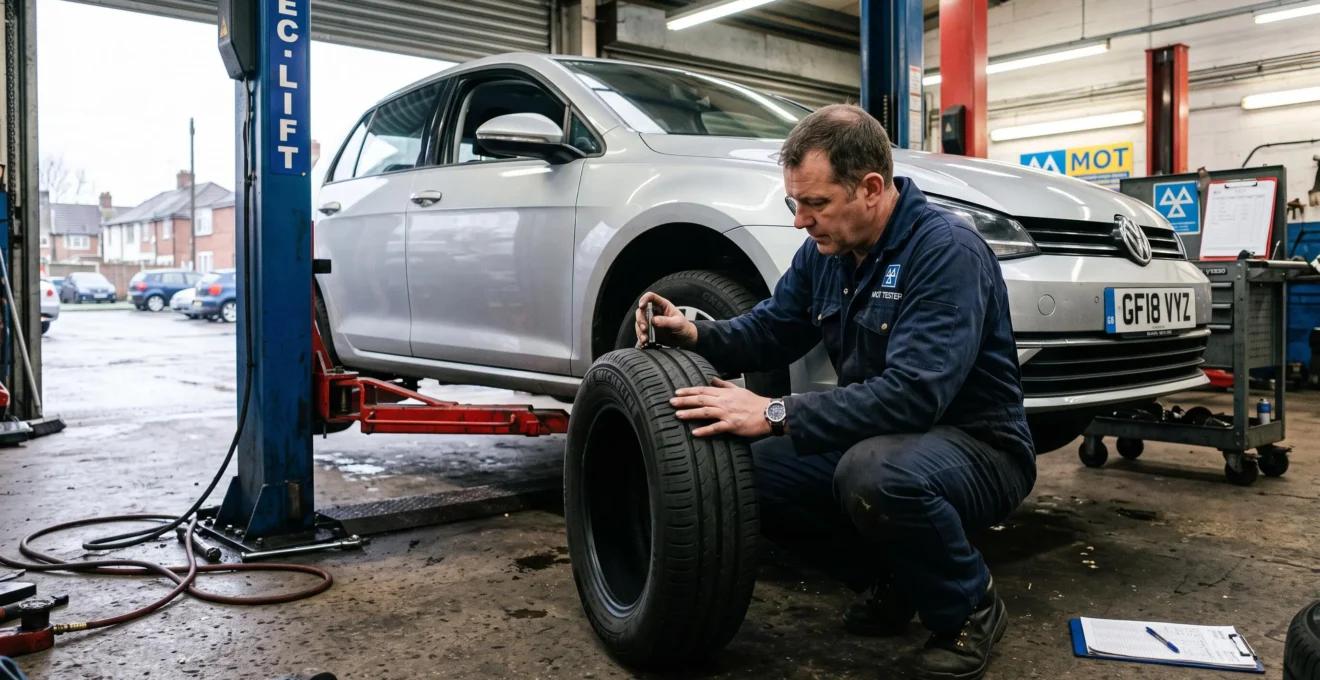
Most cars in Great Britain need their first MOT by the third anniversary of registration and another test every year afterwards. Missing that deadline can mean losing the ability to use your car for ordinary journeys, even when it appears to be running perfectly.
Fortunately, an MOT does not have to become a last-minute emergency. You can normally have the test up to one month minus one day before the current certificate expires without changing your annual renewal date. That gives you time to identify defects, arrange repairs and maintain compliance without unnecessarily bringing your next deadline forward.
The important distinction is between having a valid MOT certificate and keeping a vehicle genuinely roadworthy. Both matter, but neither automatically guarantees the other. Northern Ireland also follows different MOT arrangements, so the standard timing rules discussed here primarily concern England, Scotland and Wales.
Start with your vehicle’s actual expiry date, then use its inspection history and a few practical checks to plan the next test intelligently.
MOT deadlines: the essential rules
- Most cars in Great Britain require an MOT from three years after first registration, followed by annual testing.
- Testing within the one-month-minus-one-day renewal window preserves the existing annual renewal date.
- Check your MOT history, inspect obvious safety items and allow time for repairs before expiry.
- Why Can a Car That Drives Normally Still Fail Its MOT?
- How Can You Check Your Car Before an MOT Without Specialist Equipment?
- Early MOT or Last-Minute Test: Which Timing Reduces the Risk of Disruption?
- What Can Happen if You Forget Your MOT Expiry Date?
- When Should You Book an MOT to Keep the Same Renewal Date?
- How Can You Check a Used Car Is Legal to Drive Before the First Journey?
- Licence, Insurance, Tax or MOT: Which Requirement Applies to Whom?
- What Vehicle Registration Details Must You Keep Up to Date in the UK?
Why Can a Car That Drives Normally Still Fail Its MOT?
A car can drive smoothly and still fail its MOT because the inspection measures compliance with defined road safety and environmental standards, not simply how the vehicle feels on the road. Faults affecting brakes, tyres, emissions, lighting or structural integrity may exist without obvious symptoms during ordinary journeys. A valid MOT is also not a guarantee against future defects.
The Driver and Vehicle Standards Agency (DVSA) applies specific inspection criteria. These can identify problems that drivers rarely notice from behind the wheel, including deteriorating components, defective lights or corrosion affecting safety-critical structures.
For example, a brake system may appear to function normally during gentle driving while still failing an inspection requirement. Similarly, a headlamp can illuminate the road but have an incorrect alignment that causes problems for other drivers.
The distinction becomes clearer when considering how the DVSA MOT inspection manual classifies defects.
| Classification | What it means | Inspection outcome and next step |
|---|---|---|
| Minor | A defect with no significant effect on safety or environmental impact. | The vehicle can pass, but the defect should be addressed. |
| Major | A defect that may affect safety, the environment or other road users. | The vehicle fails and requires attention before a passing retest. |
| Dangerous | A defect presenting a direct and immediate safety risk or serious environmental issue. | The vehicle fails and must not be driven while dangerously defective. |
A major defect does not automatically make every subsequent journey unlawful solely because of that classification. However, a failed MOT, the validity of any previous certificate and the vehicle’s actual roadworthiness must all be considered. Dangerous defects must never be treated as permission to drive until the certificate expires.
An illuminated engine management warning light illustrates why apparently normal performance is not enough. Depending on the vehicle and applicable inspection criteria, a malfunction indicator lamp showing an emissions-related fault can result in a major defect. The precise assessment depends on the inspection manual, rather than the warning light’s appearance alone.
The official classifications are not a statistical ranking of failure causes. Without verified failure-frequency figures, it would be misleading to claim that a particular defect category is the most common.
Because some faults are difficult to notice in daily use, the next sensible precaution is a practical pre-test inspection rather than assuming that a comfortable drive means everything will pass.
How Can You Check Your Car Before an MOT Without Specialist Equipment?
You can reduce the risk of an avoidable MOT failure by checking tyres, lights, visibility, wipers, number plates, seat belts and accessible fluid levels before your appointment. These checks require little equipment and can reveal obvious faults. They cannot assess hidden corrosion, emissions performance or measured braking efficiency, so they complement rather than replace an authorised MOT inspection.
Start with the areas you can see and operate. The government’s vehicle safety-check guidance makes clear that maintaining roadworthiness is an ongoing driver responsibility, not something required only on the day of an MOT.
For ordinary car tyres, the legal minimum tread depth is 1.6 mm across the central three-quarters of the tread and around the entire circumference. An inexpensive depth gauge gives a more useful measurement than simply judging the tyre by eye.
Check each tyre at several positions, looking for uneven wear, visible damage and anything that may require professional assessment.
Then examine the following areas systematically:
- Visibility: clean the windscreen and mirrors, check for damage affecting visibility, and confirm the washers and wipers work properly.
- Lighting: test headlights, indicators, brake lights, rear lights, reversing lights and the number-plate illumination where fitted and applicable.
- Tyres: measure tread depth, look for cuts or bulges and check inflation against the vehicle manufacturer’s guidance.
- Seat belts: check accessible belts for obvious damage and confirm that buckles fasten and release correctly.
- Number plates: ensure they are securely fitted, legible and unobstructed.
- Fluids and controls: check appropriate levels using the vehicle handbook, and confirm that the horn and other accessible controls operate.
Some checks are easier with a second person. Ask someone to observe the rear of the vehicle while you operate the brake pedal and reversing light. Test the horn briefly in an appropriate place and check washer and wiper operation from the driver’s seat.
Your previous MOT results can also guide these checks. A recorded advisory might identify tyre wear, brake deterioration or another issue that deserved monitoring. Rechecking the affected area before the next inspection is more useful than treating last year’s certificate as an assurance that the problem has disappeared.
Your five-step pre-MOT preparation checklist
- Check the vehicle’s MOT history and write down any unresolved failures or advisories. Result: a personalised list of items to revisit.
- Measure tyre tread and inspect visible tyre condition. Result: recorded measurements and any tyres needing professional attention.
- Test lights, horn, washers and wipers, using a second person where needed. Result: a list of working and faulty items.
- Inspect visibility, number plates, seat belts and accessible fluid levels. Result: a completed visual-check record.
- Arrange professional assessment of any suspected safety issue before testing. Result: a confirmed repair appointment or completed repair record.
Do not attempt to diagnose inaccessible components or carry out unfamiliar repairs simply to avoid a garage appointment. Brake performance, emissions and concealed structural conditions require the proper procedures and equipment.
Once the obvious checks are complete, the timing of the official appointment becomes the next important decision, particularly if repairs could interrupt your normal transport arrangements.
Early MOT or Last-Minute Test: Which Timing Reduces the Risk of Disruption?
Booking an MOT before the expiry date generally reduces disruption because it gives you time to arrange repairs if the vehicle fails. In Great Britain, testing within the permitted one-month-minus-one-day window also preserves the existing renewal date. Waiting until the final day offers little practical advantage and can leave you without usable transport if something goes wrong.
The renewal window is designed to make early testing practical. A passing test completed within that window produces a new MOT expiry date based on the previous certificate’s expiry, rather than simply one year after the day you attended the test.
This means that a properly timed early test does not sacrifice the remaining validity of the previous annual inspection cycle.
Testing outside that window, however, normally sets a new renewal date based on the earlier test. That can permanently move the vehicle’s annual MOT schedule forward.
| Consideration | Early test within the renewal window | Test close to expiry |
|---|---|---|
| Renewal date | Preserved after a passing test. | Preserved if completed before expiry. |
| Repair flexibility | More time available before the deadline. | Limited time if defects are identified. |
| Transport disruption | More opportunity to organise alternatives. | Greater risk of an immediate interruption. |
| Unexpected failure | Can be addressed before expiry if circumstances permit. | May leave no useful time to resolve the failure. |
Importantly, an early test failure does not create unconditional permission to keep driving. A dangerous defect makes the vehicle unsafe to drive, while other failures may affect whether it meets the required roadworthiness standards. An unexpired previous certificate does not override those requirements.
For an older vehicle with recurring advisories, booking early is particularly sensible. It provides an opportunity to investigate faults and compare repair options without depending on immediate garage availability.
For a newer, regularly maintained car, the same approach still preserves the renewal date. There is generally little to gain from intentionally booking at the last moment.
Appointment availability can also vary seasonally. Registration-related demand may increase pressure on some test centres around March and September, but local booking capacity should be checked rather than assuming a particular delay.
Even careful booking cannot compensate for forgetting the deadline altogether, which makes understanding the consequences of expiry equally important.
What Can Happen if You Forget Your MOT Expiry Date?
If your MOT expires, you generally cannot drive the vehicle on public roads until it has passed another test, except for specific permitted journeys. Driving without a valid MOT can lead to a fine of up to £1,000. The consequences may become more serious if the vehicle is dangerous, and insurance questions can arise depending on the circumstances and policy terms.
The expiry date is a legal deadline rather than a suggested servicing date. Ordinary journeys, such as travelling to work or visiting shops, are not permitted merely because an inspection appointment is planned for a later day.
Up to £1,000
The stated maximum fine for driving a vehicle without a valid MOT when one is legally required. Separate offences and penalties can apply if the vehicle is in a dangerous condition.
GOV.UK, Getting an MOT
Driving a vehicle in a dangerous condition can involve a fine of up to £2,500, three penalty points and a possible driving ban. These penalties concern dangerous vehicle use; they should not be presented as the automatic punishment for every expired MOT certificate.
Insurance needs equally careful treatment. An expired MOT does not automatically invalidate every motor insurance policy. The insurer’s terms, the applicable law and the circumstances of any incident determine the potential implications.
A missing certificate may nevertheless complicate an insurance claim or lead to disputes about vehicle condition and compliance. Drivers should check their own policy rather than assume either automatic cancellation or unconditional protection.
Police and enforcement systems can use vehicle registration information to identify potential compliance issues. Automatic Number Plate Recognition can help flag vehicles for further checks, but it is misleading to assume that every camera instantly verifies every MOT, tax and insurance record in precisely the same way.
There are limited journey exceptions after MOT expiry, including travel to a pre-arranged MOT test and specified journeys connected with repairs. These do not permit unrestricted driving, and the vehicle must not be dangerously defective.
Where a car cannot lawfully be driven, transporting it to a suitable garage may be necessary.
The most reliable way to avoid this situation is to identify the exact expiry date and create a booking routine that leaves a reasonable margin for unexpected repairs.
When Should You Book an MOT to Keep the Same Renewal Date?
To retain your current MOT renewal date in Great Britain, book the test no earlier than one month minus one day before your existing certificate expires. If the car passes during that window, the next certificate retains the original annual renewal schedule. Booking several weeks ahead of the appointment is sensible because a failed test may require additional repair time.
Start by confirming the date in the official GOV.UK MOT history service. Enter your registration number to view the recorded inspection history and the next test deadline.
Then calculate the earliest date that preserves your renewal anniversary by going back one calendar month and adding one day. Calendar months differ in length, so treat this as a calendar-date calculation rather than assuming a fixed number of days.
For example, in a hypothetical case where an existing MOT expires on 20 November, the preservation window begins on 21 October. A passing test during that window preserves the annual 20 November expiry anniversary. A substantially earlier test would normally establish a new annual date instead.
The principle is to separate the date on which you arrange the appointment from the date on which the inspection takes place. You can contact a test centre well before the renewal window opens and reserve a suitable appointment within it.
For a practical reminder routine, set a calendar alert approximately six weeks before expiry. At that point, review previous advisories, check the car and arrange the test for a date within the preservation window.
GOV.UK also provides an official MOT reminder service that can send notifications by text message or email. Enrolling in reminders provides an additional safeguard, although the responsibility for renewing the MOT remains with the relevant vehicle keeper and driver.
New vehicles require special attention. Most cars first registered in Great Britain need their first MOT by the third anniversary of registration, after which annual testing ordinarily applies. Certain vehicle categories follow different requirements.
For a first MOT, the permitted early-testing calculation is based on the third anniversary of registration rather than an existing annual certificate. The same one-month-minus-one-day preservation principle generally applies. It should not be confused with a one-year advance-testing window.
There are also territorial exceptions. Northern Ireland has different first-test and administration arrangements, and a vehicle subsequently tested in Great Britain may be subject to different renewal-date calculations.
Once this routine is established, the same official records become valuable when buying a used vehicle, particularly before making its first journey under a new keeper.
How Can You Check a Used Car Is Legal to Drive Before the First Journey?
Before driving a used car you have bought, confirm that it has a valid MOT where required, is correctly taxed, is covered by insurance that permits you to drive it, and has been transferred into the appropriate registered-keeper records. You must also hold the correct driving licence. The seller’s previous arrangements do not automatically continue after the purchase.
Start with the MOT record using the vehicle registration number. Compare the current expiry date with the intended journey and check previous test outcomes.
Historical MOT data can reveal patterns worth investigating, including repeated defects, unresolved advisories and recorded mileage that does not follow the expected progression.
A mileage discrepancy is a reason to ask for supporting records, not conclusive evidence of odometer fraud. Recording errors and other explanations may exist. Likewise, an MOT history is not a complete servicing or mechanical history.
Next, verify the vehicle’s tax status and arrange the appropriate tax before using it on the road. Vehicle tax does not transfer automatically with a used-car sale, so the seller’s existing tax should not be relied upon.
Insurance must also cover the actual driver and the intended use. Permission from a seller or a belief that another policy includes driving-other-cars cover is not sufficient without checking the applicable conditions.
The registered-keeper change must be reported to the Driver and Vehicle Licensing Agency (DVLA). The seller normally notifies DVLA of the change, either through the available online process or the relevant V5C documentation, while the buyer receives the appropriate new-keeper details and subsequently a replacement V5C.
The V5C records the registered keeper; it is not, by itself, proof of legal ownership.
A used car advertised without a valid MOT needs particular caution. A buyer should not assume that an ordinary test drive becomes legal simply because the vehicle is being sold. Any applicable journey exception has defined conditions, and the car must remain roadworthy.
If the vehicle cannot lawfully be driven on the intended journey, arrange suitable transport instead.
These checks also demonstrate why vehicle compliance involves several separate legal responsibilities rather than a single document proving that everything is in order.
Licence, Insurance, Tax or MOT: Which Requirement Applies to Whom?
Driving licence, insurance, vehicle tax and MOT requirements concern different aspects of legal vehicle use. The driver must be appropriately licensed, insured and satisfied that the vehicle is roadworthy. The registered keeper normally manages tax and registration obligations, while MOT compliance also matters to anyone using the car. These duties can overlap when the keeper and driver are different people.
For example, a parent may be the registered keeper of a family car while an adult child regularly drives it. The registration and vehicle-tax arrangements may be managed by the parent, but the driver must still confirm that the intended journey is insured and lawful.
A similar distinction applies to company cars. Employers or fleet operators often manage inspection schedules and vehicle administration, but drivers should not assume that an employer’s maintenance process removes their responsibility to avoid using an unsafe vehicle.
| Requirement | Primary practical responsibility | What must be verified? |
|---|---|---|
| Driving licence | Driver | Valid entitlement for the relevant vehicle category and driving circumstances. |
| Motor insurance | Driver and the party arranging vehicle cover | The driver and intended use are covered by an appropriate policy. |
| Vehicle tax | Registered keeper | The vehicle is correctly taxed or has an appropriate declared status. |
| MOT | Registered keeper and anyone responsible for using the vehicle | A valid certificate exists where required, subject to specific exemptions and permitted journeys. |
| Roadworthiness | Driver, with responsibilities also arising for others responsible for vehicle use | The vehicle is safe and legally fit for the intended journey. |
These are separate requirements. A valid MOT does not establish that the vehicle is taxed, and an insurance certificate does not prove that its brakes or tyres are safe. Equally, registration in one person’s name does not authorise every other person to drive it.
Vehicle records held by DVLA and insurance databases can support compliance and enforcement checks, including those associated with number-plate recognition. However, each record has its own purpose, and a positive result in one system does not establish compliance with every other obligation.
There is also a difference between obligations attached to a journey and those attached to a vehicle’s ongoing status. Appropriate driving entitlement is needed whenever a person drives. Insurance obligations can continue while a vehicle is kept on the road, not simply when a journey begins.
Tax and Statutory Off Road Notification (SORN) depend on how the vehicle is kept and used. A SORN vehicle is not treated like an ordinarily taxed vehicle available for unrestricted road use.
The remaining administrative safeguard is ensuring that DVLA’s registration records accurately reflect the current keeper and vehicle circumstances.
Key points before updating your vehicle records
- Check that the V5C identifies the correct registered keeper and contains the keeper’s current address.
- Do not confuse ownership, registered-keeper status and permission to drive: they are different matters.
- If a vehicle is taken off the road, understand the SORN conditions before cancelling or changing tax and insurance arrangements.
What Vehicle Registration Details Must You Keep Up to Date in the UK?
You must keep the relevant DVLA vehicle registration details accurate, particularly the registered keeper’s name and address and changes of keeper. If a vehicle is sold, transferred or declared off road, the appropriate notification must be completed. Incorrect records can interfere with official correspondence, complicate a later sale and expose the keeper to avoidable administrative or enforcement problems.
The V5C registration certificate is central to these responsibilities. It identifies the registered keeper and records information associated with the vehicle’s registration, but it does not establish legal ownership by itself.
For example, a vehicle bought using finance may legally belong to a finance company under the applicable agreement while another person is recorded as its keeper. The registered keeper is generally responsible for ensuring that registration and vehicle-tax arrangements are maintained correctly.
Moving home is therefore more than an address change for convenience. The keeper should update the V5C address through the applicable DVLA process so that official correspondence reaches the right destination.
It is important not to confuse this with the MOT reminder service. Official electronic MOT reminders require the relevant contact details to remain current; a correct V5C address alone should not be assumed to guarantee an automatic MOT reminder.
When a car changes hands, the registered-keeper change should be notified promptly. The seller and buyer should follow their respective parts of the process rather than assuming that possession of the keys automatically updates DVLA’s records.
SORN is another administrative status that requires attention. A Statutory Off Road Notification generally applies when a vehicle is kept off public roads and is not being taxed for ordinary road use. It can remove the continuous insurance requirement while the vehicle remains appropriately declared off road, although other contractual considerations may still matter.
It is not permission to drive an untaxed vehicle wherever the keeper chooses. Use on public roads is restricted, with specific exceptions such as qualifying journeys to pre-arranged tests. Nor does SORN eliminate the responsibility to ensure a vehicle is safe when it is eventually returned to road use.
For a vehicle being put back into service, review its tax, insurance, MOT and roadworthiness position before any ordinary journey.
Outdated registration details can also complicate enforcement notices and correspondence, potentially leading to further problems when responses are required. Maintaining the record is easier than resolving administrative discrepancies after a notice has been missed.
As a practical next step, check your MOT expiry date, review the address on your V5C and confirm that your reminder contact details are correct. Add a calendar alert six weeks ahead of expiry and arrange the inspection within the permitted renewal window. That simple routine reduces the risk of an avoidable gap in legal vehicle use.
Can you get an MOT before your current certificate expires?
Yes. In Great Britain, you can generally take the test up to one month minus one day before the current certificate expires and preserve the original annual renewal date if the vehicle passes. Testing earlier normally changes the next expiry date. Special rules can apply in certain circumstances, including vehicles moving between Northern Ireland and Great Britain testing systems.
Does a valid MOT certificate guarantee that your car is safe?
No. An MOT records whether the vehicle met the applicable inspection standards at the time of testing. Components can deteriorate afterwards, and some aspects of mechanical condition fall outside the inspection’s scope. Drivers remain responsible for roadworthiness throughout the year.
Can you drive to a garage if your MOT has already expired?
Specified journeys, including travel to a pre-arranged MOT test and certain journeys connected with repairs, can be permitted. The exception does not cover ordinary unrestricted driving. The vehicle must not be in a dangerous condition, and other applicable legal requirements still matter.
Does an MOT failure always mean the vehicle must be recovered?
No. The answer depends on the defects, whether a previous MOT remains valid, the vehicle’s roadworthiness and the intended journey. A dangerous defect means the vehicle must not be driven while that condition remains. Other failures require assessment of the applicable legal restrictions rather than an automatic assumption that all driving is permitted or prohibited.
Is an MOT certificate enough to prove a used car is legal to drive?
No. A used car may have a current MOT but lack valid tax or insurance for the intended journey. The driver must hold the correct licence and the vehicle must remain roadworthy. Registration and keeper-transfer arrangements should also be completed correctly before relying on the vehicle for regular use.