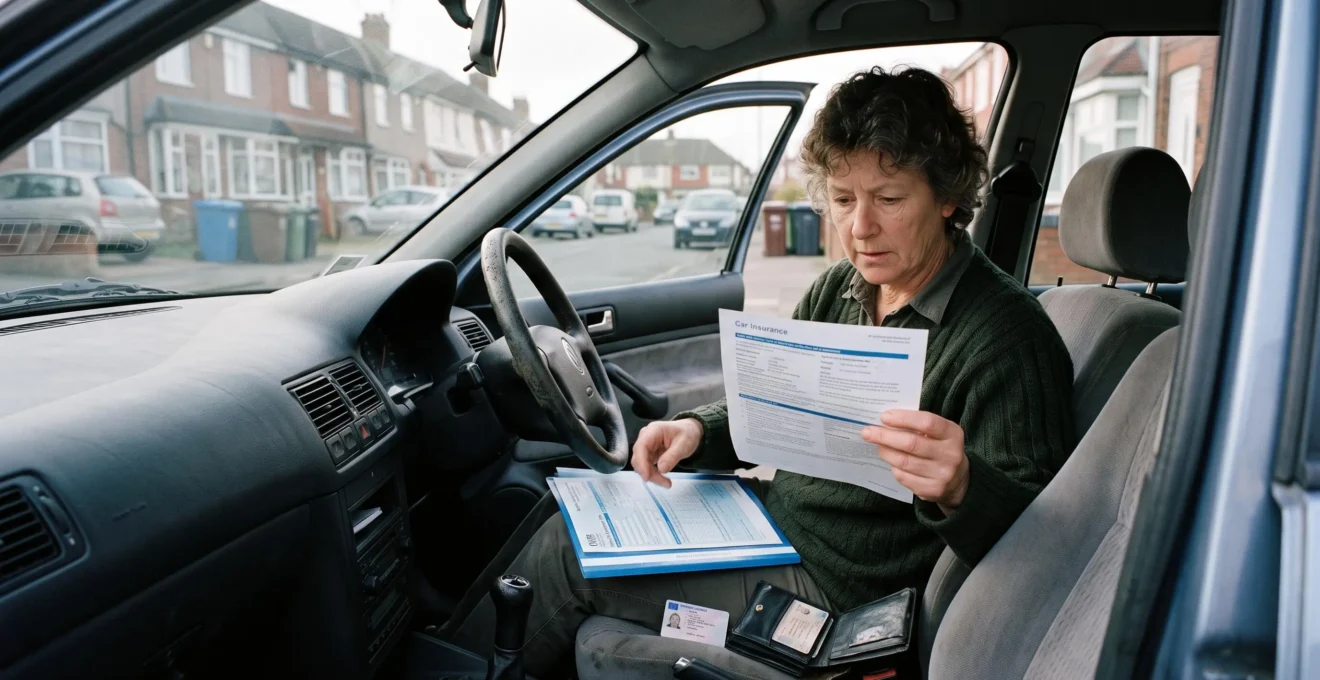
Before driving in the UK, you need more than a vehicle that starts, steers and brakes correctly. Your driving entitlement, motor insurance, vehicle tax and MOT status, where applicable, must satisfy the relevant legal requirements. The details held by Driver and Vehicle Licensing Agency (DVLA) should also accurately reflect your circumstances.
These requirements are connected, but they are not interchangeable. A valid MOT does not prove that you are insured. A V5C registration certificate does not establish legal ownership. An insurance certificate may show that a policy exists without establishing that every person using the vehicle is covered.
Administrative mistakes are especially easy to overlook after moving house, purchasing a used car, changing your name or adding another driver. Some prevent lawful road use immediately; others become problematic when correspondence, a claim or a sale requires accurate information.
The practical approach is to verify each record separately, understand what it demonstrates and update it whenever the relevant circumstances change. The guidance below focuses on UK motorists, with particular attention to DVLA procedures and differences that may apply in Northern Ireland.
Vehicle documents: the essentials before driving
- Check that you have the correct driving entitlement and appropriate insurance for the vehicle and its actual driver, alongside valid tax and MOT status where required.
- Keep the V5C, driving licence and insurance details accurate. Updating one record does not automatically correct the others.
- Use official vehicle-status services to check tax, MOT and SORN information, then verify insurance and personal details separately.
- Why Can an Incorrect Address on Vehicle Documents Cause Problems?
- How Can You Check Your Vehicle Documents in 10 Minutes Before a Long Trip?
- Insurance Certificate, V5C or MOT Record: Which Document Proves What?
- Which Documentation Mistakes Can Stop a Vehicle From Being Used Normally?
- When Must Vehicle Documents Be Updated After a Change in Circumstances?
- V5C or Proof of Ownership: What Does Each Document Actually Show?
- When Must Drivers Update Vehicle or Licence Details After a Change?
- What Vehicle Registration Details Must You Keep Up to Date in the UK?
Why Can an Incorrect Address on Vehicle Documents Cause Problems?
An incorrect address can cause vehicle-related correspondence to reach the wrong place, leave official registration records inaccurate and create questions about the information supplied to an insurer. The V5C, driving licence and insurance policy serve different purposes, so changing your address on one document does not automatically update the others.
The address on your V5C identifies where the DVLA records the registered keeper. Your driving licence contains your personal address information. Your insurance policy may use your postcode and the location where the vehicle is normally kept when assessing the insured risk.
These addresses will not necessarily be identical in every legitimate arrangement. For example, a vehicle may have a registered keeper whose address differs from the driver’s home. What matters is that each organisation holds the information it requires and that the information supplied is accurate.
An outdated address can create a sequence of avoidable difficulties. A reminder or important notice may not reach you, potentially leaving an administrative problem unresolved. Insurer communications may also be missed if the insurer has not been told about your move. However, a missed renewal notice does not itself prove that cover has ended, and an address discrepancy does not automatically invalidate a policy.
Address changes can also affect the risk information used by insurers. If the vehicle is normally kept somewhere different from the location declared, the insurer may need to reassess the policy. The consequences of incorrect information depend on the circumstances, policy terms and applicable insurance law.
For DVLA records, the duties are separate. GOV.UK’s step-by-step DVLA address-change guidance explains that motorists must update their driving licence, V5C and applicable vehicle tax Direct Debit details after moving home. Certain personalised registration and trailer records may also require attention.
Changing your driving licence address through the relevant DVLA online service is free. Failing to notify the DVLA of a change that must be reported is a separate legal matter from any insurance dispute. GOV.UK also distinguishes a genuine change of home address from a temporary move where the authority can still contact you at your permanent address.
The safest response to a move is to review each organisation’s records individually rather than assume that one successful address change has completed the process. That same principle applies when preparing for a journey.
How Can You Check Your Vehicle Documents in 10 Minutes Before a Long Trip?
A ten-minute document check starts with the vehicle registration number: verify tax, MOT and SORN status online, then compare your insurance documents, driving licence and V5C against your current circumstances. This is a quick screening routine rather than a guarantee that every discrepancy can be resolved within ten minutes.
The quickest checks are usually the publicly available vehicle-status records. DVLA’s online vehicle-information service allows motorists to enter a registration number and examine information including vehicle tax status, MOT expiry, SORN status and the date the latest V5C was issued.
These records provide a useful starting point because they do not require you to locate every physical document first. However, they do not display the full details of the registered keeper or show whether a particular driver is covered by an insurance policy.
After checking the vehicle status, examine the current insurance certificate and policy schedule. Confirm that the registration number is correct, the policy has not expired and the intended driver is covered for the journey and its purpose. Named-driver conditions, permitted use and restrictions must be checked against the actual wording.
Your driving licence also deserves attention. Check the entitlement for the vehicle category, relevant restrictions and validity of the photocard. If you are travelling in someone else’s vehicle, do not assume that having your own motor insurance automatically gives you permission to drive it.
Your five-step pre-trip document check
- Check vehicle tax and SORN status. Enter the registration number in the official DVLA service and record the displayed status.
- Confirm MOT validity. Note the expiry date or establish that an applicable exemption genuinely covers the vehicle.
- Verify insurance. Compare the certificate and schedule with the registration number, intended driver and journey purpose; retain confirmation of the relevant cover.
- Inspect your driving licence. Check the correct vehicle category, current entitlement, photocard validity and personal details; note any discrepancy requiring action.
- Review the V5C. Confirm the registered keeper details and address against the current circumstances; create a short list of corrections if anything differs.
A trip abroad requires additional checks. Depending on the destination, you may need particular insurance documentation, proof of vehicle use or ownership arrangements, and possibly an International Driving Permit. Green Card requirements depend on the countries involved and applicable arrangements, rather than a single rule for all journeys outside the UK.
Finally, a positive tax or MOT result is not evidence that the actual driver is insured. Each check answers a different question, which makes the distinction between vehicle documents particularly important.
Completing these checks before departure creates time to resolve a discrepancy without discovering it at the roadside or after crossing a border.
Insurance Certificate, V5C or MOT Record: Which Document Proves What?
Each vehicle document establishes a different fact. The V5C identifies the registered keeper, insurance documents describe the cover provided, an MOT record confirms a test result at a particular date, and vehicle tax records show the vehicle’s tax status. None of these documents independently proves everything required for lawful driving.
The distinction matters because authorities, insurers and buyers may need different evidence. A registration certificate helps establish who is recorded as responsible for the vehicle’s registration, but it is not a title deed. An insurance certificate may demonstrate the existence of a policy while leaving important driver restrictions to the accompanying policy terms.
The following comparison explains what each record can establish and where its evidential value ends.
| Document or record | What it establishes | What it does not establish |
|---|---|---|
| V5C registration certificate | Who is recorded as the registered keeper and key vehicle registration details. | Legal ownership or the keeper’s permission to sell a vehicle subject to finance. |
| Insurance certificate and policy schedule | The declared insurance arrangement, relevant dates, insured vehicle and stated driver or use conditions. | Unconditional cover for every driver, journey or circumstance. |
| MOT record | Vehicle testing history and whether a required MOT is recorded as current. | That the vehicle remains roadworthy after the inspection. |
| Vehicle tax record | The vehicle’s recorded tax status. | Insurance, ownership or driving entitlement. |
| Driving licence | The driver’s recorded entitlement, subject to current status and restrictions. | Insurance authorisation to use a particular vehicle. |
| SORN record | That a Statutory Off Road Notification has been made. | Permission for ordinary road use. |
Following an accident, insurance coverage and the identity of the driver may be central questions. When buying or selling a vehicle, the V5C helps with registered keeper changes, but purchase documents and finance information can be just as important. A vehicle taken off the road may require a SORN rather than an active vehicle tax arrangement.
Digital records also affect how compliance is checked. Insurance databases and vehicle registration systems help authorities identify potentially uninsured vehicles. A paper certificate alone cannot establish that current cover exists under all relevant circumstances, and an incomplete database entry should be investigated with the insurer rather than treated as the final word on contractual cover.
Understanding what each document proves also helps identify which errors need immediate action and which mainly threaten future administrative transactions.
Which Documentation Mistakes Can Stop a Vehicle From Being Used Normally?
The most serious documentation problems are those that prevent lawful driving: missing appropriate motor insurance, unpaid vehicle tax where required, an expired mandatory MOT or an invalid driving entitlement. Incorrect keeper details may not immediately stop a journey, but they still require correction and can interfere with important administrative processes.
Driving without appropriate insurance is an immediate legal risk. The vehicle itself being insured is insufficient if the particular person driving does not have the necessary cover. This distinction matters for occasional drivers, borrowed vehicles and policies that restrict use to specified people.
£300 + 6 penalty points
The fixed penalty that police may issue for driving without appropriate motor insurance in the UK. A court can impose an unlimited fine or disqualification, and police may seize the vehicle.
The consequences may extend beyond the immediate penalty. An insurance conviction can complicate future applications for cover and may affect premiums, although the financial impact depends on the insurer and individual circumstances.
Missing vehicle tax creates a separate compliance problem. A vehicle normally needs to be taxed for road use unless a relevant exemption applies. A vehicle covered by a SORN cannot simply be treated as taxed because its previous tax was paid or because an MOT remains current.
An expired MOT is another potentially blocking issue when testing is legally required. Limited exceptions allow specified journeys, such as travelling to a pre-arranged MOT test or relevant repairs. They are not general permission to continue using a vehicle normally after its MOT expires.
Importantly, an expired MOT does not automatically mean that every insurance policy becomes void. The more fundamental safety issue is whether the vehicle is roadworthy, alongside the requirements of the relevant policy and law. A vehicle can be unroadworthy even with a current MOT certificate.
The Highway Code’s vehicle-documentation annex distinguishes testing requirements from continuing roadworthiness and warns that driving an unroadworthy vehicle may invalidate insurance.
An outdated V5C address or a misspelled keeper name usually creates a different category of problem. The vehicle may otherwise be legally usable, but correcting the record becomes important when dealing with correspondence, a sale or a replacement document.
If the concern is an absent document rather than absent legal cover, it may be possible to provide evidence or clarify a record. However, supplying paperwork later does not retrospectively insure a journey that was genuinely uninsured.
When insurance, tax, MOT or entitlement cannot be confirmed, resolve the uncertainty before ordinary road use. Correcting the underlying status matters more than simply obtaining another copy of the paperwork.
When Must Vehicle Documents Be Updated After a Change in Circumstances?
Vehicle records should be reviewed whenever circumstances change the registered keeper, vehicle description, declared insurance risk or driver’s personal details. Moving home, buying or selling a car, changing your name and making vehicle modifications can affect different records. There is no single universal update deadline covering every document and insurer.
Some events require several separate actions. A house move affects the driving licence and V5C, while also potentially changing insurance information and vehicle tax Direct Debit contact details. Buying a vehicle requires the registered keeper change to be handled correctly and the new keeper to arrange any required tax and insurance before using it.
| Change in circumstances | Records to review | Practical priority |
|---|---|---|
| Moving home | Driving licence, V5C, insurance, applicable tax Direct Debit and other affected DVLA records. | Correct the relevant addresses individually and notify the insurer. |
| Buying or receiving a vehicle | Registered keeper record, tax status, insurance and MOT requirements. | Arrange lawful use from the point responsibility changes. |
| Selling or transferring a vehicle | DVLA registered keeper notification and existing insurance arrangements. | Record the transfer and inform relevant parties. |
| Changing your name | Driving licence, V5C and insurance details. | Update personal records and retain appropriate evidence. |
| Modifying the vehicle | Insurance declarations and V5C particulars where relevant. | Check whether the modification changes declared risk or recorded specifications. |
| Taking the vehicle off the road | Vehicle tax, SORN and insurance arrangements. | Establish the correct off-road status and conditions. |
Insurers assess policies using information about the vehicle, its drivers and its use. A newly added regular driver, change of where the vehicle is kept or modification may be relevant to the policy. Reporting requirements and the consequences of inaccurate information depend on the policy terms, the nature of the information and applicable consumer insurance law.
For timing, check the actual obligation rather than applying a guessed number of days. DVLA processes may require a change to be reported, while insurers may specify notification requirements for particular circumstances. It is sensible to report relevant changes promptly, ideally before using the vehicle under materially different conditions.
A SORN deserves special attention. It is appropriate when a vehicle is being kept off public roads and the relevant statutory conditions are met. Declaring SORN affects the vehicle tax obligation and ordinary road use; it does not automatically settle every insurance, finance or storage consideration. Before returning the vehicle to normal use, the required tax, insurance and MOT position must be addressed.
A particularly important distinction emerges during purchase and sale: updating the registered keeper does not, by itself, prove or transfer legal ownership.
V5C or Proof of Ownership: What Does Each Document Actually Show?
A V5C identifies the person recorded as the vehicle’s registered keeper, not necessarily its legal owner. Ownership is generally established through the purchase and contractual evidence relevant to the transaction. The distinction is particularly important for vehicles bought using finance, company vehicles and situations where the keeper and owner are different people.
The registered keeper is the person or organisation recorded for vehicle registration purposes. The keeper may be responsible for handling various vehicle-related administrative matters, but that status does not automatically establish the right to sell the vehicle free of another party’s interests.
Ownership can be demonstrated through documents such as a purchase invoice, sale agreement, receipt or relevant finance documentation. The weight of any particular evidence depends on the transaction and the legal question being considered.
For example, under some hire purchase arrangements, the person using the car may be its registered keeper while the finance company retains legal ownership until contractual conditions are satisfied. In other finance arrangements, ownership works differently. The contract therefore matters more than a general assumption about who possesses the V5C.
Consider a hypothetical used-car purchase. A seller presents a V5C bearing the correct registration number and their name. That supports a check of the vehicle’s recorded keeper details, but it does not establish that the vehicle has no outstanding finance or that the seller has an unrestricted right to sell it.
An appropriate vehicle history or finance check can help identify potential concerns that the V5C itself does not disclose. Buyers should also compare the vehicle identity, available transaction documents and information supplied by the seller. Holding a V5C is not conclusive proof that a vehicle is not stolen.
The V5C is still administratively significant. It supplies information used when dealing with vehicle registration and keeper changes, and its reference number may be relevant to DVLA processes. Losing it can delay transactions or make some procedures more cumbersome.
If the V5C has been lost, damaged or contains outdated details, use the applicable DVLA replacement or correction process. A simple keeper-address correction is different from a change of registered keeper, and neither should be confused with resolving an ownership dispute.
When a financed vehicle is written off or proposed for sale, the finance agreement and the interests of the finance company may determine what must happen to any payment or outstanding balance. A V5C does not override those contractual rights.
Before completing a transaction, establish both who is recorded as keeper and who has the legal right to dispose of the vehicle. Personal driving records require a similarly careful but separate review.
When Must Drivers Update Vehicle or Licence Details After a Change?
Drivers must update relevant licence details when their name or address changes and renew their driving entitlement or photocard when required. They must also ensure that insurers have accurate information about the people using the vehicle. A change to the driver’s personal circumstances is not necessarily reflected in the vehicle’s registration record.
A driving licence is primarily evidence of the driver’s entitlement to operate specified vehicle categories. It does not establish that an insurance policy permits that driver to use any particular car. Both conditions need to be satisfied independently.
In Great Britain, changing the address on a driving licence through the applicable DVLA online process is free. A temporary move may be treated differently where the DVLA can still contact the driver at their permanent address. Northern Ireland has separate licensing administration, so motorists should follow the rules relevant to the authority that issued their licence.
Photocard validity also deserves a distinct check. The expiry shown on the front of the photocard is not the same thing as every underlying driving-entitlement date. A driver can overlook a card renewal while concentrating solely on vehicle tax and MOT reminders.
The practical distinction is between the validity of the document, the driver’s current legal entitlement and any conditions attached to that entitlement. Drivers should check relevant vehicle-category dates and restrictions rather than assume that possession of a photocard establishes unrestricted permission to drive.
Changes involving additional drivers create another risk. If a younger or less experienced person becomes the vehicle’s main user, the insurer should receive an accurate description of the arrangement. Listing someone else as the main driver to obtain a lower premium can amount to insurance misrepresentation, commonly described as fronting.
Likewise, changes affecting driving entitlement must be treated separately from ordinary corrections to personal information. A driver who is disqualified or whose licence has been revoked cannot rely on an old photocard to establish permission to drive. Insurance consequences depend on the circumstances and policy terms, but the underlying legal entitlement is essential.
A useful personal-record review therefore examines the driving licence, any conditions or restrictions on entitlement, and the identity and role of each driver listed on the insurance policy. These are questions about the person driving, not simply the vehicle’s registration.
Once personal records are accurate, the final step is to maintain a consistent view of the vehicle’s registration, tax, MOT, SORN and insurance information.
Key takeaways before reviewing your registration details
- A valid driving licence and suitable insurance for the actual driver are separate requirements from the vehicle’s MOT and tax status.
- The V5C records the registered keeper; purchase and finance documents may be needed to establish ownership rights.
- Address changes, vehicle transfers, modifications and changes of driver should trigger a review of every affected record, not just one document.
What Vehicle Registration Details Must You Keep Up to Date in the UK?
UK motorists should maintain accurate registered keeper details and check the vehicle’s tax, MOT, SORN and insurance position whenever circumstances change. These records are linked to the registration number for administrative and enforcement purposes, but they are maintained through different systems. A correct entry in one does not guarantee that the others are accurate.
The V5C provides the central keeper record. Its name, address and relevant vehicle particulars should reflect the registered position. If the vehicle changes keeper or undergoes a modification affecting recorded details, the appropriate DVLA process must be followed.
Tax, MOT and SORN information serve different purposes. Vehicle tax concerns the vehicle’s taxation status. MOT records show testing information and expiry dates. SORN indicates that the vehicle has been declared off the road under the relevant procedure. These statuses cannot be treated as substitutes for one another.
Insurance information is also connected to the registration number. Continuous insurance enforcement uses vehicle registration and insurance data to identify vehicles that may not satisfy the applicable insurance or SORN requirements. A registered vehicle that appears uninsured and has no valid SORN may prompt enforcement action, subject to the relevant rules and exemptions.
It would be misleading, however, to treat a single database as a complete public record of the vehicle and its driver. A DVLA enquiry does not disclose the keeper’s full personal details through the ordinary public lookup. Insurance records do not necessarily explain which individual drivers are permitted under a policy, and administrative data can require correction or investigation.
The most practical long-term solution is a recurring review rather than relying on reminders arriving at the correct address. Align the review with an MOT appointment, insurance renewal or another routine vehicle-maintenance date.
- Confirm that the V5C reflects the current registered keeper and relevant details.
- Check tax status and establish whether SORN applies.
- Verify the MOT expiry or applicable exemption, without treating an MOT pass as a permanent roadworthiness guarantee.
- Examine insurance dates, permitted drivers and declared vehicle use.
- Check the driving licence and record any upcoming renewal or correction requirements.
Keep copies of relevant correspondence and confirmations where useful, particularly after registering a change or resolving a discrepancy. Digital copies of insurance and purchase documents can improve access to evidence, although they do not replace a legal requirement to hold valid entitlement or cover.
For a vehicle returning to the road after a period off-road, review tax, insurance and MOT requirements before restarting ordinary use. A previous registration, insurance certificate or MOT result should never be assumed to establish the current position without checking.
Set a recurring calendar reminder for your next vehicle-document review, record the relevant expiry dates and contact the DVLA or insurer whenever a change affects their records. Keeping each status accurate is more reliable than discovering a problem during a police check, insurance claim or vehicle sale.
Do you have to carry your V5C and insurance certificate whenever you drive in the UK?
Drivers are not generally required to keep their V5C and insurance certificate physically inside the car for ordinary domestic journeys. However, police can require relevant driving documents to be produced, and a driver who cannot produce them immediately may need to follow the applicable procedure for producing them later. Having accessible insurance details is useful, but the underlying legal cover and driving entitlement matter most.
Can you drive while waiting for an updated V5C or driving licence?
GOV.UK explains that motorists can continue driving while waiting for replacement documents following a change of address. This assumes that the driver remains legally entitled to drive and that the vehicle satisfies the other applicable requirements. A pending document does not override a disqualification or create insurance cover that does not exist.
Does a valid MOT mean a vehicle is legally safe to drive?
No. An MOT records the outcome of a test at a particular point in time. A vehicle can develop a dangerous defect afterwards. Drivers remain responsible for ensuring that their vehicles are roadworthy, even when the MOT is current or the vehicle is exempt from testing.
What should you do if an online vehicle record shows incorrect information?
First identify which record appears incorrect. A tax, MOT or V5C discrepancy may require a DVLA-related enquiry, while an insurance discrepancy should be raised with the insurer so the actual cover and relevant insurance data can be checked. Keep evidence of any correction request, and do not assume that submitting a correction makes an otherwise unlawful journey permissible.
Do UK vehicle-document requirements automatically apply when driving abroad?
No. The vehicle must satisfy the applicable domestic requirements, but destination and transit-country rules may impose additional obligations. Depending on the journey, these can concern driving permits, insurance documentation, vehicle registration evidence and permission to take a financed, hired or borrowed vehicle abroad. Check the requirements for each relevant country and your insurer before departure.