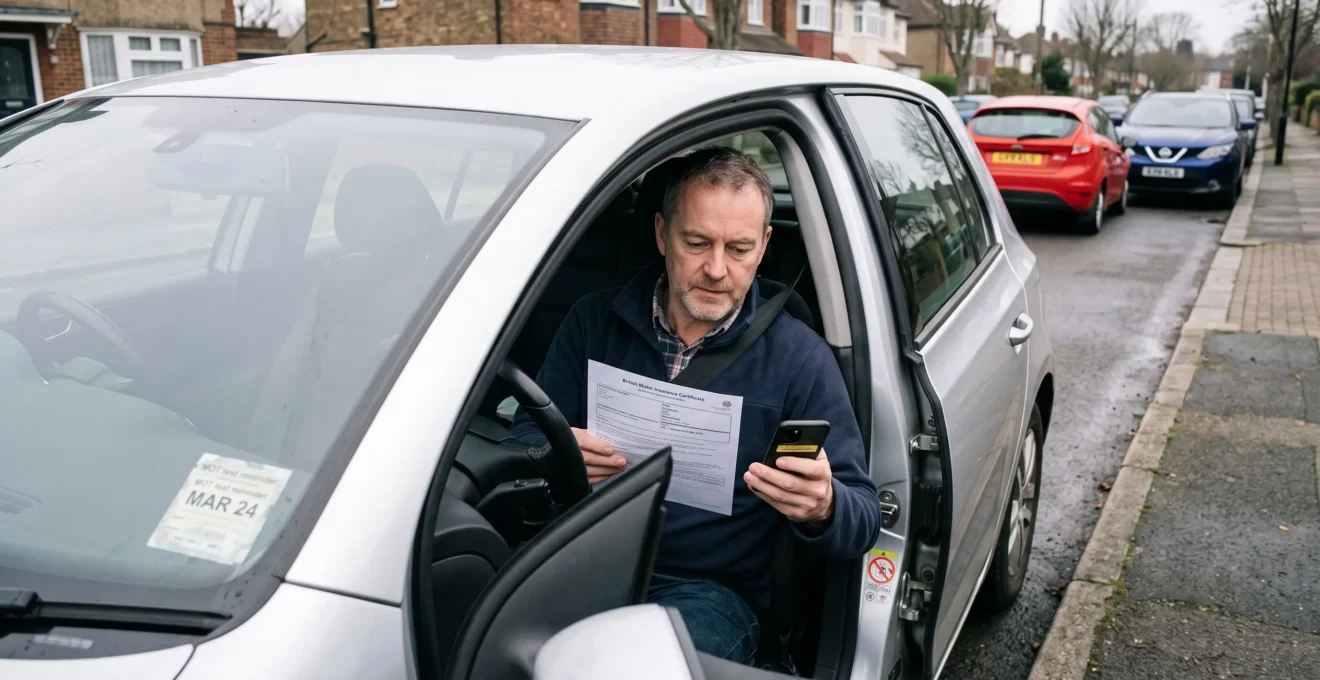
To drive legally on UK roads, you need more than a valid driving licence. You must be entitled to drive the particular vehicle, meet the relevant age and eyesight requirements, have motor insurance covering your actual use, and ensure the vehicle is properly registered, taxed, roadworthy and MOT-compliant where applicable.
These requirements apply together. A fully qualified driver can still break the law by borrowing an uninsured car, using a vehicle declared off the road or driving for business without appropriate insurance. Equally, a taxed and insured car cannot make someone legally entitled to drive it.
The distinction matters particularly when borrowing a vehicle, returning to driving after a break, changing jobs or buying a used car. Insurance permissions, DVLA records and vehicle testing obligations can change independently.
The following guide explains how the requirements interact, who is responsible for checking them and when a previous confirmation is no longer sufficient. It focuses on ordinary private motoring, with exceptions identified where they affect the answer.
UK driving requirements at a glance
- Driver eligibility: hold the correct licence, meet applicable age and eyesight standards, and comply with relevant medical and learner-driver conditions.
- Vehicle compliance: confirm suitable insurance, current vehicle tax, a valid MOT where required and roadworthiness.
- Ongoing responsibility: repeat checks when your vehicle, insurance, circumstances or intended journey changes.
- Why Is a Valid Driving Licence Not Enough to Make a Car Legal to Drive?
- How Can You Check You Are Legally Allowed to Drive Someone Else’s Car?
- Licence, Insurance, Tax or MOT: Which Requirement Applies to Whom?
- Which Insurance Assumptions Can Make an Otherwise Normal Journey Illegal?
- When Should Drivers Recheck Their Legal Right to Use a Vehicle?
- Why Can a Driver Become Non-Compliant After Starting a Legal Journey?
- When Must You Notify the DVLA About Changes to a Vehicle or Keeper?
- Which Legal Duties Must Drivers Keep Up to Date Before Using a Car?
Why Is a Valid Driving Licence Not Enough to Make a Car Legal to Drive?
A valid driving licence establishes your entitlement to drive specified categories of vehicle, but it does not establish that a particular car is legal to use. The vehicle must independently satisfy registration, taxation, insurance, MOT and roadworthiness requirements. Both the driver’s eligibility and the vehicle’s legal status must be suitable for the journey.
UK motoring law operates through two related sets of obligations. The first concerns the driver: licence entitlement, minimum age, eyesight, medical fitness and any restrictions attached to the licence. The second concerns the vehicle: its registration, tax position, insurance arrangements, condition and testing requirements.
According to GOV.UK’s legal obligations for drivers and riders, satisfying one set of requirements does not remove the need to satisfy the other.
Consider a driver with a full category B licence who borrows a friend’s car. Their licence may be perfectly valid, but that does not establish whether their friend’s insurance covers them. A current MOT also says nothing about whether that particular person is insured.
The distinction between owner, registered keeper and driver is equally important. The registered keeper normally handles vehicle registration and taxation administration, while the person actually driving must ensure that their use is lawful. These roles may belong to different people.
Driving someone else’s vehicle does not automatically transfer responsibility for compliance to its owner. A driver may face enforcement for uninsured driving or using a vehicle without a required MOT, even when another person was supposed to maintain the paperwork.
Vehicle condition is another independent requirement. A car can have an unexpired MOT certificate but subsequently develop dangerous tyres, defective lights or another condition that makes it unroadworthy. The certificate is not a guarantee of continuing safety.
Licence restrictions matter too. A driver entitled to operate one category of vehicle cannot assume that entitlement extends to a heavier or differently classified vehicle. Learners have additional conditions involving supervision and identification.
Once those independent requirements are understood, the next practical challenge is deciding whether they are satisfied when the car belongs to somebody else.
How Can You Check You Are Legally Allowed to Drive Someone Else’s Car?
Before driving someone else’s car, confirm that you have permission to use it, that insurance specifically covers you for the intended journey, and that the vehicle meets its applicable legal requirements. The owner’s insurance policy alone is not proof of your cover, and holding a comprehensive policy on your own car does not automatically extend protection to another vehicle.
Permission and insurance are separate questions. A friend may willingly lend you their keys without realising that their policy excludes you. Conversely, an insurance arrangement that potentially covers another vehicle does not itself give you the owner’s permission to take it.
Some comprehensive policies include a driving other cars (DOC) extension. However, this depends on the policy’s terms and the driver’s eligibility. When included, the extension often provides third-party liability cover only, not protection against damage to the borrowed vehicle.
It may also impose conditions concerning the driver’s age, the vehicle, existing insurance or the circumstances of use. The name of the policy or its comprehensive status cannot establish those conditions.
The Highway Code’s motor vehicle documentation requirements make clear that drivers must ensure suitable insurance is in force for their own use of a motor vehicle.
A practical check involves three separate confirmations:
- Permission: establish who is authorised to allow the vehicle’s use and obtain their agreement for the proposed journey.
- Personal insurance cover: inspect the relevant certificate and policy wording, or obtain confirmation from the insurer, including permitted drivers, vehicle eligibility and intended use.
- Vehicle status: check the tax, MOT and roadworthiness position, and establish that the vehicle is not subject to an incompatible SORN declaration.
For company cars and vehicles supplied by employers, the same logic applies. Having access to a pool-car booking system or possessing the keys does not by itself establish insurance cover. The employer or fleet manager should confirm that the driver and intended activity fall within the relevant arrangements.
A named-driver arrangement is one possible solution, but it is not the only one. Temporary insurance, suitable fleet coverage or an applicable DOC extension may also provide lawful cover, subject to their specific conditions.
If permission or coverage cannot be established, the safe decision is not to drive until the uncertainty has been resolved. An unsupported assumption can expose the driver to uninsured-driving penalties and the vehicle to seizure in qualifying circumstances.
The next distinction is administrative: some duties follow the driver, while others follow the vehicle or its registered keeper.
Licence, Insurance, Tax or MOT: Which Requirement Applies to Whom?
A driving licence belongs to the driver, vehicle tax and MOT requirements concern the vehicle, and insurance must cover the person using it for the particular purpose. The registered keeper normally administers vehicle tax and DVLA records, but the driver must still avoid using a non-compliant vehicle. Understanding this division prevents gaps when vehicles change hands or are shared.
The requirements are connected, but they do not operate as one single approval. Passing an MOT does not renew insurance, paying vehicle tax does not authorise every driver, and holding a licence does not confirm that a car is registered correctly.
| Requirement | Who or what it concerns | Practical check |
|---|---|---|
| Driving licence | The individual driver | Correct category, valid entitlement and applicable restrictions |
| Motor insurance | The insured arrangements and the driver’s actual use | Driver, vehicle, date and journey purpose are covered |
| Vehicle tax (VED) | The vehicle, normally administered by its registered keeper | Current tax or applicable exemption; no incompatible SORN |
| MOT | The vehicle, according to its age, type and exemptions | Valid test status where legally required |
| Roadworthiness | The vehicle whenever it is used | Safe, lawful condition throughout the journey |
| DVLA records | The driver or registered keeper, depending on the change | Relevant personal and vehicle details are current |
For most cars in Great Britain, the first MOT falls due by the third anniversary of registration, followed by annual testing. Northern Ireland has different testing arrangements for some vehicles, so the vehicle’s applicable jurisdiction and category must be checked.
Taxing a vehicle also requires satisfying relevant administrative conditions. A valid MOT or applicable exemption is generally necessary where the vehicle is subject to testing. Insurance verification and documentary requirements can differ by circumstances and jurisdiction, particularly in Northern Ireland.
Special vehicle categories require care. A vehicle declared SORN must normally remain off public roads, although a limited exception allows journeys to or from a pre-booked MOT or other qualifying test appointment. It still needs legally required insurance and must be roadworthy when driven.
Historic vehicles may qualify for vehicle-tax or MOT exemptions, but eligibility depends on specific conditions. Even qualifying vehicles must remain roadworthy and appropriately insured.
Electric vehicles are no longer generally exempt from vehicle tax. The change began on 1 April 2025. Under the 2026–27 rules, the applicable rate depends on registration date and vehicle classification. For example, a qualifying electric car first registered from 1 April 2025 has a £10 first-year rate and a £200 subsequent standard annual rate. The exact liability requires checking the vehicle’s details.
The absence of a paper tax disc is not evidence of an offence: physical tax discs were abolished, and electronic records are now used. Police can use number plate recognition and database information to support enforcement, although a database result does not establish every element of a driver’s insurance cover.
Of these requirements, insurance deserves particular attention because cover can depend not only on who is driving, but also on precisely what the journey involves.
Which Insurance Assumptions Can Make an Otherwise Normal Journey Illegal?
Common insurance mistakes include assuming that a friend’s policy covers you, that comprehensive insurance permits driving any car, or that social-use cover automatically includes commuting and business journeys. UK law requires at least third-party insurance covering the driver’s actual use. Policy restrictions and undisclosed circumstances must therefore be checked before travelling.
The most important distinction is between a vehicle appearing insured and the individual being insured to use it. Insurance certificates, schedules and policy terms may identify different permitted drivers, vehicles and purposes.
Several everyday assumptions can create problems:
- “My friend is insured, so I can borrow their car.” The owner’s policy might restrict driving to specific individuals. Confirm that you are covered independently or under that policy.
- “My fully comprehensive policy covers every car.” Comprehensive protection for your own vehicle does not guarantee a driving-other-cars extension. Check the wording and conditions.
- “Third-party cover is always sufficient.” Third-party insurance is the statutory minimum for ordinary road use, but the policy must still cover that driver, vehicle and use. Other legal or contractual requirements may also apply in particular situations.
- “The hire company has insurance, so everything is covered.” Rental agreements and insurance arrangements may contain driver eligibility requirements, permitted-use restrictions, excesses and exclusions. Confirm the actual terms.
Use classification is a frequent source of uncertainty. A policy for social, domestic and pleasure use may not include journeys to a regular workplace. Business-use cover may be needed for certain work-related trips, depending on the policy and activity.
Vehicle modifications, changes in storage address and material inaccuracies in insurance information can also affect the contract. However, not every policy breach automatically eliminates legally required third-party protection. The consequences depend on the facts, policy terms and applicable insurance law. An insurer’s ability to reject an own-damage claim or recover money is not necessarily identical to whether statutory third-party liabilities remain protected.
The penalties for driving without appropriate insurance are substantial. As explained in GOV.UK’s rules and penalties for driving without insurance, police can issue a £300 fixed penalty and six penalty points. Court proceedings can result in an unlimited fine or disqualification. Police also have powers to seize and, in certain circumstances, destroy uninsured vehicles.
£300 + 6 points
Possible fixed penalty for driving without required insurance. This is not an automatic outcome in every case; court proceedings and additional enforcement measures may apply.
GOV.UK, Vehicle insurance: Driving without insurance.
Insurance-related penalties may also affect future premiums and a driver’s record. An uninsured driver involved in a collision can face serious financial consequences, although the precise position depends on third-party compensation arrangements and potential recovery rights.
Someone who knowingly permits uninsured use of their vehicle may face separate legal consequences. Lending a car is therefore not merely a question of personal trust: both parties should establish that the proposed driver is properly covered.
Once suitable insurance is confirmed, it must remain suitable as the driver’s circumstances and the vehicle’s use evolve.
When Should Drivers Recheck Their Legal Right to Use a Vehicle?
Drivers should recheck legal compliance whenever a vehicle, driver, journey purpose or relevant personal circumstance changes, as well as before insurance, MOT or tax deadlines. A check completed months earlier cannot guarantee continuing legality. The practical approach is to combine advance renewal reminders with event-based reviews whenever something changes.
The most useful triggers are not limited to expiry dates. Buying or borrowing another car, changing address, adding a driver, modifying a vehicle or beginning a new commute may all affect different legal requirements.
A new job is a straightforward example. Someone previously driving only for leisure may begin travelling to a workplace or visiting clients. Their driving licence remains valid, but their insurance’s permitted-use category may need updating.
Insurance renewal deserves particular care. Some policies renew automatically while others do not, and renewed terms or payment failures may change whether cover remains in force. An uninterrupted history of insurance does not itself guarantee that coverage continues after the scheduled expiry.
A simple compliance file can reduce overlooked changes. Keep accessible copies of the insurance certificate and relevant schedule, vehicle registration information, tax confirmation, MOT status and important DVLA correspondence. Record renewal dates separately from document storage.
Medical circumstances also matter. Certain conditions affecting fitness to drive must be reported to the DVLA, and a medical assessment or licensing decision may change entitlement. Not every diagnosis is automatically notifiable, so the relevant condition-specific guidance should be consulted rather than assuming that any health change has the same consequence.
Five checks to document before the next journey
- Verify your licence: confirm the relevant vehicle category and restrictions; retain a note of your entitlement check.
- Confirm insurance: compare the certificate and policy terms with the driver, vehicle and journey; save the coverage confirmation.
- Check vehicle tax: establish the current tax or lawful exemption status; record the result and next relevant date.
- Check MOT and roadworthiness: record the applicable MOT expiry or exemption and complete a basic vehicle condition check.
- Review changes: note any updated address, vehicle, medical or usage circumstances and retain confirmation of required notifications.
For shared vehicles, this record should be available to the people responsible for administration and, where appropriate, to those driving. It should not expose unnecessary personal information.
Most importantly, complete checks before starting the relevant journey. Discovering a problem after a collision or police stop does not retrospectively establish legal compliance.
Advance checking reduces predictable problems, but drivers must also recognise that circumstances can change after a lawful journey has begun.
Why Can a Driver Become Non-Compliant After Starting a Legal Journey?
A journey that begins legally can become unlawful if an essential requirement ceases to be satisfied while the vehicle is being used. Insurance may expire, an MOT deadline may pass, the driver’s permitted use may change, or a fault may make the car unroadworthy. Compliance is a continuing condition, not a one-time approval at departure.
The difference is between checking that requirements are satisfied at the start and ensuring they remain satisfied throughout the journey. In many situations these coincide, but long trips, changes of plan and unexpected events can separate them.
Consider a hypothetical overnight journey beginning shortly before an insurance policy expires. If that policy ends at midnight and no replacement cover is effective, continuing to drive afterwards may constitute uninsured driving. The initial lawful departure does not protect the later use.
A similar issue can arise with an MOT that reaches its expiry date during an extended trip. The relevant validity dates, applicable exemptions and any new test arrangements should be checked before departure rather than relying on assumptions about when the document stops being valid.
Not every change is a paperwork issue. A serious tyre defect, dangerous mechanical failure or unsafe lighting condition may develop during a journey. Even with a current MOT, the driver must not continue using an unroadworthy vehicle unlawfully.
Changing the purpose of a journey can also matter. For example, a hypothetical driver undertaking a personal trip might be asked to make an additional business visit. Whether that detour is insured depends on the policy’s permitted uses. The fact that the first part of the journey was covered does not prove the new activity is covered.
Licence entitlement may also be affected by a legally effective court decision or DVLA action. The timing and legal effect of any decision matter; merely receiving a notification does not mean that every licensing change takes effect in the same way. A driver facing such a decision should establish its effective date and restrictions.
Prevention is largely administrative. Arrange renewals ahead of deadlines, review cover before longer journeys and avoid planning journeys that depend on a policy or MOT remaining valid beyond its stated period.
If a defect or compliance issue arises unexpectedly, assess it before continuing. Where required insurance or legal entitlement is absent, the appropriate response is to stop driving and arrange a lawful alternative.
Maintaining that position also depends on accurate official records, particularly when a vehicle changes hands or its registered details change.
When Must You Notify the DVLA About Changes to a Vehicle or Keeper?
You must notify the DVLA of specified changes affecting vehicle registration or driving records, including a vehicle sale or transfer, changes to registered details and relevant vehicle alterations. Drivers must also report applicable personal or medical changes. Keeping an insurer informed is a separate responsibility: updating one organisation does not automatically update the other.
The registered keeper is the person recorded as responsible for the vehicle’s registration administration. This is not necessarily the legal owner, and ownership cannot be established simply by the name on the V5C registration certificate.
When a vehicle is sold or transferred, the DVLA must be informed through the appropriate process. Failure to update the registered keeper can mean that official notices continue to reach the former keeper, creating disputes or requiring additional evidence to establish when responsibility changed.
Changes to address are particularly important. Relevant driving licence and vehicle registration records must be updated as applicable. Updating the driving licence alone does not necessarily update the V5C, and changing the V5C does not amend an insurance contract.
Vehicle alterations may also need notification. These can include relevant changes to engine details, body type or other registered vehicle characteristics. The precise procedure depends on the modification and the supporting evidence required.
Scrapping or permanently exporting a vehicle also involves notification and registration procedures. A SORN declaration, meanwhile, concerns the vehicle’s off-road status and does not substitute for reporting a sale or another change in keeper.
Drivers have separate duties concerning matters such as their name, address and relevant medical conditions. Medical notification depends on the condition and its implications for driving. It should not be assumed that every temporary illness or diagnosis requires an identical notification.
Insurance administration must be handled independently. An address change, modification, new keeper or different vehicle use may affect the insurer’s assessment of risk and the contract’s terms. Informing the DVLA does not establish that the insurer has accepted the change.
A reliable record should include the date of a change, which organisation was notified and any confirmation received. This is especially useful after a vehicle sale or a change of address.
These updates complete the administrative side of compliance, but the central task remains the same: checking that all relevant conditions are met each time the car is used.
Key takeaways before you drive
- Different requirements have different responsible parties, but the driver must not assume that another person’s administration makes the journey lawful.
- Changes in circumstances can affect insurance, entitlement or vehicle compliance even when existing documents have not visibly expired.
- Keeping accessible records, confirmation messages and advance reminders makes it easier to identify gaps before they affect a journey.
Which Legal Duties Must Drivers Keep Up to Date Before Using a Car?
Before using a car on UK roads, confirm that your licence and driving entitlement are valid, your insurance covers the intended use, and the vehicle meets its applicable tax, MOT, registration and roadworthiness requirements. You must also comply with relevant medical and notification duties. These checks should be repeated whenever circumstances change.
The core obligations are connected but should be assessed separately. A useful final review combines personal eligibility, insurance permissions and vehicle status rather than treating any single document as decisive.
For the driver, the essential questions concern licence category, validity, restrictions, eyesight and fitness to drive. Learner drivers must also comply with applicable supervision and learner-plate requirements. Additional rules may apply to particular vehicle categories and professional uses.
For the vehicle, confirm that its registration and tax status are appropriate for road use, that it meets the relevant MOT rules and that its condition is lawful and safe. SORN vehicles and vehicles relying on exemptions require specific attention to the conditions of those arrangements.
Insurance must be checked against the person actually driving and the journey being undertaken. This matters whether the car is owned, borrowed, hired or provided by an employer.
Administrative compliance continues after the initial check. Registered keepers must make the relevant DVLA notifications, drivers must meet their own notification duties, and policyholders must keep their insurers appropriately informed.
Failing to meet these requirements can lead to different consequences according to the offence: financial penalties, penalty points, prosecution, vehicle seizure or disqualification. Repeated motoring offences may also contribute to losing driving entitlement under applicable rules, while insurance-related offences can make future cover more costly or difficult to obtain.
Prevention does not require memorising every administrative process. It requires knowing which requirement applies, where reliable confirmation can be obtained and which changes should trigger another check.
For each vehicle regularly used, maintain a single record of relevant documents, verification results, expiry dates and pending actions. Schedule reminders in advance of insurance, tax and MOT deadlines, and review the file before first driving a newly acquired or borrowed vehicle.
When a requirement is uncertain, use the relevant official service or contact the insurer before driving. A verbal assurance from a friend, employer or seller may help identify who to ask, but does not replace verification of the applicable conditions.
Before the next journey, identify the driver, vehicle and intended use, confirm the required documents and statuses, and resolve any outstanding uncertainty before setting off. That short routine is more reliable than discovering a compliance gap on the road.
Can I drive a car immediately after buying it?
Only when you are legally entitled and insured to drive it, the vehicle is appropriately taxed, and it meets MOT and roadworthiness requirements. Vehicle tax does not transfer automatically to a new keeper when a car is sold. Check the registration and tax arrangements before driving away.
Do I have to carry my driving licence and insurance documents in the car?
You are not generally required to carry these documents on every ordinary journey in Great Britain, but police may require you to produce your licence, insurance certificate and MOT certificate where applicable. If you cannot show them immediately, you may be required to produce them at a police station within seven days. Different circumstances and vehicle uses may involve additional documentation requirements.
Can I drive without an MOT if the car is booked for a test?
A limited exception can permit travel to a pre-arranged MOT test and certain qualifying repair journeys, subject to the applicable rules. This is not general permission to drive without an MOT. The vehicle must still be insured as legally required and roadworthy, and dangerous defects may prevent lawful use.
Does a vehicle-tax exemption mean I can drive without taxing the vehicle?
Not necessarily. A vehicle qualifying for a zero-rate or exempt tax class may still need to be registered or taxed through the appropriate process. An exemption from paying Vehicle Excise Duty does not remove insurance, roadworthiness or applicable MOT requirements. Electric vehicles are also subject to vehicle-tax charges under rules introduced from April 2025.
Can police check my insurance without stopping me first?
Police can use automatic number plate recognition and insurance information to identify vehicles that may be uninsured. However, database information alone does not establish every detail of a particular driver’s cover or permitted use. Drivers should confirm their insurance directly rather than assuming that a vehicle’s database status answers every coverage question.