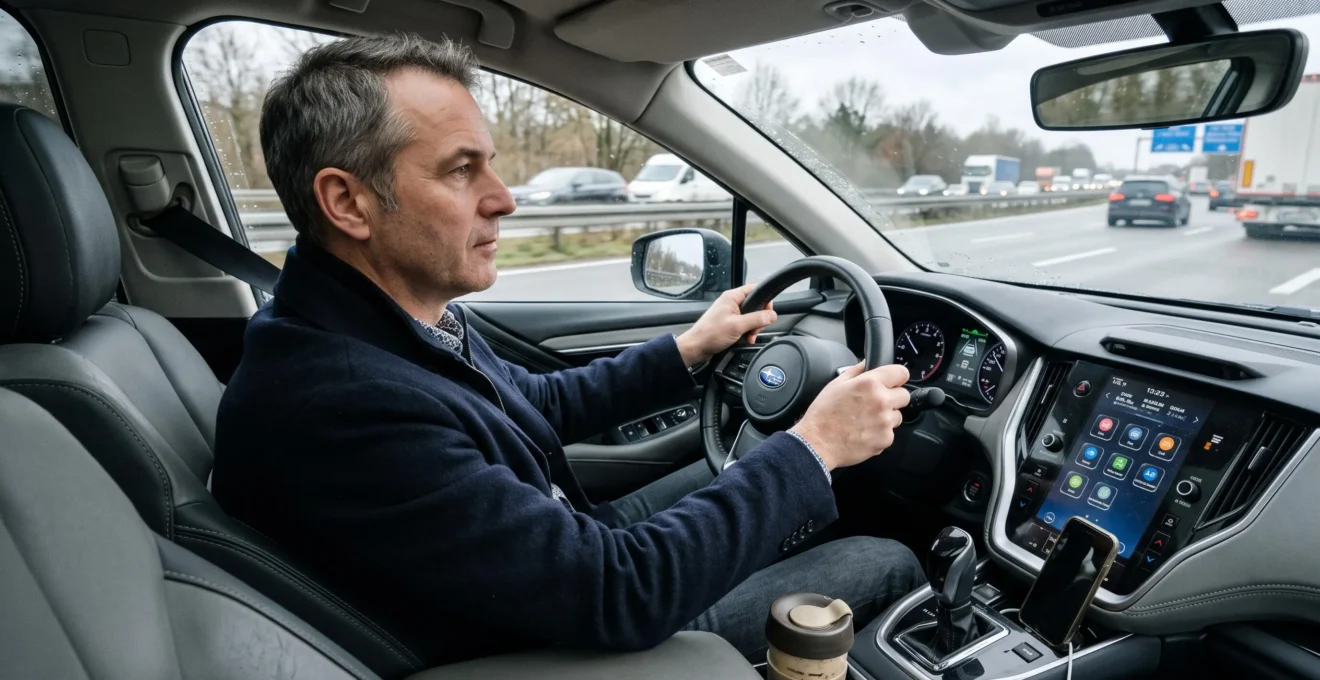
Modern cars can automatically adjust their speed, maintain a position within a marked lane, warn about nearby vehicles and apply emergency braking. Some can even handle steering and acceleration together for extended periods. Yet these capabilities do not necessarily mean a car can drive itself or safely manage every situation without human intervention.
The crucial distinction is between technology that assists a driver and technology that temporarily or fully performs the driving task. Most consumer-facing automation features remain forms of supervised assistance, requiring the person behind the wheel to monitor traffic and respond immediately when something goes wrong.
Understanding those limits matters when choosing a vehicle, interpreting its dashboard indicators or deciding whether to activate assistance in difficult conditions. The strongest evidence of safety benefits also comes from specific crash-avoidance technologies, not necessarily from systems that perform more of the routine driving task.
A realistic assessment starts with the automation level, the manufacturer’s stated operating conditions and the driver’s continuing responsibilities.
Automated driving: what matters most
- Level 2 assistance can control steering and speed together, but the driver must continuously supervise the vehicle.
- Automatic emergency braking and other crash-avoidance features have documented safety benefits, although their effectiveness varies by system and situation.
- Bad weather, obscured sensors, unclear road markings and driver fatigue can make reliance on automation particularly risky.
- Driver Assistance or Autonomous Driving: What Is the Practical Difference?
- Why Does an Automated Car Still Need an Attentive Driver?
- Which Car Safety Technologies Actually Help Prevent Accidents?
- Which Driver-Assist Mistakes Can Create a False Sense of Security?
- How Can You Use Automated Driving Features Without Overestimating Their Limits?
- Which Automation Assumptions Can Make Drivers Less Safe?
- When Should Drivers Avoid Relying Heavily on Automated Features?
- How Can You Check the Main Safety Systems on a Car Before Driving?
Driver Assistance or Autonomous Driving: What Is the Practical Difference?
Driver assistance supports a human who remains in charge of driving, while autonomous driving allows a system to perform the driving task within defined conditions without continuous human supervision. The practical distinction depends on what the system can control, whether the driver must monitor the road and who is expected to handle situations the technology cannot manage.
The SAE framework, reflected in NHTSA‘s explanation of automated driving levels, distinguishes six levels, numbered 0 through 5. These levels describe the division of the driving task between the human and the technology, rather than providing a simple ranking of vehicle safety.
The differences become clearer when the levels are compared directly.
| SAE level | What the system does | What the driver must do |
|---|---|---|
| Level 0 | Provides warnings or momentary emergency interventions. | Performs the driving task. |
| Level 1 | Continuously assists with either steering or speed control. | Drives and supervises the assistance. |
| Level 2 | Continuously assists with steering and acceleration or braking together. | Continuously monitors the environment and remains responsible for driving. |
| Level 3 | Performs the driving task under specified operating conditions. | Remains available to respond to a takeover request. |
| Level 4 | Performs the driving task within a defined operational domain without requiring human intervention while operating. | Does not need to supervise driving within that domain. |
| Level 5 | Performs the driving task across all driver-manageable conditions and roads. | Does not need to drive. |
Level 2 systems are widely offered by manufacturers, but that does not establish that most new vehicles sold include them. Level 3 remains much less broadly available, while Level 4 technology is associated primarily with restricted operating environments rather than ordinary consumer purchases. Level 5 remains a classification rather than a generally available consumer capability.
Marketing names can blur these distinctions. Terms such as Autopilot, co-pilot and automated driving assistance may suggest greater independence than a system actually provides. The manufacturer’s operating instructions are more useful than the name when establishing what the driver must do.
To understand an individual vehicle, check whether the instructions require hands on the steering wheel, continuous visual supervision or operation only on specifically supported roads. Hands-free operation alone does not demonstrate Level 3 autonomy: a Level 2 system may allow hands-free steering while still requiring constant attention.
Legal responsibility also depends on the jurisdiction and circumstances. SAE levels describe technical responsibilities, but do not settle every question of civil liability, insurance or criminal law. Drivers should consult applicable rules rather than assume that activating a feature transfers all legal responsibility to the manufacturer.
Regulators continue to scrutinize partially automated systems, including how their limitations are communicated and how drivers interact with them. This oversight reinforces the need to distinguish actual operating authority from promotional language.
Once a vehicle’s automation level is understood, the next question is why a system capable of managing routine steering and speed still depends so heavily on human attention.
Why Does an Automated Car Still Need an Attentive Driver?
An automated car still needs an attentive driver whenever its system requires continuous human supervision. Level 2 assistance can manage routine steering and speed adjustments, but it may fail to recognize an unusual hazard, misinterpret road conditions or disengage unexpectedly. The driver must remain ready to detect problems and respond without relying on a guaranteed advance warning.
The challenge is partly psychological. When people actively drive, they continuously assess surrounding vehicles, road geometry and potential hazards. When automation handles routine controls, the human’s role shifts toward monitoring a system that may perform correctly for long periods.
This kind of passive supervision can make sustained attention harder. A driver may gradually stop checking mirrors, anticipating traffic changes or maintaining an accurate mental picture of surrounding conditions.
The resulting risk is particularly important during a sudden handover. Takeover time is more than the interval needed to place a hand on the wheel. The driver must recognize that intervention is necessary, understand the developing situation, decide what action to take and execute it safely.
Those steps can be demanding when the driver has not been actively processing the road environment. A warning does not guarantee enough time to recover full situational awareness, and no universal safe takeover interval applies across vehicles or circumstances.
Consider a hypothetical motorway scenario: adaptive cruise control maintains distance from a moving vehicle, but traffic ahead encounters an unexpected stationary obstruction. The driver must recognize whether the system has detected the hazard and be prepared to brake or steer appropriately.
Similarly, faded lane markings, unusual temporary traffic arrangements and reduced visibility can interfere with how assistance systems interpret their surroundings. Even when a system continues operating, that does not prove its perception is reliable.
Level 3 systems have a different supervision model, but their takeover expectations still require careful attention to operating restrictions. A Level 2 driver should never apply Level 3 assumptions merely because the vehicle normally drives smoothly.
The practical rule is to maintain the same active awareness needed for conventional driving: monitor the road ahead, check surrounding traffic, avoid distracting activities and keep ready access to the controls.
Attention is one part of the safety equation. The next is identifying which technologies have demonstrated crash-prevention benefits rather than merely making driving feel easier.
Which Car Safety Technologies Actually Help Prevent Accidents?
Automatic emergency braking, forward collision warning, lane departure prevention and blind spot detection have demonstrated crash-avoidance benefits in real-world research. Their effectiveness depends on the specific system, operating conditions and type of incident. Continuous steering and speed automation may improve convenience, but its additional safety value is less clearly established than that of dedicated crash-prevention technologies.
The distinction matters because a vehicle advertised as highly automated is not necessarily better at preventing every kind of collision. Crash-avoidance features intervene in particular situations, while sustained driving assistance takes over parts of the routine driving task for longer periods.
IIHS research on advanced driver assistance provides evidence for several specific safety benefits. In the vehicle populations studied, forward collision warning combined with automatic emergency braking was associated with approximately 50 % fewer rear-end crashes.
Approximately 50%
Reduction in rear-end crashes associated with forward collision warning combined with automatic emergency braking in the IIHS study cited in its research synthesis. This is not a universal performance guarantee.
Insurance Institute for Highway Safety, advanced driver assistance research.
The same research synthesis reports a 27% reduction in rear-end crashes associated with forward collision warning alone in the cited study, a 27 % reduction in pedestrian crashes associated with pedestrian-detecting automatic braking, and a 14% reduction in lane-change crashes associated with blind spot detection.
These findings are specific to the studied technologies, vehicles and crash categories. They should not be interpreted as the expected reduction in every driver’s overall accident risk.
Performance also varies between versions of a feature. One automatic emergency braking system may have different detection capabilities and operating limits from another. Lane departure warning differs from active lane-keeping assistance, and blind spot monitoring systems may differ in their detection zones and relative-speed thresholds.
Adaptive cruise control primarily manages following speed and distance. More advanced systems may coordinate that function with steering assistance, but this does not automatically establish a separate crash-prevention advantage.
IIHS has also highlighted that evidence for the independent crash-reduction benefit of partial driving automation is less established than the evidence supporting dedicated crash-avoidance systems.
Driver behavior can influence realized benefits. If assistance makes someone follow other vehicles more closely or pay less attention, the resulting reduction in safety margins may undermine some of the protection the technology could otherwise provide.
Regulatory requirements also vary between markets. Certain crash-avoidance and warning features are increasingly required on new vehicles in some jurisdictions, but implementation dates, vehicle categories and technical standards differ. A buyer in the United States, United Kingdom, Australia or another English-speaking market should verify local requirements instead of assuming identical equipment specifications.
Even effective safety features can create misleading expectations when drivers misunderstand what their warnings, interventions and dashboard indicators really mean.
Which Driver-Assist Mistakes Can Create a False Sense of Security?
Driver-assist systems create a false sense of security when motorists assume they detect every hazard, work at every speed or intervene automatically whenever a dangerous situation develops. Common misunderstandings involve blind spot coverage, emergency braking limits and lane-keeping behavior. Repeated warnings, unfamiliar dashboard symbols and disabled features can further increase the gap between expected and actual protection.
Blind spot detection is one example. A driver might assume that a clear warning indicator means every adjacent lane is free of approaching traffic. In reality, sensor coverage and alert thresholds depend on the vehicle, and the feature does not replace mirrors or a shoulder check where appropriate.
Automatic emergency braking is another frequent source of overconfidence. Its detection and response depend on factors including the target, vehicle speed, road conditions and sensing capabilities. A system that successfully brakes for one obstacle may not respond identically to another.
Lane-related functions also need careful interpretation. Lane departure warning alerts the driver to certain departures, while active lane-keeping functions can apply steering corrections. Sustained lane-centering assistance is a different capability again.
None should be assumed to navigate every bend, recognize every road edge or follow temporary traffic arrangements correctly.
Warning fatigue presents another problem. Repeated or poorly understood alerts may encourage drivers to ignore warnings or disable the relevant systems. Conversely, a driver who assumes a function is always active may overlook that it has been switched off or temporarily suspended.
The safest approach is to learn the dashboard indicators and operating descriptions while the vehicle is stationary. A quiet parking area can be used to identify menus, warning symbols and activation controls without entering a hazardous situation.
On ordinary low-demand drives, drivers can observe the system’s routine status messages while continuing to drive normally. Deliberately provoking emergency braking, lane departures or near-collisions is not a safe way to discover a feature’s limits.
System startup behavior also varies. Some features may restore their previous settings, others may reactivate at the next ignition cycle, and some require manual engagement each journey. This must be established for the exact vehicle and software configuration.
Once those misconceptions are addressed, owners can build practical habits that match the assistance system’s actual capabilities rather than its perceived sophistication.
How Can You Use Automated Driving Features Without Overestimating Their Limits?
Use automated driving features safely by checking their operating conditions, understanding what supervision they require and learning how they signal limitations or disengagement. Begin with manufacturer-approved situations on familiar roads, maintain full attention and treat every intervention as assistance rather than guaranteed protection. Recheck the instructions after software updates because system behavior and availability may change.
A useful owner’s-manual review covers three questions. First, where and when can the feature operate? Check speed ranges, road types, lane-marking requirements, weather restrictions and any limitations involving mapped roads.
Second, what must the driver do? The instructions may require contact with the steering wheel, continuous monitoring of the roadway, attention to a driver-monitoring camera or immediate readiness to intervene.
Third, how does the system become unavailable? Read the descriptions of warning messages, automatic disengagement, temporary suspension and fault conditions.
These details are more meaningful than the vehicle’s price or brand positioning. Different manufacturers, and even different models from the same manufacturer, may use different cameras, radar arrangements, processing systems and control strategies.
A premium vehicle should not automatically be considered more reliable in a particular assistance task than a less expensive vehicle. What matters is the actual equipment, its tested performance, its limitations and the manufacturer’s documented instructions.
A gradual learning process can help. Start in permitted, relatively uncomplicated conditions on familiar routes, without deliberately testing dangerous edge cases. Keep track of ordinary circumstances in which the feature becomes unavailable, requests attention or behaves differently from expectations.
For example, a driver may notice that lane-centering assistance becomes unavailable when lane markings disappear. Recording that observation provides a useful reminder, but it does not establish that the system will behave identically the next time the road is encountered.
Software updates add another reason to review assumptions. Updates may change available functions, driver-monitoring behavior, system interfaces or operating restrictions. Read the manufacturer’s release information when available and confirm that any previously learned operating habits remain appropriate.
Build a practical automation limits checklist
- Identify the exact assistance system and its stated automation level. Record the feature name, software version where available and relevant manual section.
- Document permitted operating conditions. Create a short note covering supported roads, speed ranges and stated weather or visibility restrictions.
- Record driver supervision requirements. Write down the rules concerning hands, attention, warnings and immediate intervention.
- Review system status indicators while parked. Produce a reference note distinguishing engaged, unavailable, disabled and fault states.
- Review normal operation on familiar routes without provoking hazards. Keep a brief log of ordinary disengagement messages and recheck it after relevant updates.
These records are personal aids, not substitutes for the manufacturer’s instructions. They can improve familiarity but cannot establish a system’s safety or authorize use outside its stated limits.
The next challenge is recognizing the assumptions that can remain dangerous even after a driver becomes experienced with a particular system.
Which Automation Assumptions Can Make Drivers Less Safe?
The most dangerous automation assumptions are that sensors detect everything, software anticipates every road user’s behavior and warnings always arrive early enough for a safe response. These beliefs can encourage drivers to stop monitoring their surroundings or reduce their safety margins. Familiarity with a system may further increase overconfidence, especially when many uneventful journeys create unrealistic expectations.
A camera or radar system does not have unlimited perception. Its field of view, detection performance and ability to interpret an object are constrained by hardware, environmental conditions and software.
An obstructed camera or a vehicle emerging from a difficult angle may present challenges that are not obvious to the person supervising the system. Even when the dashboard shows that assistance is active, that indicator does not prove every relevant hazard has been identified.
Another mistaken assumption is that automation understands intentions in the same way as an attentive human driver. Automated systems estimate road geometry, objects and movement patterns, but reliable prediction is especially challenging when people behave unpredictably.
A pedestrian hesitating near a crossing, an unusual vehicle maneuver or a complex temporary road layout may therefore require immediate human judgment.
Warnings themselves are not guarantees. Their timing varies according to detection, system logic and the circumstances developing ahead. A late warning can leave little opportunity for a safe response, particularly when a driver has lost situational awareness.
Automation complacency describes the tendency to reduce monitoring when a system repeatedly performs as expected. A long series of successful journeys can build confidence without revealing how the technology will handle an unfamiliar emergency.
This is important because perceived reliability and actual capability are not identical. A system may work exceptionally smoothly in familiar conditions while remaining vulnerable to situations it rarely encounters.
Experience also does not transfer automatically between cars. A driver accustomed to strong lane-centering assistance may expect similar steering support in another vehicle equipped only with lane departure prevention.
Likewise, the response of one manufacturer’s adaptive cruise control should not be treated as a reliable guide to another manufacturer’s system.
Whenever switching vehicles, review the relevant controls, alert meanings and supervision requirements instead of assuming that similarly named functions behave alike.
These behavioral risks become particularly important in difficult road conditions, when automation may appear attractive precisely because driving demands more attention.
When Should Drivers Avoid Relying Heavily on Automated Features?
Drivers should avoid relying heavily on automation when road, weather, vehicle or personal conditions make system performance or rapid human intervention uncertain. Heavy rain, fog, obscured sensors, unclear lane markings, construction zones and complex traffic arrangements deserve particular caution. Fatigue, medication-related impairment and other conditions affecting alertness are additional reasons not to treat automation as a substitute for safe driving.
Environmental limitations are among the most important. Cameras may struggle when visibility deteriorates, while different sensing technologies have their own operating constraints. Roadworks can introduce markings, barriers and traffic movements that do not resemble the conditions in which a system normally performs best.
A regulatory example illustrates why these limitations matter. In 2024, the National Highway Traffic Safety Administration opened an investigation, PE24031, concerning reduced roadway visibility and certain Tesla vehicles operating with FSD Beta or FSD Supervised.
Regulatory investigation: reduced visibility and supervised automation
The NHTSA’s investigation into reduced-visibility driving incidents identified four reported crashes involving relevant vehicles and systems in conditions including sun glare, fog and airborne dust.
One reported crash involved a pedestrian fatality and another involved an injury. The investigation opening sought to examine whether the system’s engineering controls adequately detected and responded to reduced visibility. This opening document did not establish a final defect finding or a crash rate, and its observations cannot be generalized to every Level 2 system.
Other difficult situations include complicated roundabouts, toll plazas, dense urban traffic, temporary lane narrowing and roads with damaged markings. Whether a particular feature may be used depends on its operational design domain and the manufacturer’s restrictions.
Some systems are explicitly designed for limited traffic conditions, including low-speed congestion. Such features can reduce repetitive control demands, but Level 2 traffic-jam assistance still requires continuous supervision.
Stop-and-go traffic can be deceptively demanding because its monotony encourages reduced attention while sudden braking, pedestrians or unexpected lane changes may still occur.
Physical and cognitive readiness matter just as much as road conditions. A fatigued driver may be tempted to activate assistance to make a difficult journey easier, but fatigue can also reduce the ability to identify a hazard and respond effectively.
Medication that impairs alertness, severe stress and extended night driving can present similar concerns. Automation must never be treated as a way to make impaired driving acceptable. If the driver cannot safely supervise the vehicle, the appropriate response is to stop driving safely rather than delegate responsibility to a Level 2 system.
Vehicle configuration can also create restrictions. Towing, certain tire changes or modifications may affect system behavior or availability. Dirty, icy or snow-covered sensors can degrade detection or lead to automatic suspension.
Where the manufacturer prohibits use under these conditions, the feature should remain disengaged. If system performance is uncertain, conventional attentive control is preferable, provided the driver is fit to drive and road conditions are manageable.
These decisions are more reliable when paired with routine checks of the vehicle’s sensors, warning indicators and maintenance condition.
Key takeaways before your next drive
- System availability is not proof of complete sensor visibility or unrestricted safe operation.
- Recent glass replacement, repairs or vehicle modifications may justify checking whether calibration or further inspection is required.
- Recognizing the difference between a disabled feature, temporary unavailability and an actual fault prevents incorrect assumptions about protection.
How Can You Check the Main Safety Systems on a Car Before Driving?
Before driving, inspect accessible cameras and sensor surfaces, confirm that relevant dashboard warnings have cleared and check that the tires are in suitable condition. Also verify that the assistance features you intend to use are actually available and correctly configured. After repairs or windshield replacement, confirm whether the manufacturer requires sensor calibration before relying on affected systems.
A practical pre-drive routine begins outside the car. Check the windshield area containing forward-facing cameras, the front surfaces associated with radar or other sensors where identifiable, and the accessible areas used by blind spot detection.
Remove ordinary dirt, snow or other obstructions using cleaning methods approved for the vehicle. Avoid abrasive materials, excessive pressure or attempts to dismantle sensor components. Not every sensor is visible, and an apparently clean exterior does not prove that all sensors are operating correctly.
Next, inspect the instrument cluster after startup. A temporarily unavailable system may report reduced visibility, sensor obstruction or unsuitable operating conditions. A voluntarily disabled system may display a different status, while a malfunction warning may indicate the need for professional diagnosis.
These states should not be treated as interchangeable. Some systems automatically become available when conditions improve, while others need driver activation or fault resolution. The owner’s manual explains which indicators apply to the particular vehicle.
Tire condition is another essential check. Correct inflation, adequate tread and manufacturer-approved specifications support predictable braking and handling. Assistance systems cannot compensate for inadequate grip, and some vehicle configurations may require specific settings or procedures following wheel or tire changes.
Maintenance history also matters. Replacing a windshield can alter the mounting or alignment of cameras used by driver-assistance systems. According to AAA‘s windshield replacement and ADAS calibration information, relevant vehicles may require recalibration after replacement.
Depending on the manufacturer’s procedures, calibration may use stationary targets, a controlled driving procedure or a combination of methods. The appropriate process depends on the vehicle and repair, so drivers should not assume that every windshield replacement follows the same procedure.
Other events, such as certain collision repairs, suspension work or equipment changes, can also justify checking the manufacturer’s calibration requirements. A minor impact or routine tire replacement does not automatically mean camera recalibration is required on every vehicle.
After relevant work, request documentation identifying the repair and any required calibration performed. Keeping these records alongside the vehicle’s maintenance history can assist subsequent servicing and may be useful when discussing a repair or insurance claim.
Insurance coverage and maintenance obligations vary by policy and jurisdiction. Owners should check their actual terms rather than assume that a particular calibration procedure is universally covered or required for every claim.
Finally, remember that dashboard indicators and physical checks cannot certify complete system reliability. They are practical safeguards that complement proper maintenance, manufacturer guidance and attentive driving.
Before your next journey, identify the assistance functions fitted to your vehicle, review their limitations in the owner’s manual and check for unresolved warnings or maintenance requirements. This simple preparation is more dependable than assuming an automated feature will manage whatever the road presents.
Does hands-free driving mean a car is autonomous?
No. A system may allow the driver to remove their hands from the steering wheel while still requiring continuous visual supervision. Such a feature can remain SAE Level 2. Its automation level depends on the driving tasks performed and the driver’s monitoring responsibilities, not simply on whether steering-wheel contact is required.
Can automatic emergency braking prevent every collision?
No. Automatic emergency braking can reduce the frequency or severity of certain collisions, but its performance depends on the specific system and conditions. Vehicle speed, obstacle characteristics, road grip and sensor limitations may affect its response. Drivers must continue maintaining safe distances and monitoring traffic.
Can a software update change how driving assistance behaves?
Yes. Depending on the vehicle and update, software changes may affect system behavior, operating conditions, interfaces or driver-monitoring requirements. Owners should review the manufacturer’s release information and updated instructions rather than assume that previously observed behavior will remain unchanged.
Should assistance features be switched off whenever it rains?
Not necessarily. The decision depends on the manufacturer’s restrictions, the severity of the rain, road conditions and system availability. Some assistance functions remain usable in certain wet conditions, but their performance should never be assumed to be unaffected. Follow the vehicle instructions and take direct control whenever conditions make reliable assistance uncertain.
Does replacing a windshield affect automated safety features?
It can. Vehicles with windshield-mounted cameras may require calibration following replacement to ensure correct sensor alignment. The need for calibration and the applicable procedure depend on the vehicle and repair specifications. Ask the repairer to confirm that the manufacturer’s relevant requirements have been followed.