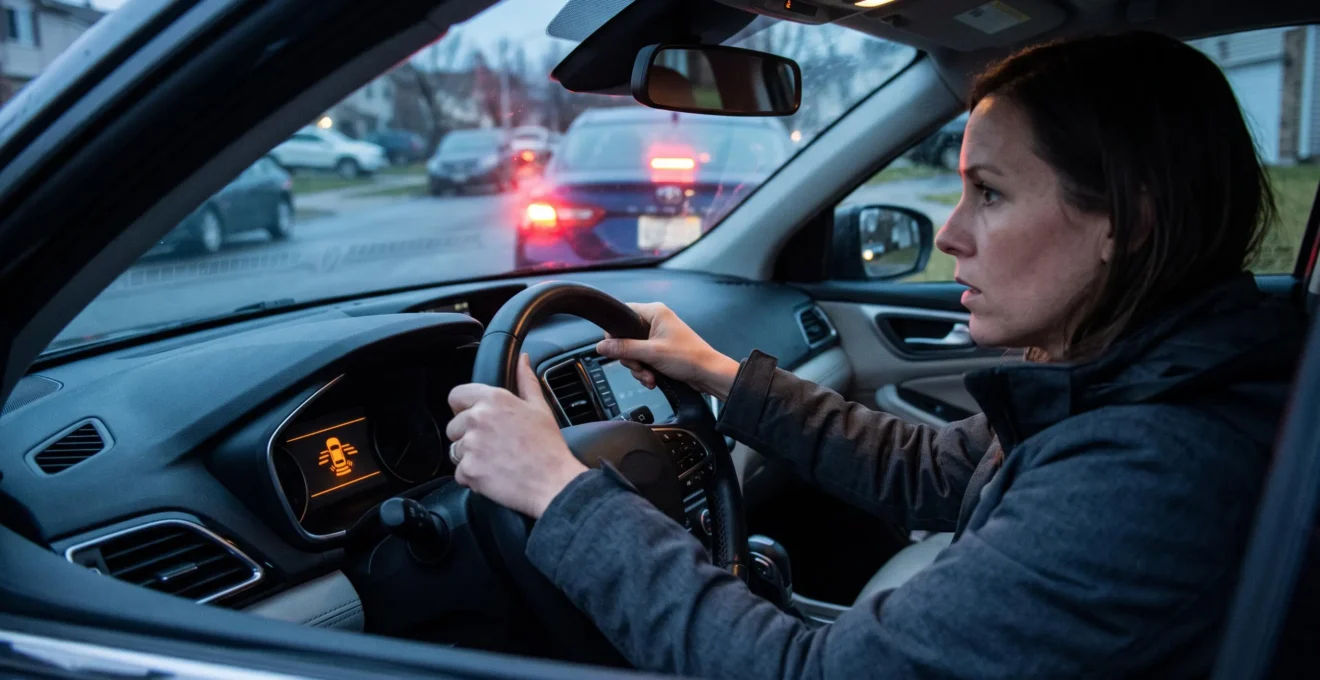
Automatic emergency braking (AEB) can intervene when a driver reacts too late to a potential collision. Using information from cameras, radar or other sensors, the system identifies certain hazards ahead and may apply the brakes automatically. Depending on the vehicle’s speed, the available distance and road conditions, that intervention can prevent a collision or reduce the speed at which it occurs.
The distinction matters because AEB is not a guarantee that a vehicle will stop before hitting an obstacle. Some systems work only within particular speed ranges, detect certain road users more effectively than others, or struggle when visibility and traction deteriorate. The driver must remain ready to brake or steer.
Research from the Insurance Institute for Highway Safety (IIHS) supports the value of the technology while illustrating its limits. Rear-end crashes with forward collision warning combined with automatic braking was associated with approximately 50 % fewer rear-end crashes compared with vehicles without the technology. That population-level result does not describe the probability of avoiding any particular collision.
Automatic emergency braking: the essentials
- AEB may prevent a collision or reduce its severity by lowering impact speed, but detection and braking distance remain critical.
- Forward collision warning alerts the driver; AEB can apply braking automatically. Equipment and operating conditions vary by vehicle.
- Clean sensors, appropriate maintenance, adequate following distance and continuous driver attention remain essential.
- Why Does Automatic Emergency Braking Not Stop Every Collision?
- How Can You Help Automatic Emergency Braking Work Properly?
- Forward Collision Warning or AEB: Which System Actually Applies the Brakes?
- Why Is Relying on AEB as a Backup Driving Strategy Dangerous?
- When Can Weather or Road Conditions Limit Automatic Emergency Braking?
- Active or Passive Safety Technology: Which Protects You Before a Crash?
- How Can You Set an Excess That Your Emergency Fund Can Actually Cover?
- What Can Today’s Automated Driving Systems Actually Do for the Driver?
Why Does Automatic Emergency Braking Not Stop Every Collision?
Automatic emergency braking cannot stop every collision because its sensors must recognise a threat early enough for braking to make a difference. At high closing speeds, the remaining distance may be insufficient to avoid impact. The system can also miss hazards outside its detection capabilities. Its useful outcomes therefore include both collision avoidance and reduced impact severity.
AEB depends on a sequence of events: sensors collect information, the system assesses whether a collision is likely, and its control software determines whether braking is appropriate. Even a correctly functioning system requires some time to identify the danger and initiate intervention.
Once braking begins, vehicle speed, tyre grip and available road distance determine how much speed can be removed. A car approaching a stationary obstacle rapidly may have too little room to stop completely. Nevertheless, reducing impact speed can still make a collision less severe.
Three distinct outcomes help explain what an AEB intervention can achieve:
- Complete avoidance: the system identifies the threat soon enough and brakes sufficiently to prevent contact.
- Impact-speed reduction: automatic braking begins, but the vehicle still strikes the obstacle at a lower speed than it otherwise might have.
- No effective intervention: the threat is not detected, is detected too late, or falls outside the system’s operating conditions.
Detection is particularly important when obstacles do not resemble the situations the system handles most reliably. A vehicle stopped at an unusual angle, a pedestrian crossing in darkness, a cyclist or an object entering the driving path unexpectedly may challenge some systems. Performance depends on the fitted hardware, software and circumstances.
Approximately 50% fewer rear-end crashes
IIHS cites research finding this reduction for vehicles equipped with forward collision warning and automatic braking compared with vehicles without the technology. The result concerns the studied vehicle population, not every collision scenario or current vehicle model.
AEB should therefore be evaluated through two questions: can the vehicle recognise the hazard, and can it remove enough speed before impact? Both matter more than the mere presence of an automatic braking label in a specification sheet.
The central benefit is not that braking errors disappear. It is that an additional intervention may reduce the consequences of a late human reaction. Keeping the system ready is the next part of that protection.
How Can You Help Automatic Emergency Braking Work Properly?
Drivers can support automatic emergency braking by keeping sensor areas clear, maintaining adequate following distances, checking system status and arranging correct calibration after relevant repairs. They should also learn their vehicle’s operating limitations. These precautions improve the conditions for reliable operation, but they cannot guarantee that AEB will recognise every danger or intervene successfully.
Many systems depend on a camera mounted near the upper windshield, front radar equipment or both. Road dirt, snow, ice and objects obstructing the sensor area can interfere with their ability to gather information.
Maintenance should follow the vehicle manufacturer’s instructions. The camera’s viewing area can be kept clear without disturbing the camera housing. Front radar areas also need attention, although their locations vary and some sensors are concealed behind vehicle trim.
Physical damage deserves particular care. A windshield replacement, bumper repair or minor front-end collision can affect sensor positioning. According to AAA findings on driver assistance system repair costs, cameras and radar equipment may require inspection, repair or calibration following vehicle damage.
AAA’s 2023 research examined three vehicles and found that repairs involving advanced driver assistance components could add substantial costs. These findings concern specific US repair scenarios rather than universal prices, but they underline why restoring sensor alignment is a safety concern rather than merely a cosmetic repair detail.
Checking the dashboard is equally important. Some vehicles display an AEB status symbol, a fault message or a temporary-unavailability warning. A warning-free dashboard, however, does not prove that every sensor is detecting perfectly. A partially obstructed or damaged component may not always produce an obvious alert.
Drivers should consult their owner’s manual to establish whether AEB can be switched off, which dashboard indicators apply and whether particular driving modes alter system availability. Low-speed manoeuvring, trailer operation and turning behaviour should not be assumed to trigger the same responses across manufacturers.
Five checks to confirm your AEB is ready
- Locate the sensors: consult the owner’s manual and identify the camera and radar areas. Keep a record of their locations.
- Inspect visible obstructions: check for dirt, ice, stickers, damage or unsuitable accessories. Record anything requiring cleaning or professional attention.
- Check system status: review the dashboard indicators and settings while safely parked. Confirm the displayed operating state.
- Review recent repairs: check windshield and front-end repair records for required inspection or calibration. Obtain confirmation from the repairer where necessary.
- Review driving limitations: identify the system’s stated operating speeds, warnings and override behaviour in the manual. Keep a short reference note for the vehicle.
Do not deliberately approach an obstacle to test whether AEB works. A dangerous real-world experiment cannot reliably demonstrate system readiness and may cause a collision.
Maintenance supports detection, but it does not replace attentive driving. Understanding what happens before automatic braking begins is equally valuable, particularly when the vehicle provides a warning without an intervention.
Forward Collision Warning or AEB: Which System Actually Applies the Brakes?
Forward collision warning (FCW) alerts the driver to a potential collision but does not itself apply the brakes. Automatic emergency braking (AEB) can intervene by applying braking pressure when the system determines that a forward collision is imminent. A vehicle may have both technologies, but the presence of a warning feature alone does not establish that automatic braking is available.
That distinction is easy to overlook because both systems may use similar cameras, radar sensors and dashboard messages. Their essential difference lies in whether the technology simply informs the driver or takes physical action.
The NHTSA explanation of driver assistance technologies distinguishes collision warnings from automatic braking interventions and advises drivers to check the equipment fitted to their specific vehicle.
Manufacturers may combine the features in a sequence: an initial alert, a more urgent warning and, if the conditions are met, automatic braking. That sequence is illustrative, not universal. Warning timing and braking activation differ between systems.
Whenever a collision warning appears, the driver should respond to the hazard immediately rather than assume that automatic braking will follow.
For a vehicle purchase or insurance review, the following comparison helps identify what the equipment actually provides.
| Vehicle feature | What it does | What to verify |
|---|---|---|
| Forward collision warning only | Provides a visual, audible or haptic warning | Whether automatic braking is also installed |
| Low-speed AEB | Can brake automatically within specified operating conditions | Speed range and supported obstacles |
| Broader-speed-range AEB | Can intervene across a wider range of driving speeds | Upper and lower operating limits |
| AEB with pedestrian or cyclist detection | Can recognise and respond to certain vulnerable road users | Supported scenarios, lighting conditions and detection restrictions |
Equipment can vary by model year, market and trim level. Brand names alone are not reliable indicators of capability. A used vehicle’s original specification, owner’s manual and relevant manufacturer documentation are more useful than assumptions based on a badge or sales description.
The distinction may also matter after a rear-end collision. A warning-only system creates different factual questions from a system designed to apply the brakes. However, insurance claims and legal responsibility depend on the circumstances, evidence, applicable law and policy terms; neither a warning nor a missed AEB intervention determines fault automatically.
Knowing exactly what is fitted prevents a dangerous expectation that a warning system will act on the driver’s behalf. Even with full AEB, relying on that intervention changes the risks rather than eliminating them.
Why Is Relying on AEB as a Backup Driving Strategy Dangerous?
Relying on automatic emergency braking as a routine backup is dangerous because the system may fail to recognise a hazard or intervene too late. Drivers who shorten following distances or divert attention on the assumption that AEB will compensate remove the safety margin the technology needs. AEB is an emergency assistance feature, not permission to drive less attentively.
The behavioural concern is known as risk compensation: people may accept greater risks when they believe a protective technology makes an activity safer. In driving, that could mean following more closely, delaying braking or checking a phone because the vehicle seems capable of handling emergencies.
These are plausible risk-compensation behaviours, not proof that all drivers with AEB behave this way. The available source material does not establish that AEB ownership necessarily increases phone use or tailgating.
The practical danger remains clear. Following distance and attention provide time for human judgement, hazard recognition and avoidance. AEB adds another possible intervention, but it cannot restore a safety margin that has already disappeared.
Another limitation is that drivers generally cannot see every detail of the system’s internal hazard assessment. A dashboard may indicate whether a feature is enabled or unavailable, but it does not necessarily show whether the system has correctly recognised a specific obstacle at that moment.
That creates an important distinction between enabled and able to intervene successfully. A feature can be switched on while a particular hazard remains outside its capabilities.
Hypothetical driving scenario: a distraction on a suburban road
A driver travelling behind another vehicle briefly looks away from the road. Traffic ahead stops unexpectedly. The equipped car detects a potential collision and begins emergency braking before the driver reacts.
If the remaining distance is sufficient, the car may stop. If not, AEB may still reduce impact speed. If the obstacle is detected too late or not at all, a collision may occur without useful intervention.
The scenario illustrates why maintaining attention and following distance remains necessary even when automatic braking is installed.
Driver responsibility also needs careful interpretation. AEB is a driver assistance feature, not a grant of autonomous driving authority. Drivers generally remain responsible for complying with road rules and supervising their vehicles, although collision liability must be assessed under the applicable jurisdiction’s law and the particular facts.
A useful mental model is to treat AEB as protection against some genuine mistakes, rather than a replacement for attention. Its intervention may help after an unexpectedly late reaction, but that does not make intentional distraction safer.
Preserving a safe margin becomes even more important when environmental conditions make obstacle detection or braking less predictable.
When Can Weather or Road Conditions Limit Automatic Emergency Braking?
Heavy rain, snow, fog, glare and dirty sensors can reduce the ability of automatic emergency braking systems to recognise hazards. Wet, icy or loose road surfaces can also increase stopping distance, even when the system detects the obstacle and applies strong braking. Under difficult conditions, drivers should increase their safety margins rather than depend on AEB to compensate.
Two limitations operate independently: detecting the danger and generating sufficient braking force.
Cameras depend on usable visual information. Heavy precipitation, darkness, glare and contamination around the windshield camera can make identifying pedestrians, vehicles or road boundaries more difficult.
Radar may perform differently from cameras in adverse visibility, but it is not immune to interference, obstruction or difficult object interpretation. The exact performance depends on the sensor arrangement and system design.
The IIHS research overview identifies adverse weather and low-light conditions as limitations of some crash avoidance technologies. Its cited pedestrian AEB research also shows that performance in darkness has historically been a concern, while newer systems have improved.
Road grip imposes another physical limit. Braking force must be transmitted through the tyres to the road. When the surface is icy, covered in wet leaves or loose gravel, the available friction may be much lower than on clean, dry pavement.
AEB cannot create traction that the tyres do not have. Even if automatic braking is initiated correctly, the vehicle may continue travelling farther than expected.
Curved roads introduce additional challenges. A stationary car around a bend may not enter the sensors’ effective detection area until late. Conversely, roadside objects such as barriers or parked vehicles can complicate the assessment of what lies in the vehicle’s intended path.
These situations do not mean every AEB system behaves identically. Software design and sensor capabilities differ, so the relevant owner’s manual remains essential.
In deteriorating conditions, a practical approach is to assume that AEB may provide less help than usual:
- Reduce speed sufficiently for the available visibility and traction.
- Increase following distance and avoid abrupt manoeuvres.
- Keep the windshield and relevant sensor areas clear when it is safe to do so.
- Pay attention to temporary-unavailability indicators, without assuming that their absence guarantees normal detection.
- Do not continue relying on a suspected malfunctioning system; seek inspection when necessary.
The safest response to uncertain conditions is to preserve enough room to react personally. AEB is only one part of a wider set of crash prevention and injury protection technologies.
Active or Passive Safety Technology: Which Protects You Before a Crash?
Active safety technologies help drivers avoid collisions or reduce crash severity before impact. Examples include automatic emergency braking, electronic stability control and anti-lock braking systems. Passive safety features, such as seatbelts, airbags and crumple zones, primarily reduce injury when a collision occurs. Both are important, but AEB belongs to the active safety category.
The distinction helps explain why automatic emergency braking is valuable when a driver reacts too late. Passive protection cannot bring the vehicle to a stop before impact. AEB can potentially intervene during the short interval between detecting a threat and the collision itself.
Active safety technology also includes functions that assist the driver before a situation becomes critical. Electronic stability control helps manage certain losses of vehicle stability, while anti-lock braking helps preserve steering control during heavy braking by limiting wheel lock.
Not all active systems operate automatically in the same way, and none eliminates the need for appropriate driver control.
The technologies can be understood as successive protective layers:
- Hazard awareness: the driver observes traffic and assistance features may provide warnings.
- Driver assistance: selected functions support steering, speed management or stability.
- Emergency intervention: systems such as AEB may brake when a qualifying threat becomes imminent.
- Occupant protection: seatbelts, airbags and energy-absorbing structures help limit injury if a crash occurs.
This sequence is a conceptual explanation, not a guarantee that every warning or assistance stage will activate in a fixed order.
For vehicle buyers, looking at both active and passive protection provides a more complete assessment than focusing on AEB alone. Crash-test information, fitted safety equipment and the condition of a used vehicle all matter.
Insurance implications require similar caution. Some active safety systems have been associated with lower frequencies of certain insurance claims. However, an individual insurance premium may depend on many factors, and having AEB does not guarantee a discount.
Used-vehicle buyers should also consider whether previous damage or repairs have affected safety-system operation. A feature listed in the original specification is only useful if it remains correctly functioning.
Even with several safety layers, some collisions remain possible. That residual risk makes the financial terms of motor insurance another practical consideration.
How Can You Set an Excess That Your Emergency Fund Can Actually Cover?
Choose a car insurance excess that you could pay from readily available savings without compromising essential expenses. Add the applicable compulsory and voluntary excess amounts, then compare the total with your emergency fund. A higher voluntary excess may reduce the premium, but the saving is only useful if the resulting out-of-pocket expense remains affordable after an accident.
In the United Kingdom, an insurance excess is the amount a policyholder contributes towards a claim, subject to policy conditions. The comparable term commonly used in the United States is deductible, although contractual details can differ.
AEB does not remove the need for this financial preparation. It may lower the likelihood or severity of certain collisions, but repairs, insurance claims and unexpected expenses remain possible.
The first step is to identify the portion of emergency savings genuinely available for a motor insurance claim. Money needed for rent, essential bills, food or other unavoidable commitments should not be treated as freely available.
Then review the insurer’s compulsory excess and any voluntary excess you choose. The combined amount may be payable in relevant claim circumstances, depending on the policy.
Consider an explicitly hypothetical example:
Hypothetical example: choosing an affordable insurance excess
A driver has £1,200 in emergency savings but needs to preserve £700 for essential expenses. That leaves £500 potentially available for an unexpected insurance payment.
If the applicable compulsory excess is £200, selecting a £300 voluntary excess would produce a combined £500 excess in circumstances where both amounts apply.
A higher combined excess would exceed the driver’s available buffer. Even if it reduced the annual premium, the driver would need to consider how to fund the difference after a claim.
The figures illustrate a budgeting method, not a universal recommendation for a particular excess amount.
To evaluate competing policies, compare the total premium with the potential excess payment. A cheaper policy with a much higher excess may create an unsuitable financial exposure, particularly when savings are limited.
In some claims, the insurer may require the excess to be paid upfront. In other arrangements, it may be deducted from a settlement. The precise process depends on the insurance contract and circumstances.
A useful affordability test is to imagine that a qualifying accident occurs next month. Could the excess be paid immediately without borrowing, missing an essential bill or delaying a necessary repair? If not, the selected amount may be too high.
Policyholders should not assume that inability to pay an excess automatically means an entire claim will be refused. The outcome depends on the contract and insurer’s claims process.
A realistic insurance budget complements good driving habits and safety equipment. It also reinforces a broader point: advanced vehicle technology changes some risks, but it does not transfer every driving or financial responsibility away from the person behind the wheel.
Key takeaways before relying on driving automation
- Check which steering, speed-control and emergency braking functions your vehicle actually supports, rather than relying on marketing terminology.
- Identify the situations in which the driver must actively supervise, intervene or resume full control.
- Assess automated assistance as part of a complete safety strategy that includes visibility, following distance, maintenance and financial preparedness.
What Can Today’s Automated Driving Systems Actually Do for the Driver?
Today’s driver assistance systems can help manage vehicle speed, following distance and steering within defined operating conditions. Some also monitor driver engagement or intervene during emergencies. However, most systems fitted to consumer vehicles still require continuous driver supervision. Features described as hands-free or automated must not be confused with unrestricted self-driving capability.
Several technologies commonly appear together in modern vehicles, although their exact combinations vary:
- Adaptive cruise control: adjusts vehicle speed to help maintain a selected following distance from traffic ahead.
- Lane-centering assistance: provides steering support to help keep the vehicle within its lane under suitable conditions.
- Automatic emergency braking: may intervene when a qualifying collision threat becomes imminent.
- Driver monitoring: where fitted, uses vehicle-specific methods to assess aspects of driver engagement or attention.
These capabilities address different driving tasks. Adaptive cruise control is not a substitute for emergency hazard recognition, and lane-centering assistance does not guarantee that the vehicle can safely negotiate every curve or road layout.
The distinction between ongoing assistance and brief emergency intervention also matters when discussing driving automation levels.
Under the classification explained by NHTSA, momentary safety interventions such as AEB are considered Level 0 features. Level 1 assistance supports either steering or vehicle speed control, while Level 2 can support both at the same time, with the driver remaining responsible for supervision.
A vehicle equipped with AEB is not automatically a Level 2 automated vehicle. Nor does a Level 2 system become self-driving simply because it can control steering and speed for extended periods.
Some systems allow hands-free operation in specified circumstances, while others require hands-on-wheel engagement. In both cases, the driver’s attention and takeover obligations must be understood from the actual system instructions rather than inferred from the advertised name.
More advanced automation exists in limited operational settings, where the system’s defined capabilities and driver responsibilities may differ. This should not be confused with the capabilities of ordinary driver-supervised assistance systems.
Marketing expressions such as “autopilot” or “self-driving” can create expectations that exceed what a particular vehicle can safely perform. A more useful assessment asks what the vehicle is designed to do, where it can operate and who must respond when circumstances change.
As automated driving technology develops, emergency braking remains an important protective function. It can support driver-supervised systems by responding to some collision threats, but its presence does not establish that the vehicle can manage all unforeseen hazards.
Before your next journey, review the driver assistance features in your owner’s manual, check for unavailable-system warnings and maintain sufficient following distance. Treat every collision alert as a reason to respond immediately, and remain prepared to brake or steer whenever necessary.
Does automatic emergency braking work if the driver does not press the brake pedal?
Yes. AEB can apply braking automatically without a driver pressing the brake pedal when its activation conditions are satisfied. However, the system must recognise the threat, and its operating limits may prevent or restrict intervention. Drivers should brake themselves whenever necessary rather than waiting for automatic intervention.
Can automatic emergency braking stop a car at motorway speeds?
Some AEB systems operate at motorway speeds, but whether they can prevent a collision depends on the vehicle, detected hazard, closing speed, road conditions and available stopping distance. Other systems have narrower operating ranges. The owner’s manual and model-specific safety information should be checked before assuming high-speed collision avoidance capability.
Can AEB activate when there is no actual collision threat?
Unnecessary or unexpected braking can occur when a system incorrectly interprets an object or road situation as hazardous. Drivers should remain attentive, follow the manufacturer’s instructions and arrange an inspection if unexpected interventions recur. The possibility of false activation does not justify routinely disabling a correctly functioning safety feature.
Does replacing a windshield affect automatic emergency braking?
It can. Vehicles with windshield-mounted cameras may require inspection or calibration after glass replacement. The need depends on the manufacturer and model. Ask the repairer whether the relevant procedures were completed, and retain the documentation. A clear dashboard alone is not definitive proof of correct sensor alignment.
Will having automatic emergency braking reduce car insurance premiums?
Not necessarily. Research has associated certain front crash prevention systems with lower frequencies of relevant collisions or insurance claims, but individual premiums depend on the insurer, policy, vehicle, driver and local market. Check actual quotations rather than assuming that AEB equipment automatically produces a discount.