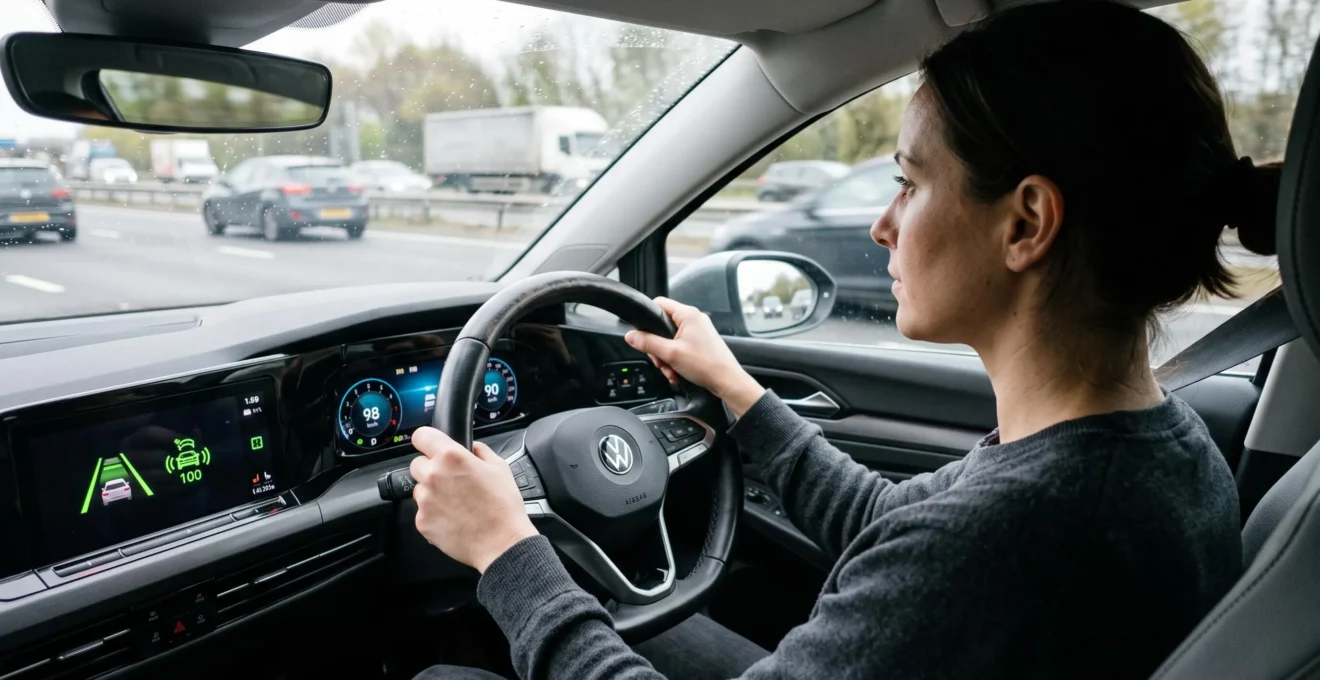
Automatic emergency braking can intervene when a driver reacts too late. Blind spot warnings can draw attention to approaching vehicles, while electronic stability control helps maintain control when traction becomes unstable. Yet none of these systems can recognize every hazard or guarantee that a collision will be avoided.
The difference lies in what each technology detects, how quickly it responds, and whether it merely warns the driver or actively changes the vehicle’s behavior. A feature that works reliably during an ordinary commute may have difficulty with an obscured cyclist, faded lane markings, or a stationary vehicle in an unusual position.
Understanding these distinctions helps drivers compare vehicles, configure assistance features, and recognize situations requiring more cautious manual control. The most useful safety technology is not necessarily the one offering the most automated functions. It is the one whose capabilities and limitations the driver understands well enough to use correctly.
Car safety technology: the essentials
- Automatic emergency braking can actively reduce collision risk, while forward collision warning alone cannot apply the brakes.
- Driver-assistance sensors have operating limits, particularly in poor visibility, unusual road layouts, and situations involving partially hidden hazards.
- Regular checks, appropriate alert settings, and continuous driver attention make safety technology more useful without encouraging overreliance.
- Why Can Driver-Assist Technology Still Miss a Hazard?
- How Can You Set Driver-Assist Features Without Becoming Overwhelmed by Alerts?
- Active or Passive Safety Technology: Which Protects You Before a Crash?
- Which Driver-Assist Mistakes Can Create a False Sense of Security?
- When Should You Rely Less on Vehicle Safety Sensors?
- How Can You Check the Main Safety Systems on a Car Before Driving?
- Forward Collision Warning or AEB: Which System Actually Applies the Brakes?
- How Does Automatic Emergency Braking Help When a Driver Reacts Too Late?
Why Can Driver-Assist Technology Still Miss a Hazard?
Driver-assistance technology can miss a hazard because its sensors have limited visibility, detection ranges, and object-recognition capabilities. Cameras, radar, and ultrasonic sensors interpret different information, and an obstacle may not meet the conditions required to trigger a response. Detection also does not guarantee intervention: the system must correctly assess the hazard before acting.
A camera uses visual information to identify lane markings, vehicles, pedestrians, and other road features. It may struggle when sunlight shines directly into the lens, contrast is poor, or an object is partly concealed. Radar measures reflected radio signals and is useful for estimating distance and relative movement, but some systems have limitations in distinguishing relevant stationary objects from roadside structures.
Ultrasonic sensors generally operate over shorter distances, making them useful for parking assistance rather than identifying hazards far ahead at road speeds.
Consider three hypothetical situations:
- A cyclist emerging from behind a parked vehicle: the cyclist may become visible only when little stopping distance remains.
- A stalled car beyond a hill crest: the road geometry may prevent forward sensors from detecting the obstacle until the vehicle approaches the crest.
- Road debris on a highway: the object may be too small, too unusual, or outside the system’s recognized object categories to trigger automatic braking.
These examples distinguish two different failure mechanisms. In the first, a hazard is not detected early enough. In the second, a sensor may register something without the vehicle classifying it as a threat requiring action.
The distinction matters because an apparently functioning system may still fail to intervene. A dashboard without warnings is not proof that every object ahead has been recognized.
In March 2026, the National Transportation Safety Board reported findings from two fatal crashes involving Ford BlueCruise partial driving automation. In both 2024 crashes, the vehicles struck stationary vehicles, and investigators concluded that driver overreliance contributed to the collisions.
Real-world investigation: partial automation and stationary vehicles
The NTSB investigated crashes in San Antonio on February 24, 2024, and Philadelphia on March 3, 2024. Both involved vehicles operating with Ford BlueCruise partial driving automation.
Investigators found no recorded driver-applied or system-initiated braking or steering immediately before either impact. The findings illustrate the consequences of overreliance in these specific incidents, not a failure rate applicable to every assisted-driving system. Read the NTSB findings on two fatal partial-automation crashes.
The practical lesson is to maintain an independent understanding of the traffic environment. Scan beyond the vehicle directly ahead, watch for partially hidden road users, and never interpret uninterrupted assistance as evidence that the technology will handle the next unexpected event.
Once the limits of detection are clear, the next challenge is configuring warnings so that they remain useful rather than becoming background noise.
How Can You Set Driver-Assist Features Without Becoming Overwhelmed by Alerts?
Set driver-assistance alerts while the vehicle is parked, starting with the manufacturer’s recommended settings. Review each warning separately, understand its purpose, and adjust sensitivity only where the vehicle permits. The goal is to preserve meaningful warnings without creating unnecessary distraction or developing a habit of ignoring alerts.
Modern vehicles may offer settings for forward collision warning timing, lane departure notifications, steering assistance, blind spot alerts, and audible feedback. However, the range of available adjustments varies considerably between models.
Some systems allow early, normal, or late collision warnings. An earlier setting may provide more reaction time but can also produce warnings in situations the driver does not consider immediately dangerous. A later setting may reduce nuisance warnings while leaving less time to respond.
Fewer warnings do not necessarily mean greater safety. Silence can simply mean that an alert has been delayed or disabled.
A practical setup routine begins by identifying which assistance features are installed and which are enabled by default. Review the owner’s manual to understand each feature’s operating conditions before making changes.
Next, select the standard or recommended warning configuration. During ordinary driving, observe when alerts appear without deliberately provoking dangerous situations. If an alert repeatedly activates unexpectedly, note the circumstances and check whether the system is behaving as designed.
For example, a lane departure warning that frequently activates on roads with faded markings might reflect environmental limitations rather than excessive sensitivity.
If the vehicle allows adjustments, change one setting at a time while parked. Keep a written record of the original and final configuration, especially when using a rental vehicle or after a software update.
Drivers should also examine their reactions to different warning sounds. An alert that is routinely dismissed without checking the road has lost much of its practical value. Rebuilding the habit of checking the relevant hazard is preferable to automatically silencing it.
Where audible alerts are especially distracting, look for manufacturer-supported alternatives such as steering-wheel vibration or visual notifications, provided those options remain suitable for the driver.
After establishing useful settings, it becomes easier to distinguish systems that merely communicate danger from technologies that can physically intervene before impact.
Active or Passive Safety Technology: Which Protects You Before a Crash?
Active safety technology helps prevent a crash or reduce its severity before impact, while passive safety technology primarily protects occupants during a collision. Automatic emergency braking, stability control, and lane keeping assistance are active systems. Airbags, seatbelts, and crumple zones are passive protections. Both categories are essential because preventing every collision is impossible.
The distinction is based on function rather than technological sophistication. A conventional seatbelt is a vital safety feature even though it does not monitor traffic or automatically steer the vehicle.
Active systems influence the events leading up to an accident. Some intervene directly, while others provide information that allows the driver to respond.
Passive protections work primarily by managing forces and occupant movement when a collision occurs. Seatbelt pretensioners can tighten belts during a crash event, airbags help manage occupant contact with interior structures, and crumple zones absorb energy through controlled deformation.
The main differences are summarized below.
| Criterion | Active safety | Passive safety |
|---|---|---|
| Primary purpose | Prevent or mitigate collisions | Limit injuries during a collision |
| Typical systems | AEB, electronic stability control, lane keeping assistance | Airbags, seatbelts, crumple zones |
| When protection acts | Before impact or while preventing loss of control | During impact or in preparation for it |
| Driver involvement | Varies from responding to a warning to supervising automatic intervention | Usually requires correct use, such as wearing a seatbelt |
| Main limitation | Detection, operating conditions, and available stopping or maneuvering distance | Cannot eliminate all injury risk or crash forces |
The strongest protection comes from combining both layers. If automatic emergency braking reduces impact speed without completely avoiding a crash, passive safety systems still play a central role in protecting occupants.
When comparing vehicles, drivers should inspect the actual safety equipment fitted to the particular model year and trim level. A feature advertised for a vehicle range may be optional, restricted to a particular package, or unavailable in some markets.
Useful questions include whether the vehicle has pedestrian-detecting AEB, active blind spot intervention rather than warning alone, and lane keeping assistance rather than a simple departure alarm.
Subscription requirements or software activation conditions should also be checked directly, where applicable.
Insurance considerations can influence the purchase decision, but discounts should never be assumed. Insurers may assess safety equipment differently depending on the vehicle, market, claims history, and insurance policy.
Insurance compensation addresses financial consequences after an incident; it cannot replace the physical benefits of effective crash avoidance and occupant protection.
Even a vehicle equipped with both types of protection can become less safe if its driver interprets assistance as permission to disengage from driving.
Which Driver-Assist Mistakes Can Create a False Sense of Security?
The most serious driver-assistance mistakes involve treating partial automation as self-driving, looking away from the road during lane centering, and assuming the vehicle will respond to every obstacle. Repeated successful interventions can encourage excessive trust. When assistance suddenly becomes unavailable, an inattentive driver may not be ready to take control.
Level 2 driving assistance can combine steering support with speed and braking control, but it still requires continuous driver supervision. It is not equivalent to autonomous driving, regardless of how confidently the vehicle appears to handle familiar roads.
According to NHTSA‘s driver-assistance technology explanations, drivers must remain fully engaged when using Level 2 assistance.
One common mistake is assuming that a car maintaining its lane and following distance is also watching for every type of danger. Lane centering may track visible road markings without being capable of handling an unusual construction zone, an unexpected intersection arrangement, or every stopped vehicle.
Another mistake involves attention monitoring. Some vehicles monitor steering-wheel input, others use driver-facing cameras, and some employ multiple signals. Hands-free capability, when specifically supported, does not mean eyes-free driving.
Hands-free is not the same as attention-free. Likewise, keeping a hand lightly on the steering wheel does not establish that the driver is mentally engaged.
Automation complacency develops when successful routine operation causes the driver to monitor less actively. If the system suddenly requests a takeover, the driver must recognize the problem, understand the surrounding traffic, and choose an appropriate action.
There is no single guaranteed amount of time available for that transition. The consequences depend on the road, traffic speed, system behavior, and the hazard itself.
For example, imagine a vehicle using lane centering and adaptive cruise control on a highway. The driver looks down to read a message. Ahead, traffic becomes stationary just beyond a curve. The car may or may not respond as expected, depending on its sensors and operating conditions.
This hypothetical scenario illustrates why attention must be maintained continuously rather than recovered only after an alarm sounds.
A useful self-test is whether the driver can immediately explain the system’s operating limits, identify when it is engaged, and describe what will happen if assistance disengages.
If those answers are unclear, the appropriate response is to use less automation until the vehicle’s actual capabilities are understood.
Correct expectations are particularly important when weather, visibility, road geometry, or sensor condition makes the assistance system less predictable.
When Should You Rely Less on Vehicle Safety Sensors?
Rely less on vehicle safety sensors during heavy rain, fog, snow, strong glare, poor road-marking visibility, and unusual traffic layouts. Sensor performance can also deteriorate when cameras or radar units are obstructed, damaged, or incorrectly aligned. In these situations, drive according to visible conditions and be prepared to manage steering and braking independently.
Environmental conditions affect sensing technologies differently. Cameras depend on usable visual information, while radar can operate in some low-visibility conditions but still has performance limits associated with obstruction, precipitation, object geometry, and system design.
A snow-covered windshield camera may be unable to identify lane boundaries. Road spray can obscure parts of the forward sensing area, and low sunlight can reduce camera contrast. Some assistance functions may issue an unavailable or reduced-performance message, while others may simply operate less effectively under conditions described in the owner’s manual.
Drivers should not depend on receiving a warning before deciding to reduce their reliance on assistance.
Road geometry creates additional complications. Sharp curves, steep crests, temporary construction markings, and unusual intersection designs may prevent a system from interpreting the road as it would under normal operating conditions.
Vehicles towing trailers, carrying external accessories, or traveling near unusually shaped vehicles should also be assessed against the specific manufacturer’s limitations.
Maintenance is another critical factor. Cameras and radar sensors rely on correct positioning. A minor collision, replacement windshield, or other repair affecting the sensing system may make manufacturer-prescribed inspection or calibration necessary.
Research announced by AAA in December 2023 examined driver-assistance repair expenses for three 2023 model-year vehicles across selected repair scenarios. The analysis highlighted the cost and importance of restoring sensor components correctly following damage or replacement.
Read the AAA research on driver-assistance system repair and calibration costs for the study’s scope and findings.
A practical trust-downshift approach involves recognizing degraded conditions early. Clean accessible sensor areas using the manufacturer’s instructions, check for system warnings, confirm that required post-repair calibration has been completed, and choose a more conservative driving strategy whenever road conditions become difficult.
Remember that even a correctly calibrated system has design limitations. Maintenance restores intended performance; it does not make the technology capable of recognizing every possible road hazard.
These precautions become more effective when incorporated into a brief routine before every journey rather than considered only after a warning appears.
How Can You Check the Main Safety Systems on a Car Before Driving?
Before driving, inspect warning lights, tire condition, and the visible areas around cameras and radar sensors. Confirm that essential assistance features are available and that no unresolved malfunction or repair-related calibration issue remains. A short pre-drive check cannot test every safety system, but it can identify conditions that make assistance unreliable.
Begin with the dashboard. When the ignition is switched on, some warning lights illuminate briefly as part of the vehicle’s self-check. Persistent warnings, displayed messages, or unexpected status indicators require attention.
Amber or yellow symbols commonly indicate a caution, system limitation, or malfunction. Red warnings often signal an issue requiring more urgent action. However, exact meanings vary by manufacturer, and the vehicle’s owner’s manual determines the correct interpretation and response.
For critical braking, steering, or other safety-related warnings, follow the manufacturer’s instructions immediately. Do not assume a vehicle is safe to drive simply because it still moves normally.
Inspect the windshield near the forward camera, typically located around the rearview mirror. Check accessible bumper and grille sensor areas for dirt, ice, damage, stickers, or other obstructions. Avoid pressing, adjusting, or attempting to reposition sensing components yourself.
Check tire pressure against the vehicle manufacturer’s specified values and inspect tires for obvious damage. Tire condition affects braking and vehicle stability, including the effectiveness of electronic control systems.
Finally, review assistance status indicators. An adaptive cruise control icon may indicate that a feature is available rather than actively controlling the vehicle. Lane keeping and blind spot systems may also have conditions that limit when they operate.
Five-minute pre-drive safety check
- Read the dashboard: identify any persistent warning light or message and record the exact symbol or wording that needs attention.
- Inspect the sensor areas: check the windshield camera region and accessible bumper or grille zones, leaving them visibly clear of obstructions.
- Check the tires: compare the displayed or measured pressures with the manufacturer’s recommendations and identify any tire requiring attention.
- Verify assistance status: confirm which safety features are enabled, available, or temporarily restricted using the vehicle’s indicators and manual.
- Review recent repairs: check service documentation for required sensor calibration and identify any unresolved inspection or recalibration work.
Keep repair and calibration documentation, particularly after windshield replacement, collision repairs, or work affecting ADAS components. Such records can help demonstrate maintenance history and support discussions with a repairer or insurer.
Insurance coverage and liability consequences depend on the applicable jurisdiction, policy terms, and circumstances of any incident. A warning light or disabled feature does not automatically establish that a claim will be refused.
With the vehicle checked, drivers can focus on an especially important distinction: whether a forward collision feature only warns of danger or can actively apply the brakes.
Forward Collision Warning or AEB: Which System Actually Applies the Brakes?
Automatic emergency braking, or AEB, can apply the brakes without waiting for driver input. Forward collision warning, or FCW, only alerts the driver to a potential collision. Some vehicles combine both functions, but a warning system alone does not automatically stop the car. Checking the exact equipment fitted to the vehicle is therefore essential.
Forward collision warning monitors conditions ahead and provides a visual, audible, or other alert when the system identifies a potentially dangerous closing situation.
The driver remains responsible for braking or steering appropriately. If the warning appears but the driver does not respond, an FCW-only system has no independent braking function to prevent the crash.
Automatic emergency braking goes further. When its detection and intervention conditions are met, the system can initiate braking to avoid a collision or reduce impact speed.
Some vehicles use multiple phases of assistance. A possible sequence includes an initial warning, preparation of the braking system, additional support when driver braking is insufficient, and automatic braking when a collision becomes imminent.
This sequence is not universal. The exact timing, braking force, driver override behavior, and available intervention stages depend on the vehicle and its software.
Dynamic brake support is another function worth recognizing. It supplements braking when a driver has already applied the pedal but the system determines that the braking effort is insufficient under the conditions for which it is designed.
The differences can be summarized as follows.
| Function | Forward collision warning | Automatic emergency braking |
|---|---|---|
| Detects a potential forward collision | Yes, within its operating limits | Yes, within its operating limits |
| Alerts the driver | Yes | Often, depending on design |
| Applies brakes automatically | No | Yes, when intervention conditions are met |
| Requires driver supervision | Yes | Yes |
| Guarantees collision avoidance | No | No |
AEB capabilities can also vary according to the type of hazard. Conventional forward AEB, pedestrian AEB, cyclist detection, and intersection-related braking are not interchangeable descriptions.
A vehicle may recognize cars directly ahead without offering the same detection or braking performance for pedestrians, cyclists, or crossing traffic. These functions should be verified individually rather than inferred from a general safety-package name.
The most dangerous misunderstanding occurs when a driver sees a collision warning feature on the specification sheet and assumes the vehicle will brake automatically.
Once this distinction is understood, the evidence for automatic braking can be evaluated more accurately, particularly when a delayed human reaction leaves very little stopping time.
Key takeaways before relying on automatic braking
- Confirm that the vehicle includes actual automatic braking rather than forward collision warning alone.
- Understand which road users and collision scenarios its specific AEB system is designed to recognize.
- Respond to developing hazards immediately instead of waiting to discover whether automatic braking will activate.
How Does Automatic Emergency Braking Help When a Driver Reacts Too Late?
Automatic emergency braking can reduce the consequences of a delayed driver reaction by identifying an imminent collision and initiating braking under its operating conditions. It may prevent impact entirely or lower the vehicle’s speed before contact. Its effectiveness depends on detection accuracy, available distance, road grip, vehicle speed, and how the driver responds.
The main advantage is the possibility of reducing the delay between recognizing danger and generating braking force.
A driver who is surprised by stopped traffic must first notice the hazard, interpret its urgency, and physically react. AEB can independently initiate braking when its triggering conditions are satisfied, potentially compensating for part of that human response delay.
Consider a hypothetical driver approaching slowing traffic. If the driver notices the situation late, the remaining stopping distance may be insufficient. An AEB system that recognizes the danger can begin braking and reduce closing speed, even if complete avoidance is no longer possible.
That reduction matters because impact severity is strongly influenced by speed. Under simplified physical assumptions, a moving vehicle’s kinetic energy is proportional to the square of its speed. Actual injury outcomes also depend on collision geometry, crash compatibility, restraints, and many other factors.
There is evidence that crash-prevention systems reduce certain types of collisions in real-world use.
50% fewer rear-end striking crashes
A US study using police-reported crash data from 22 states during 2010–2014 found that forward collision warning combined with higher-speed AEB was associated with a 50% lower rear-end striking crash involvement rate compared with comparable vehicles without the optional systems. This is a historical, system-specific association, not a guaranteed reduction for every current vehicle or collision type.
IIHS research abstract on forward collision warning and automatic braking effectiveness, Jessica B. Cicchino, Accident Analysis & Prevention, February 2017.
The same study reported a 27% reduction associated with forward collision warning alone and a 43% reduction for the low-speed AEB systems examined. Injury-involving rear-end striking crash rates were also lower in the studied groups, with differences depending on the technology.
These results support the practical value of automatic braking for the investigated rear-end collision scenarios. They do not establish identical effectiveness for pedestrians, cyclists, crossing traffic, or newer systems fitted to different vehicles.
Drivers should also understand what an intervention may feel like. Depending on the vehicle, a warning may precede braking, the brake pedal may feel different, and deceleration may be more abrupt than expected.
If an imminent hazard is visible, the driver should brake firmly and steer as necessary to maintain control and avoid the danger. Do not delay action while waiting for AEB, and do not deliberately release effective braking because the system has activated.
Some vehicles may modify or cancel automatic intervention in response to accelerator, steering, or braking inputs. The exact behavior varies, so manufacturers’ instructions take precedence over any universal assumption about how an AEB event should be handled.
Automatic emergency braking should therefore be understood as a final protective layer, not the primary stopping strategy.
Its usefulness depends on the same habits that support other safety systems: a clean and correctly maintained sensing system, awareness of operating limits, appropriate following distance, and a driver ready to act.
For the next journey, check whether the vehicle has AEB, review its supported detection functions in the owner’s manual, and confirm that no malfunction or sensor obstruction is present. Then drive as though braking remains entirely your responsibility: automatic intervention is an additional opportunity to avoid harm, never a reason to react later.
Can automatic emergency braking work when adaptive cruise control is turned off?
Many vehicles provide AEB as a separate safety function that can operate without adaptive cruise control being engaged. However, activation settings, operating conditions, and system dependencies vary between manufacturers. Check the owner’s manual and vehicle status indicators to confirm how the specific model works.
Does a five-star crash safety rating mean a car has every driver-assistance feature?
No. Safety ratings reflect the testing program, assessment criteria, tested vehicle configuration, and applicable evaluation period. They do not establish that every available driver-assistance feature is installed on every trim level. Compare the relevant rating details with the equipment fitted to the exact vehicle.
Should driver-assistance systems be switched off in heavy rain or snow?
Not automatically. Some systems remain useful in reduced visibility, while others may become unavailable or operate less effectively. Follow the manufacturer’s guidance and dashboard warnings, reduce speed, increase following distance, and maintain direct control. Do not assume that every safety function must be disabled simply because weather conditions are poor.
Can a windshield replacement affect lane keeping or automatic emergency braking?
Yes. If the windshield supports a camera used by an assistance system, replacement may require inspection, calibration, or other manufacturer-prescribed procedures. The necessary work depends on the vehicle and repair performed. Request confirmation from the repairer that the applicable requirements have been followed.
Is a car with more electronic safety features always safer?
No. The number of features alone does not establish real-world effectiveness. Consider independent safety evaluations, the functions fitted to the particular vehicle, the collision types each system addresses, and their operating limitations. Effective passive protection, maintained tires and brakes, and attentive driving remain important regardless of how many electronic features are installed.