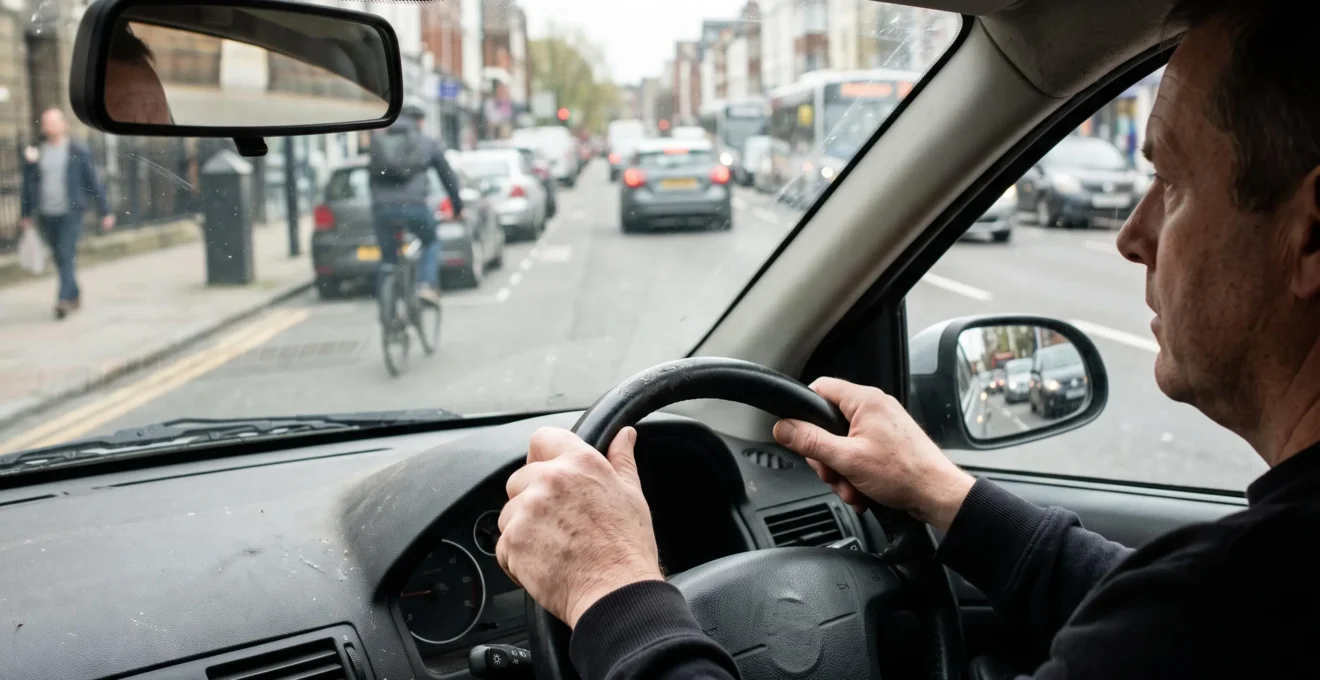
Better road awareness helps drivers recognise potential danger while there is still enough time and space to respond calmly. Rather than waiting for a pedestrian to step into the road, a vehicle to pull out or traffic to stop suddenly, attentive drivers identify the circumstances that could produce these events and adjust their driving beforehand.
This ability depends on more than eyesight. Effective hazard awareness combines active observation, anticipation, sound judgement and suitable vehicle condition. A driver must notice relevant information, understand how a situation could develop and choose a response that preserves a safe margin.
Everyday journeys present particular challenges. Familiar routes can encourage automatic behaviour, congestion competes for attention, and junctions create uncertainty about what other road users have noticed. Weather, fatigue and mechanical defects can further reduce the time available to respond.
The practical objective is not to predict every incident. It is to recognise changing risks early enough that ordinary adjustments in speed, position and following distance can prevent an avoidable emergency.
Essential road-awareness habits
- Scan the road ahead, nearby traffic and vulnerable road users repeatedly rather than concentrating on the vehicle directly in front.
- Increase observation and reduce speed when visibility, road conditions or traffic complexity deteriorate.
- Check vehicle roadworthiness before departure because awareness is only useful when the vehicle can respond safely.
- Why Do Familiar Routes Sometimes Make Drivers Less Alert?
- How Can You Scan Busy Roads Without Missing Cyclists or Pedestrians?
- Which Road Warning Signs Should Drivers Prioritise in Heavy Traffic?
- How Does Assuming You Have Been Seen Increase Junction Collision Risk?
- When Should Drivers Increase Their Observation Level During a Journey?
- When Should You Avoid an Off-Road Route Because Conditions Are Too Risky?
- Which Safety Defects Should Never Be Ignored Before a Journey?
- Which Vehicle Safety Standards Matter Most Before You Drive on UK Roads?
Why Do Familiar Routes Sometimes Make Drivers Less Alert?
Familiar routes can reduce alertness because repeated driving encourages the brain to rely on expectations rather than continually evaluating the road. A driver who knows every bend and junction may begin anticipating yesterday’s conditions instead of detecting today’s changes. Maintaining awareness means deliberately checking whether the actual environment still matches those expectations.
Repeated experience makes many driving tasks feel easier. This familiarity can reduce mental effort, but it can also encourage habituation: ordinary features receive less conscious attention because they have become predictable.
Consider a hypothetical commuter travelling along the same residential street each morning. The driver expects an unobstructed junction and continues at the usual speed. Today, however, a delivery vehicle conceals part of the pavement, reducing the distance at which a pedestrian might become visible.
The road has not become unfamiliar, but its risk profile has changed. Route familiarity is not evidence that current conditions are safe.
Habitual driving can also lead to fixed assumptions about following distance, speed and mirror-checking frequency. These habits become problematic when traffic density, visibility or road layout differs from the driver’s remembered experience.
A useful self-diagnostic exercise is the name three changes check. After completing a familiar journey, ask whether you can identify three meaningful differences from previous trips. They might include temporary roadworks, an unusually busy crossing or a newly obstructed sightline.
Failing to identify three changes does not prove that attention was inadequate; some journeys genuinely contain few noticeable differences. The exercise simply encourages active comparison between expectation and observation.
Experienced drivers can still encounter predictable-location incidents because experience does not eliminate the need to reassess familiar situations. A comfortable commute should therefore remain an actively observed journey, not one completed largely from memory.
Once attention moves away from remembered conditions and towards current evidence, the next challenge is deciding where to look in a crowded road environment.
How Can You Scan Busy Roads Without Missing Cyclists or Pedestrians?
Drivers can scan busy roads more effectively by repeatedly checking distant traffic, developing hazards ahead and potential conflicts close to the vehicle. Cyclists and pedestrians require deliberate attention because they may be obscured by larger vehicles or appear from the edges of the scene. Safe scanning also includes appropriate mirror and blind-spot checks before changing direction.
A practical scanning method is to divide the road environment into three overlapping zones:
- Far distance: Look for congestion, changing traffic signals, roadworks and vehicles slowing ahead.
- Middle distance: Observe lane changes, turning intentions, traffic gaps and vehicles that may enter your path.
- Near zone: Check pedestrian crossings, parked-car doors, cyclists alongside the vehicle and people approaching the carriageway.
Move attention between these zones frequently, adapting the pattern to road conditions. This is a practical observation framework rather than a scientifically established fixed scanning interval. The objective is to avoid staring continuously at one prominent vehicle.
Busy traffic can create visual competition. A large bus ahead may dominate attention while a cyclist approaches through a narrower gap beside stationary vehicles. The more useful question is often not which object is most visible, but which road user could enter your intended path.
Search deliberately around parked vehicles, gaps in traffic and crossing approaches. Allow for people who may be temporarily hidden and reappear with little warning.
Before moving off or changing position, check the appropriate mirrors and the areas those mirrors cannot show. A shoulder check may be necessary when it can be performed safely and without neglecting the road ahead.
The UK Highway Code explains these principles in the Highway Code rules on using the road. Rules 159–161 address observation, mirrors and blind spots, while junction guidance highlights cyclists, motorcyclists and pedestrians.
The familiar Mirrors–Signal–Manoeuvre principle is useful, but checking mirrors alone does not guarantee that a planned movement is safe. Observation must match the manoeuvre and the possibility of a road user occupying an unseen position.
Good scanning identifies developing conflicts; understanding warning signs then helps drivers interpret changes in the road environment before reaching them.
Which Road Warning Signs Should Drivers Prioritise in Heavy Traffic?
In heavy traffic, drivers should prioritise signs and signals that immediately affect safe or lawful movement, including temporary traffic controls, lane closures, speed restrictions and pedestrian crossings. Warnings about hazards further ahead also matter because early recognition creates time to slow down, select the correct lane and avoid sudden manoeuvres.
Congestion produces competing visual information: traffic lights, regulatory signs, advertising, road markings and vehicles all demand attention. The safest response is not to read everything with equal urgency, but to identify information relevant to the next driving decision.
A practical prioritisation framework distinguishes immediate instructions from developing warnings.
| Information type | Examples | Driver response |
|---|---|---|
| Immediate controls | Traffic signals, temporary speed limits, lane-control instructions | Recognise and comply promptly and safely. |
| Approaching hazards | Roadworks, merging traffic, crossing warnings | Anticipate changes and adjust speed, position or following distance early. |
| Route information | Directional and destination signs | Plan ahead without sacrificing attention to immediate hazards. |
| Non-essential information | Commercial advertising | Avoid diverting attention from the driving task. |
Temporary roadworks deserve particular attention on familiar roads. They can introduce unfamiliar lane markings, narrower lanes, reduced speed limits and stopped traffic where drivers would normally expect an unobstructed route.
The UK Department for Transport addresses these risks in the Highway Code rules for roadworks. Rule 288 advises drivers to follow additional signs, maintain appropriate distances and enter the correct lane in good time.
Early recognition makes a practical difference. Noticing a lane closure while adequate space remains allows an orderly adjustment. Discovering it at the last moment may instead create pressure to brake or change position abruptly.
Sign shape and colour can help drivers recognise categories quickly, but these conventions differ internationally. A driver travelling outside the UK must follow the applicable local signs and regulations.
Signs help explain the road layout, but they cannot establish whether another driver has understood the situation or noticed nearby road users.
How Does Assuming You Have Been Seen Increase Junction Collision Risk?
Assuming another driver has seen you increases junction risk because visibility does not guarantee recognition. A driver may look towards an approaching cyclist, motorcyclist or vehicle without consciously registering its presence or judging its speed correctly. Defensive driving means allowing for that uncertainty and avoiding movements that depend entirely on another person’s awareness.
Junctions require several assessments simultaneously. Drivers must monitor approaching traffic, road markings, pedestrians, signals and possible turning movements. An observer may look in the correct direction but fail to identify a particular road user.
This is sometimes described as a looked-but-failed-to-see error. The person may be physically within view while still not becoming part of the driver’s conscious assessment.
For example, imagine a vehicle waiting at a side road as a motorcycle approaches along the main carriageway. The waiting driver may focus on gaps between cars and overlook the motorcycle. If the motorcycle rider assumes that eye contact or an unobstructed view guarantees recognition, an unsafe conflict may develop.
Eye contact is not proof that another road user will yield. It may offer a clue about attention, but it cannot replace observation of actual vehicle movement.
Several defensive behaviours preserve an additional margin:
- Watch the position and movement of vehicles waiting to emerge, including their front wheels where visible.
- Approach uncertain junctions at a speed that allows a safe response.
- Keep enough space to respond if another vehicle moves unexpectedly.
- Remain visible where possible without making unsafe positioning changes.
- Prepare for braking when a developing conflict makes that appropriate, while maintaining control of the vehicle.
Drivers must also recognise the opposite mistake: assuming that legal priority guarantees another person will respect it. Having priority does not remove the need to check whether the road is actually clear.
Collisions involving larger vehicles and unprotected road users can have particularly serious consequences. Insurance and liability assessments depend on the circumstances, evidence and applicable law; no general conclusion about fault follows merely from one driver’s belief that they were visible.
The same cautious judgement is valuable beyond junctions, especially when changing conditions increase the number of hazards that demand attention.
When Should Drivers Increase Their Observation Level During a Journey?
Drivers should increase observation whenever road conditions become less predictable, visibility worsens or the consequences of missing a hazard become greater. Typical triggers include built-up areas, school traffic, adverse weather, unfamiliar roads, fatigue and complex junctions. Higher observation should be accompanied by appropriate speed and following-distance adjustments rather than relying on attention alone.
A useful approach is to recognise specific conditions that require a deliberate change in driving behaviour.
| Trigger | Developing risk | Practical adjustment |
|---|---|---|
| Entering a built-up area | More crossings, parked vehicles and turning movements | Search pavement edges and potential entry points more frequently. |
| School arrival or departure periods | Children and unpredictable pedestrian movements | Reduce speed where appropriate and watch gaps between vehicles. |
| Rain, fog or spray | Reduced visibility and potentially longer stopping distances | Slow down, increase separation and use appropriate lighting. |
| Unfamiliar roads | Unexpected junctions or road layouts | Read signs early and avoid rushed decisions. |
| Fatigue or reduced concentration | Delayed recognition and impaired judgement | Stop safely and rest rather than trying to force concentration. |
| Immediately after a demanding manoeuvre | Premature relaxation while hazards remain | Re-establish a full observation pattern before settling back into routine. |
The central principle is that observation and speed must reflect the conditions actually encountered. Looking harder cannot reliably compensate for driving too quickly when available visibility is restricted.
A driver’s total stopping process includes recognising a hazard, deciding how to respond and physically slowing the vehicle. Poor visibility can delay the first stage, while reduced grip increases the distance needed for braking.
The UK Highway Code states that wet-weather stopping distances are at least twice those needed on dry roads. Its advice on adverse weather also recommends increasing following distance and considering whether journeys are necessary during snow or ice.
At least twice the stopping distance
The Highway Code’s wet-weather comparison illustrates why drivers need more space and lower speeds when grip deteriorates. Actual stopping distances depend on vehicle, tyres, speed and road conditions.
UK Highway Code, Rule 227.
In fog, the distant observation zone may become severely restricted. The response is not simply to scan more intensely; it is to travel at a speed that permits stopping within the distance that can be seen to be clear, while maintaining appropriate separation.
Fatigue requires a different response. More frequent mirror checks cannot reverse significant tiredness. If concentration is deteriorating, find a safe place to stop and rest.
Some situations reduce safety margins so substantially that adjusting driving technique is not enough. In those circumstances, the safest choice may be to avoid the route altogether.
When Should You Avoid an Off-Road Route Because Conditions Are Too Risky?
An off-road route should be avoided when uncertain terrain, severe weather, poor vehicle suitability or limited access to assistance creates risks that cannot be managed confidently. Deep water, unstable slopes, isolated locations and inadequate daylight are particular warning signs. The decision to continue should be made before entering terrain where turning around or recovering a stranded vehicle could become difficult.
Off-road driving differs from ordinary tarmac driving because surface conditions may change rapidly and traction is less predictable. Mud, loose stones, standing water and uneven ground can affect both steering and the ability to stop or reverse safely.
Planning therefore begins with a go/no-go decision, not with selecting a driving technique.
Assess the following conditions before departure:
- Surface condition: Is the route affected by mud, standing water, loose material or damage from recent rainfall?
- Gradient and camber: Could steep or sideways slopes exceed the vehicle’s safe operating limits?
- Vehicle suitability: Are ground clearance, tyres, load and manufacturer limitations appropriate for the terrain?
- Daylight and weather: Is there sufficient time to complete the journey and respond to deteriorating conditions?
- Communication and recovery: Does someone know the route, and could assistance reach the vehicle if necessary?
For a simple conservative screening exercise, reconsider the journey whenever two or more factors are unfavourable. This is a planning heuristic, not a scientifically validated threshold. A single severe factor, such as dangerous flooding or an unstable slope, may already justify cancelling the route.
Consider a hypothetical driver approaching an isolated track after heavy rain. Even if the first section looks passable, the driver may have no reliable information about deeper ruts or standing water beyond the next bend. Continuing simply because the route initially appears manageable could remove the option of turning back safely.
Getting stranded can introduce additional problems, including exposure, delayed assistance and recovery expenses. Insurance coverage for off-road use and recovery varies by policy, circumstances and location. Drivers should review their actual policy wording rather than assume that every situation is covered.
Uncertainty itself is useful information. Where the surface cannot be assessed safely, declining the route is often the most sensible decision.
Whether the journey follows a surfaced road or an unpaved track, the vehicle’s mechanical condition determines how effectively the driver can respond to hazards.
Which Safety Defects Should Never Be Ignored Before a Journey?
Drivers should never ignore defects affecting braking, tyres, steering, essential lighting or visibility. These faults can reduce the ability to detect hazards, remain visible to others or respond effectively when danger appears. Warning lights and unusual vehicle behaviour also require appropriate investigation, especially when they suggest a safety-critical system is malfunctioning.
A vehicle’s safety systems form part of its hazard-response capability. Observation helps the driver recognise danger, but tyres, brakes, steering and visibility equipment determine whether the intended response can be carried out safely.
Worn or damaged tyres can reduce grip, particularly on wet roads. Defective brakes may compromise stopping performance, while failed lights can make the vehicle harder for other road users to notice. Wipers that cannot clear rain or dirt may seriously restrict the view through the windscreen.
These problems can combine with an ordinary traffic hazard. Imagine, hypothetically, a pedestrian appearing from behind a parked vehicle during heavy rain. Late recognition already reduces the driver’s available response time; inadequate tyre grip could further reduce the remaining safety margin.
In the UK, drivers remain responsible for keeping their vehicles roadworthy. The government’s published guidance on vehicle safety explains that a current MOT certificate does not guarantee that the vehicle remains safe between inspections.
For cars and applicable light vehicles, the UK legal minimum tyre tread depth is 1.6 mm across the central three-quarters of the tread and around the entire circumference. Tyres must also be free from dangerous defects. Different vehicle categories and countries may have different requirements.
A dashboard warning should not automatically be treated as proof that a vehicle is unsafe, but it should not be dismissed either. Its meaning and urgency depend on the warning, the vehicle and the manufacturer’s instructions. A safety-critical fault must be resolved before driving further.
Five practical checks before setting off
- Inspect the visible tyre surfaces for damage, unusual deflation or obvious wear. Check result: identify any tyre requiring closer inspection or professional assessment.
- Check essential exterior lights and indicators. Check result: confirm that required lights illuminate and operate correctly.
- Inspect the windscreen, mirrors and wipers. Check result: establish a clear view and identify any cleaning or repair needed.
- Review dashboard warnings and any known braking or steering faults. Check result: identify unresolved safety alerts before departure and consult the manual or a qualified professional as appropriate.
- Adjust mirrors and confirm the driving position provides proper control and visibility. Check result: establish a suitable observation position before moving off.
These checks are not a substitute for scheduled servicing, manufacturer-required maintenance or professional mechanical inspection. If a serious defect is suspected, do not continue driving merely because the vehicle can still move.
Insurance consequences are not automatic or identical across policies. Following an incident, vehicle condition may become relevant to an insurer’s assessment, but the outcome depends on applicable law, policy terms and the circumstances.
These practical checks support roadworthiness, but understanding the legal baseline helps drivers distinguish minimum compliance from additional safety protection.
Key takeaways before checking vehicle standards
- A valid inspection certificate does not replace ongoing checks of the vehicle’s actual condition.
- Minimum legal compliance and advanced safety equipment serve different purposes.
- Effective hazard awareness depends on three connected capabilities: detecting danger, making a suitable decision and having a vehicle capable of responding.
Which Vehicle Safety Standards Matter Most Before You Drive on UK Roads?
The most important vehicle safety standards for UK drivers concern ongoing roadworthiness, including tyres, brakes, steering, lights and clear visibility, together with applicable MOT requirements. A valid MOT is important where required, but it does not guarantee safety throughout the following year. Modern driver-assistance technology may provide additional protection without replacing the driver’s responsibilities.
The UK MOT system checks specified vehicle components against prescribed inspection standards. Most cars require an annual MOT once they reach the applicable testing age, although the timing and requirements vary by vehicle category and jurisdiction. Eligible exemptions also exist.
For an individual driver, the key distinction is between passing a scheduled test and maintaining a roadworthy vehicle every day.
For example, a tyre may meet the required standard at the time of an MOT but subsequently become damaged or worn. The earlier test does not establish that the vehicle is still safe several months later.
The UK government explains these ongoing responsibilities in the UK government’s vehicle safety checks. The guidance covers tyre condition, lights, brakes, windows and mirrors, alongside the responsibility to ensure that a vehicle remains safe to drive.
Safety standards also extend beyond the minimum legal threshold. Some vehicles include advanced driver-assistance systems designed to help detect or respond to particular hazards.
| Safety area | Basic requirement or responsibility | Additional protection |
|---|---|---|
| Tyres and braking | Maintain tyres and brakes in a safe, legally compliant condition. | Vehicle-specific braking and stability assistance may support control within system limits. |
| Visibility and lighting | Keep required lights working and maintain clear windows and mirrors. | Additional visibility or detection features may help in certain conditions. |
| Collision avoidance | Observe hazards, maintain control and leave sufficient stopping distance. | Autonomous emergency braking may help mitigate certain developing collisions. |
| Lane positioning | Drive safely within the appropriate lane and respond to road markings. | Lane-warning or assistance systems may provide supplementary alerts or steering support. |
Driver-assistance features differ substantially by manufacturer, model and system design. Their presence does not guarantee that a pedestrian, cyclist or vehicle will be detected, and they may have limitations involving weather, markings, speed or sensor obstruction.
Safety technology should therefore be understood as a supporting layer rather than permission to reduce attention or following distance.
Requirements may also change over time. Drivers should verify the current MOT, construction, use and equipment rules applicable to their particular vehicle and location, including relevant differences between UK jurisdictions.
Vehicle condition can be relevant to insurance assessments, but whether a defect affects a claim depends on the facts, contractual terms and applicable law. A general assertion that any defect automatically invalidates insurance would be misleading.
Before the next journey, confirm that the vehicle is roadworthy, identify conditions likely to demand greater attention and adopt a deliberate scanning pattern from the moment you move off. These small, repeatable decisions create the opportunity to respond before a developing hazard becomes an emergency.
What is the difference between hazard awareness and hazard perception?
Hazard awareness is the broader habit of noticing changing conditions and understanding what could become dangerous. Hazard perception focuses more specifically on recognising potential hazards and identifying when they are developing into situations that may require action. Effective driving combines both with appropriate judgement, speed and positioning.
How can drivers improve observation without becoming distracted by constant checking?
Use a flexible scanning pattern that alternates between the road ahead, surrounding traffic and relevant mirrors. Give more attention to areas where another road user might enter your path. Checks should be brief and suited to the situation, never so prolonged that they compromise attention to the road ahead.
Does driving more slowly always provide enough time to avoid a hazard?
No. An appropriate lower speed can increase the time and distance available to respond, but safe driving also depends on visibility, road grip, following distance, observation and the behaviour of other road users. Severe conditions may make postponing or avoiding a journey necessary.
Can an advanced driver-assistance system replace active hazard observation?
No. Systems such as autonomous emergency braking and lane assistance are designed to support particular driving tasks within defined operating conditions. They may fail to recognise certain hazards or respond as expected in difficult conditions. Drivers must remain attentive and follow the vehicle manufacturer’s instructions.
Should a driver continue a journey if an important safety warning light appears?
The correct response depends on the warning and the vehicle. Some alerts require the driver to stop safely as soon as possible and avoid further driving, while others call for prompt inspection. Consult the manufacturer’s guidance, and do not continue if a safety-critical fault or unsafe vehicle condition is suspected.