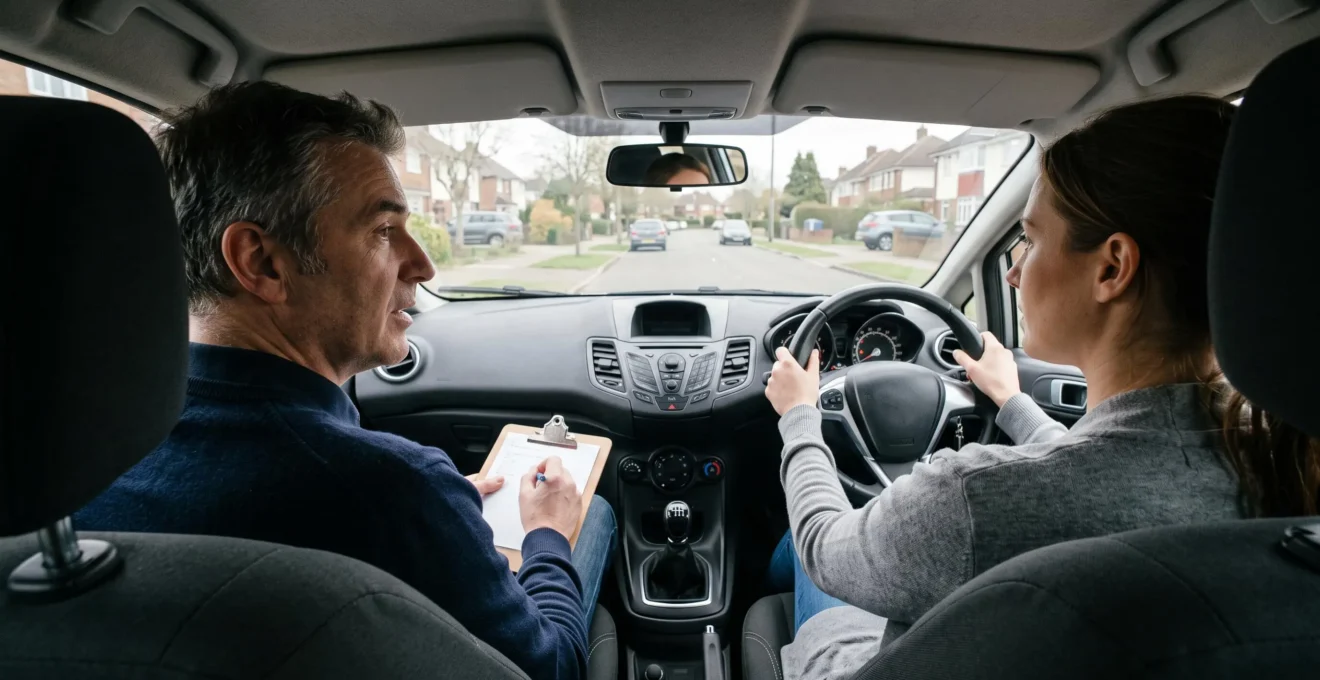
Passing your driving test establishes that you met the required standard at a particular point in time. It does not mean your skills will remain equally reliable through years of commuting, unfamiliar roads, changing vehicles or periods without driving.
Extra driver training is worth considering when a specific weakness affects your safety, confidence or ability to manage ordinary journeys. That might mean struggling with motorway merging, avoiding night driving, following other vehicles too closely or feeling uncertain after a collision. It can also make sense when you already drive regularly but want to improve hazard anticipation and decision-making.
The important distinction is between driving more and learning more. Experience provides opportunities to practise, but structured instruction adds observation, corrective feedback and measurable objectives. A targeted lesson may therefore offer more practical value than repeatedly completing journeys while relying on the same unexamined habits.
The right choice depends on what has changed, what you can currently do and which skills need attention.
When additional driver training makes sense
- Choose refresher lessons when specific driving routines feel rusty, uncomfortable or unreliable.
- Consider advanced training when basic driving is secure but you want stronger observation, anticipation and defensive techniques.
- Prioritise professional feedback after significant changes in driving conditions, vehicle type, confidence or personal circumstances.
- Why Can Driving Skills Become Less Reliable Years After Passing the Test?
- How Can You Choose Driver Training for a Specific Confidence Problem?
- Refresher or Advanced Driving Course: Which Fits Your Needs?
- Which Driving Habits Are Worth Correcting Before They Cause Problems?
- When Should You Consider Driver Training After a Major Change?
- When Is Leaving 15 Minutes Earlier Worth Changing Your Routine?
- How Can You Use Automated Driving Features Without Overestimating Their Limits?
- How Can Defensive Driving Reduce the Risk of Everyday Collisions?
Why Can Driving Skills Become Less Reliable Years After Passing the Test?
Driving skills can become less reliable because everyday repetition gradually replaces deliberate technique with automatic routines. Once regular instructor feedback disappears, drivers may adopt shortcuts without noticing. Their confidence can remain high even when observation, positioning or judgement has weakened. Conversely, someone who drives infrequently may retain adequate technical skills while losing confidence in using them.
A driving test measures performance under defined conditions and observation. Everyday driving happens without an examiner checking whether you consistently scan junctions, leave adequate space or make safe decisions under pressure.
This creates a problem of unnoticed habit drift. A driver might gradually reduce mirror checks because nothing adverse happens on familiar journeys. Another might start following too closely because doing so appears to shorten travel time.
The absence of an immediate incident does not establish that either behaviour is safe. Infrequent negative consequences provide poor feedback about the quality of repeated decisions.
Look for observable changes rather than judging your competence entirely by confidence:
- Passengers regularly comment on abrupt braking, late decisions or uncomfortable following distances.
- Unfamiliar junctions, roundabouts or motorway entrances create unusual uncertainty.
- You depend on a narrow set of familiar routes and increasingly avoid alternatives.
- Night driving, heavy traffic or poor weather causes disproportionate hesitation.
- You notice more last-minute corrections, missed observations or unexpected conflicts.
These signals do not establish a diagnosis of poor driving. They provide reasons to examine your current abilities through a supervised assessment.
It is equally important to distinguish skill deterioration from confidence deterioration. An anxious driver may perform safely with guidance, while a relaxed, experienced driver may have developed unsafe habits. The first may need gradual exposure and reassurance grounded in demonstrated ability; the second may need detailed correction of technique.
Recognising the difference between feeling capable and demonstrating reliable performance makes it easier to choose training that addresses the actual problem.
How Can You Choose Driver Training for a Specific Confidence Problem?
Choose driver training by identifying the precise situation that causes difficulty, then finding an instructor experienced in that type of driving. Motorway anxiety, parking uncertainty and confidence after a collision require different exercises. A useful first lesson should assess your current performance, establish a manageable objective and give you specific feedback rather than simply adding driving mileage.
Start by turning a broad concern such as “I am nervous behind the wheel” into an observable situation. The more precisely you can describe when your confidence changes, the easier it becomes to select appropriate instruction.
The following examples illustrate how different problems can be matched with targeted training.
| Confidence problem | Training approach | Practical first objective |
|---|---|---|
| Motorway merging | Supervised motorway lessons with an instructor experienced in post-test training | Complete a familiar motorway entry and exit while making planned observations and speed adjustments |
| Night driving anxiety | Progressive evening lessons covering visibility, speed and hazard recognition | Complete a familiar, manageable route after dark with professional guidance |
| Parking in busy areas | Low-speed vehicle-control and parking tuition | Park safely in a selected public parking area without rushed corrections |
| Driving after an incident | Patient, confidence-focused tuition informed by the driver’s concerns | Revisit one manageable driving situation without unsafe avoidance or overcorrection |
| Returning after a long break | General refresher assessment followed by targeted lessons | Complete a routine journey while independently applying core observation and control skills |
When contacting a training provider, ask whether the instructor regularly works with fully licensed drivers, offers an initial on-road assessment and has relevant experience with anxious or returning drivers.
A productive first session should combine discussion with direct observation of your driving, provided you are fit and legally entitled to drive. It should end with a clear explanation of strengths, priorities and possible next steps.
Repeated solo exposure can sometimes help a driver become familiar with a situation, but it does not automatically correct poor technique. Someone who repeatedly merges too slowly may reinforce the same response each time. Professional feedback can identify the problem and guide safer practice.
For an initial training block, choose one measurable goal: for example, completing a specific motorway route with the instructor while demonstrating timely observation, appropriate speed adjustment and predictable lane changes.
Success means performing those actions reliably, not merely reaching the destination.
Once the initial difficulty has been defined, the next question is whether a short refresher programme is sufficient or whether more comprehensive advanced training is appropriate.
Refresher or Advanced Driving Course: Which Fits Your Needs?
A refresher driving course is usually the better choice when you need to restore confidence, revisit basic procedures or correct an identifiable weakness. Advanced training suits drivers who already handle everyday journeys competently but want to improve observation, hazard anticipation and road planning. Neither option is automatically superior: the useful course is the one matched to your current capability and intended outcome.
The distinction matters because course names can sound interchangeable even when their objectives differ.
| Decision factor | Refresher training | Advanced training |
|---|---|---|
| Typical starting point | Rusty routines, reduced confidence or a specific weakness | Regular, competent driving with room to improve anticipation |
| Main objective | Restore reliable everyday driving skills | Develop more systematic observation, planning and judgement |
| Common format | Individual sessions or a tailored series | Structured coaching, potentially leading to an assessment or qualification |
| Training emphasis | Targeted correction and gradual confidence-building | Consistent application of higher-level driving techniques |
| Best indicator of progress | Independent, safe performance in previously difficult situations | Demonstrably improved hazard management and planning across varied roads |
In the United Kingdom, Pass Plus provides one example of structured post-test development. According to the UK government guidance on Pass Plus training, the programme covers town driving, all-weather driving, rural roads, night driving, dual carriageways and motorways.
At least 6 hours
The minimum duration of the UK Pass Plus programme, which covers six modules and assesses performance throughout rather than through a separate final test. This is a programme requirement, not evidence that six hours will resolve every driver’s needs.
Driver and Vehicle Standards Agency, GOV.UK
Pass Plus requires 6 hours as a UK-specific example, not a universal qualification available on identical terms throughout English-speaking countries. Drivers elsewhere should check local training frameworks and recognised providers.
Cost also deserves careful evaluation. Individual sessions may suit a narrow problem, while a multi-session course offers opportunities to receive feedback, practise and return for reassessment. Spacing sessions can be a sensible learning strategy, but the supplied evidence does not establish that it always produces better long-term results than intensive tuition.
Insurance savings should not be assumed. Some insurers may recognise advanced qualifications, but eligibility and any premium adjustment depend on the insurer, course and driver profile. IAM RoadSmart notes that completing its advanced driving test does not guarantee a particular saving.
Before enrolling, compare the total course fee, travel commitments, assessment requirements and what you should be able to do afterwards. If insurance savings matter, obtain a quotation from your own provider rather than treating a possible discount as guaranteed reimbursement.
Whether you choose a short course or a broader qualification, the greatest immediate value often comes from correcting a small number of consequential everyday habits.
Which Driving Habits Are Worth Correcting Before They Cause Problems?
Prioritise driving habits that reduce your ability to detect hazards, respond in time or preserve a safe escape route. Following too closely, incomplete mirror and blind-spot checks, inappropriate speed and late observation at junctions deserve attention before minor stylistic imperfections. Professional assessment helps distinguish behaviours that merely look untidy from those that create meaningful safety concerns.
Habit correction is particularly difficult because frequently repeated actions become automatic. Once a driver has adopted an inefficient observation routine, they may repeat it without conscious awareness, especially under pressure.
A general instruction to “be more careful” rarely identifies the precise moment at which behaviour needs to change.
Start with the following priorities:
- Following distance: allow enough time and space to respond when traffic ahead slows unexpectedly.
- Observation before manoeuvres: check the relevant mirrors and blind spots before changing position, while keeping attention on the road ahead.
- Speed adaptation: adjust for visibility, bends, junctions, pedestrians, surface conditions and available stopping distance.
- Early hazard recognition: identify developing risks before they require sudden braking or evasive steering.
- Predictable decisions: signal appropriately, avoid unnecessary hesitation and do not force other road users to compensate for poor planning.
The Highway Code’s general driving rules provide concrete UK guidance on stopping distance, speed and attention. Rule 126 recommends a following gap of at least 2 seconds on high-speed roads and in tunnels where visibility is reduced, with substantially larger margins in wet or icy conditions.
This is a contextual UK recommendation, not a universal guarantee of safety or a rule automatically applicable in every jurisdiction. The essential principle is to preserve sufficient space for the actual speed, visibility and road conditions.
To establish what needs correction, gather observations rather than relying entirely on memory. A trusted passenger can describe repeated abrupt braking. Existing dashcam footage, reviewed while parked, may show patterns of late reactions or poor spacing. A qualified instructor can observe decisions directly and determine which behaviours matter most.
Avoid concentrating disproportionately on cosmetic faults, such as an unconventional but controlled steering-hand position, while overlooking more consequential errors at pedestrian crossings or junctions.
Five actions to build a personal driving improvement plan
- Record three recent situations where driving felt difficult or rushed. Produce a short list stating the road conditions and what happened.
- Ask a trusted passenger or instructor for feedback on observable behaviour. Write down two specific observations rather than general impressions.
- Rank the identified habits by potential safety consequence. Produce a priority list with the most consequential issue first.
- Agree on one corrective exercise with a qualified instructor. Record the behaviour to practise and the standard for successful performance.
- Arrange a follow-up assessment after suitable practice. Keep a brief record of whether the targeted behaviour is now performed consistently.
Once your core routines are dependable, they still need to transfer safely when vehicles, roads or personal circumstances change.
When Should You Consider Driver Training After a Major Change?
Consider additional driver training when a major change introduces demands that your previous experience did not fully prepare you for. Returning after a long break, towing a trailer, changing vehicle type or driving in an unfamiliar country can justify supervised practice. After a health change or serious collision, professional or medical advice may be needed before driving lessons begin.
The key issue is a mismatch between familiar confidence and unfamiliar demands. You may feel comfortable controlling a small car but have little experience judging the turning space, visibility or braking behaviour of a much larger vehicle.
Likewise, years of experience with one transmission do not automatically establish proficiency with another. The relevant legal entitlement and licensing conditions must also be checked.
Different changes call for different levels of support:
| Change | Useful response | Important precaution |
|---|---|---|
| New, larger or heavier vehicle | Vehicle familiarisation and supervised manoeuvring | Understand dimensions, visibility and handling before demanding journeys |
| Starting to tow | Practical towing instruction covering coupling, turning and reversing | Check vehicle limits, trailer requirements and licensing rules |
| Long break from driving | Assessment followed by gradual practice | Start in manageable conditions and avoid unnecessary pressure |
| Driving in another country | Study local rules and consider practical familiarisation | Check road signs, traffic direction, licensing and insurance requirements |
| Health change or medication effects | Appropriate medical assessment before deciding on instruction | Do not drive if fitness, alertness or legal eligibility is uncertain |
| Collision followed by driving anxiety | Supportive refresher lessons, potentially alongside other professional care | Address persistent distress rather than forcing exposure |
Some transitions benefit primarily from preparation and gradual exposure. Others, especially towing or managing an unfamiliar vehicle’s handling, may warrant direct supervision from the outset.
Driving after a collision deserves particular sensitivity. Some people begin avoiding certain roads, while others compensate by braking excessively early or hesitating unpredictably. These responses can create new difficulties even when the intention is to drive cautiously.
A patient instructor can help the driver identify which situations remain manageable and rebuild predictable responses through suitable practice. Where fear, intrusive memories or panic are persistent, appropriate psychological support may be more useful than driving instruction alone.
A health-related change requires a different approach. Training cannot establish medical fitness to drive, reverse medication effects or replace assessments required by licensing authorities.
After identifying whether additional skills are needed, consider how ordinary routines and time pressure affect your ability to apply those skills consistently.
When Is Leaving 15 Minutes Earlier Worth Changing Your Routine?
Leaving 15 minutes earlier is worth considering when predictable time pressure regularly leads you to rush observations, follow too closely or accept uncertain gaps. A departure buffer can reduce the temptation to recover lost time through risky decisions. It is most useful on unpredictable journeys, although the appropriate margin depends on traffic, responsibilities and personal circumstances.
Driving competence is not determined solely by technique. The conditions in which you apply that technique also matter.
When you are late, ordinary decisions can begin to feel urgent. A driver who normally waits for a comfortable gap might accept a smaller one. Another might delay braking, change lanes repeatedly or give insufficient attention to approaching junctions.
Leaving earlier does not directly improve mirror technique or reaction capability. Instead, it removes one potential source of pressure that may interfere with their consistent application.
Consider a hypothetical commuter who regularly reaches a congested junction just before a fixed appointment. The driver becomes impatient, rushes the final section of the journey and occasionally brakes sharply when traffic stops.
If adjusting departure time creates a manageable buffer, that driver may find it easier to maintain deliberate, predictable decisions. The benefit arises from reducing pressure, not from any special safety effect associated with exactly 15 minutes.
Assess the trade-off using three questions:
- Does lateness frequently influence how you drive, or do you already maintain safe decisions regardless of schedule?
- Would the earlier departure create meaningful flexibility on this particular route?
- Would the change compromise essential sleep, rest or other responsibilities?
The potential consequences of a collision can include repair costs, insurance excess, disruption and injury. Those consequences are not comparable to a simple promise of time saved, and no precise collision-risk reduction can be attributed to a fixed departure buffer using the supplied evidence.
Leaving earlier is particularly relevant for journeys affected by variable congestion, school-run traffic, limited parking or unfamiliar destinations. On an uncomplicated, low-traffic journey, a substantial additional margin may offer little practical benefit if time pressure is not a problem.
One caution is important: do not sacrifice needed sleep merely to depart earlier. Fatigue can undermine the very alertness that a calmer schedule is intended to support.
Reducing avoidable pressure supports good judgement, but drivers must also understand how modern vehicle technology changes the demands placed on that judgement.
How Can You Use Automated Driving Features Without Overestimating Their Limits?
Use driver assistance features safely by learning their operating limits, remaining engaged and maintaining the ability to control the vehicle when assistance is unavailable. Adaptive cruise control, lane support and parking aids can assist with particular tasks, but they do not automatically replace driver responsibility. Familiarisation and supervised practice may be valuable when technology creates uncertainty about monitoring or intervention.
Modern vehicles can reduce the workload associated with selected driving tasks. However, features with similar names may perform differently depending on the manufacturer, model, software and operating conditions.
The NHTSA‘s information on driver assistance technologies distinguishes systems that provide momentary warnings or interventions from those that assist continuously with steering, speed or both.
For example, Level 2 driver assistance can support steering and acceleration or braking together, while the driver must remain engaged and monitor the driving task. Such assistance is not equivalent to unrestricted self-driving capability.
Before using a feature, establish four things:
- Its precise function: determine whether it warns, intervenes briefly or provides ongoing assistance.
- Its operating conditions: consult the vehicle manual for relevant limitations involving weather, markings, road types or speed.
- Your continuing responsibility: understand which tasks remain yours throughout operation.
- The response to disengagement: learn how the feature indicates that assistance has changed or become unavailable.
The challenge is not simply learning to press the correct button. Drivers must continue monitoring the road and be prepared to respond when the system cannot perform as expected.
“You, as the driver, are responsible for driving the vehicle.”
There is also a potential competence-maintenance issue. If a driver relies heavily on a feature for a particular manoeuvre, they may have fewer opportunities to practise that task manually. However, the supplied sources do not establish that prolonged assistance-system use necessarily causes manual skill deterioration.
Where appropriate, maintaining manual familiarity through normal driving or supervised instruction can help preserve confidence. Do not deactivate mandatory safety equipment or disregard manufacturer instructions merely to create practice opportunities.
Likewise, practise understanding system transitions in safe, appropriate conditions rather than deliberately creating an emergency disengagement on public roads.
Technology can support responsible driving, but consistent hazard anticipation and independent judgement remain essential elements of defensive driving.
Key takeaways before choosing your next step
- Make training decisions from observable driving behaviour, not years of licence ownership or confidence alone.
- Choose learning exercises that build anticipation and decision-making rather than simply increasing mileage.
- Check progress in varied, manageable real-world conditions so improved techniques become dependable routines.
How Can Defensive Driving Reduce the Risk of Everyday Collisions?
Defensive driving can help reduce exposure to everyday collision risks by improving observation, anticipation, spacing and decision-making. Rather than simply driving slowly or cautiously, it involves recognising potential conflicts early and preserving room to respond safely. Structured training gives drivers practical opportunities to rehearse these techniques and receive feedback before poor decisions become emergencies.
The defensive approach is built around a central idea: do not rely exclusively on other road users behaving exactly as expected.
At a junction, another driver may misjudge a gap. A vehicle ahead may brake unexpectedly. Someone changing lanes may fail to notice your position. Pedestrians and cyclists may be difficult to see near parked vehicles or roadside obstacles.
A defensive driver looks for these possibilities early enough to respond without unnecessary sudden manoeuvres.
Four trainable routines are particularly relevant:
- Observation range: look beyond the vehicle immediately ahead and scan for developing hazards.
- Anticipation: consider plausible actions by other road users instead of assuming everyone will follow the expected path.
- Space management: preserve adequate following distance and avoid remaining unnecessarily trapped beside other vehicles.
- Predictable positioning: choose speed and road position that support visibility, safe manoeuvring and clear communication.
These techniques can help a driver prepare for junction conflicts, sudden braking and lane-change hazards. They do not guarantee collision avoidance, and the supplied sources do not quantify how much a particular defensive driving course reduces crash frequency.
Formal training can still be useful because it turns abstract intentions into observable actions. An instructor can ask you to identify developing hazards, explain why a particular following distance is appropriate and demonstrate how earlier decisions create more options.
Progress should be evaluated through behaviour, not confidence alone.
During a typical driving week, record occasions when you needed sudden corrective action, misunderstood another driver’s intentions or found yourself without comfortable stopping space. A high or recurring count may indicate that further assessment would be useful, although it is not a validated crash-risk score.
A professional review can then separate avoidable errors from situations caused by other road users or genuinely unpredictable events.
Defensive driving offers a useful continuation of post-test learning because its principles apply across many ordinary journeys. Its value lies in developing routines that can be maintained, reviewed and refined rather than treating course completion as permanent proof of competence.
Choose one driving situation that regularly challenges you, arrange an assessment with a qualified instructor and agree on a specific improvement goal. Additional training is worthwhile when it helps you drive more reliably in the conditions you actually face, and when those improvements remain evident after the lesson ends.
Can you book driving lessons even if you already have a full licence?
Yes. Refresher and advanced driving instruction are intended for people who already hold driving licences. Providers may offer individual assessments, targeted lessons or structured courses. Availability, instructor qualifications and any vehicle or insurance requirements depend on the country and provider. Explain your current experience and objectives before booking.
How many refresher driving lessons might you need?
There is no reliable universal number. Someone needing help with a specific manoeuvre may require a different amount of tuition from someone returning after years without driving. Begin with an assessment, agree on observable goals and review progress before committing to further sessions. A course’s minimum duration does not establish how much training an individual driver needs.
Does completing an advanced driving course guarantee cheaper insurance?
No. Some insurers may recognise particular advanced driving qualifications, but a discount is not guaranteed. IAM RoadSmart explicitly cautions that passing its Advanced Driver or Rider test does not guarantee a specific saving. Ask your own insurer whether a proposed qualification is recognised and obtain relevant quotations before assessing its financial value.
Should you take refresher training in your own car or an instructor’s vehicle?
Either arrangement may be useful, depending on the training objective and provider’s conditions. Practising in your own car can help with vehicle-specific controls, dimensions and visibility. An instructor’s training vehicle may offer additional instructional equipment and an appropriate supervised learning environment. Confirm insurance, permitted vehicle use and any local requirements before arranging lessons.
Can driver training help if driving anxiety continues after a collision?
Supportive lessons may help some drivers rebuild confidence through manageable, supervised driving situations. However, training is not a substitute for appropriate medical or psychological care when anxiety is severe, persistent or associated with trauma symptoms. Consider professional healthcare advice when needed, and avoid forcing yourself into driving conditions that you cannot currently manage safely.