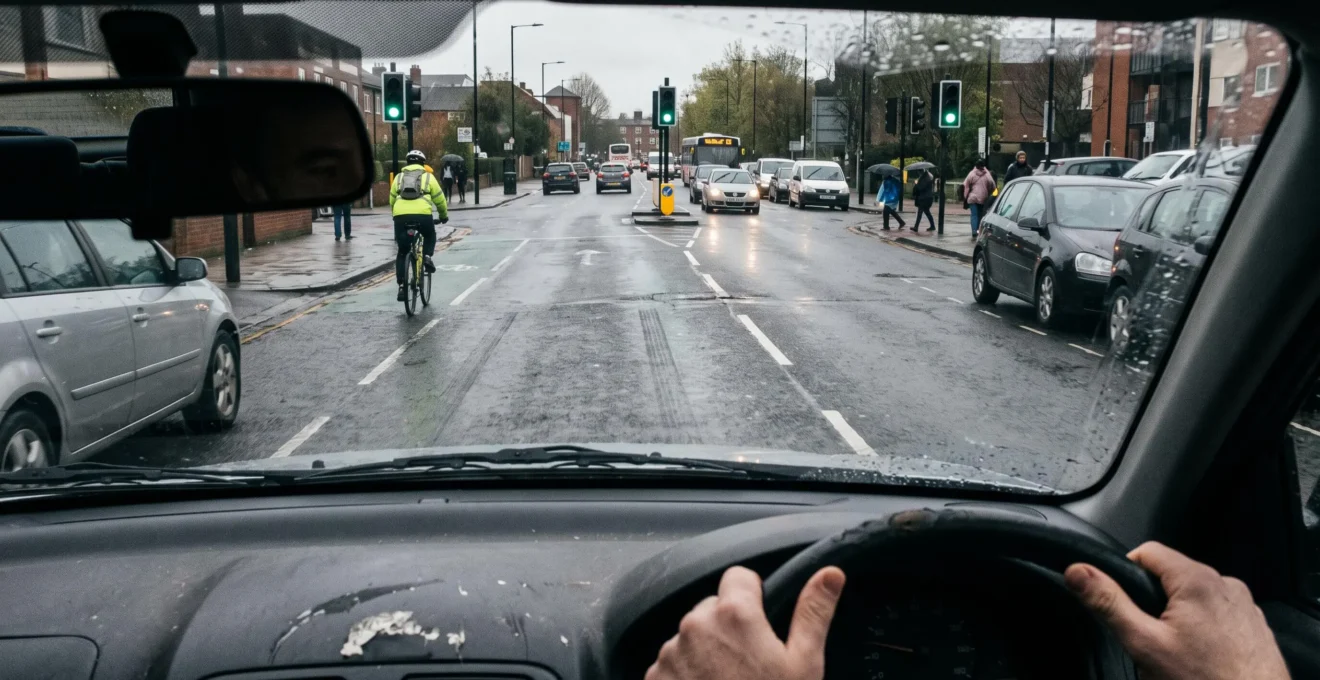
Everyday driving collision risk increases when drivers have less time to recognise a hazard, less space to respond or more conflicting traffic movements to monitor. Junctions, closely spaced traffic, merging lanes and restricted-visibility manoeuvres deserve particular attention because a small observation or timing error can rapidly develop into a collision.
Not every road situation carries the same type of danger. Rear-end collisions often involve insufficient following distance or delayed reactions. Side-impact collisions commonly arise when vehicle paths intersect. Parking and reversing incidents present different challenges, especially when pedestrians or smaller vehicles are difficult to see.
Understanding these differences makes prevention more precise. Rather than relying on general advice to drive carefully, motorists can identify the warning signs associated with each situation and adjust speed, spacing, observation and positioning before a hazard becomes urgent.
There is no reliable universal ranking of these scenarios across every English-speaking country. Collision patterns depend on road design, traffic conditions and local reporting methods. The practical priority is to recognise where the available safety margin is shrinking.
Everyday collision risks at a glance
- Junctions require observation in several directions because vehicles, cyclists and pedestrians may approach from conflicting paths.
- Tailgating reduces both reaction time and stopping space, particularly when roads are wet or visibility is restricted.
- Safer driving combines appropriate speed, adequate following distance, vehicle maintenance and deliberate checks before manoeuvres.
- Why Are Junctions Such Common Locations for Vehicle Collisions?
- How Can You Reduce Collision Risk at a Junction With Poor Visibility?
- Rear-End or Side-Impact Crash: Which Situations Make Each More Likely?
- How Does Tailgating Reduce Your Chance of Avoiding a Sudden Collision?
- When Should You Increase Following Distance Beyond Your Normal Gap?
- Why Can Comprehensive Car Insurance Sometimes Be Cheaper Than Expected?
- Which Safety Defects Should Never Be Ignored Before a Journey?
- Which Common Collisions Can Drivers Most Often Prevent?
Why Are Junctions Such Common Locations for Vehicle Collisions?
Junctions create collision risks because several road users may enter or cross the same space from different directions. Drivers must assess priority, approaching speed, turning intentions and possible obstructions simultaneously. When attention concentrates on one traffic stream, another approaching vehicle, cyclist or pedestrian may be overlooked until there is insufficient time to respond.
The central difficulty is the combination of conflicting trajectories and limited observation time. A driver turning across traffic must judge whether an approaching vehicle leaves a safe gap. Someone entering from a side road must also account for traffic that may be hidden behind parked vehicles, buildings or vegetation.
Junction design changes the likely scenario. The following distinctions help identify where additional caution is needed.
| Junction type | Potential conflict | Preventive response |
|---|---|---|
| Traffic-light junction | Turning vehicles conflicting with pedestrians or other permitted traffic movements | Confirm the path is clear before moving, even when a signal permits entry |
| Uncontrolled crossroads | Uncertainty about priority and approaching vehicles | Reduce speed and apply local priority rules without assuming another driver will yield |
| Roundabout | Conflicts while entering, circulating or exiting | Observe approaching traffic, signal appropriately and check for vulnerable road users |
| Slip road or merging entry | Vehicles converging at different speeds | Assess traffic gaps early and adjust speed without forcing another vehicle to brake |
One particularly important observation error occurs when drivers look towards traffic but fail to register every relevant road user. Motorcycles and bicycles may be less conspicuous than larger vehicles, especially when partially obscured by turning traffic.
The UK Highway Code rules for junctions and road manoeuvres specifically emphasise careful observation, attention to cyclists and motorcyclists, and checking again before completing turns. These principles are useful internationally, although legal priorities differ between countries.
After a junction collision, insurance assessments may require evidence about traffic signals, vehicle positions, priority and the sequence of events. Neither the location nor the point of impact alone establishes responsibility.
Where visibility is obstructed, the next challenge is deciding whether there is enough information to proceed safely.
How Can You Reduce Collision Risk at a Junction With Poor Visibility?
At a poorly visible junction, reduce speed early, obey the required stopping or give-way position, and scan for approaching traffic before committing. If a building, hedge or parked vehicle blocks the view, wait until you can assess a safe gap. Move forward cautiously only where permitted and without obstructing other road users.
A blocked sightline changes the decision from simply checking for traffic to determining how much of the approaching road can actually be seen. A vehicle may be travelling towards the junction while remaining concealed behind an obstruction.
Begin observation before reaching the junction. Check the relevant road markings and signs, look for pedestrians and cyclists, and identify any areas hidden by parked vehicles or roadside structures.
If the legal stopping position does not provide an adequate view, a further observation from a slightly advanced position may be necessary where road rules and conditions permit. The vehicle should remain controlled and must not intrude into an occupied traffic path. The bonnet and window edges can help a driver recognise visual obstructions, but they are not reliable universal markers for safe positioning.
Whether to enter depends on visibility, traffic speed and the space available to complete the manoeuvre. A slow-moving vehicle on the main road may offer a different opportunity from fast traffic emerging from behind a blind bend. Uncertainty about the approaching gap is a reason to wait, not to assume the road is clear.
Large vehicles, fog, rain and low sunlight can create further blind areas. Reduce approach speed, maintain clear windows and avoid depending on another driver’s signal as proof of their intended movement.
The UK Highway Code also advises approaching partially hidden junctions at a speed that allows stopping within the visible clear distance. This is particularly relevant when a driver cannot see far enough to judge approaching traffic.
Moving excessively slowly into an active traffic lane is not automatically safer. It can create a new conflict if approaching drivers must brake or swerve. The objective is a controlled, predictable movement into a genuinely safe opening.
Once drivers recognise how crossing trajectories create danger, it becomes easier to distinguish side-impact collisions from the following-distance problems behind rear-end crashes.
Rear-End or Side-Impact Crash: Which Situations Make Each More Likely?
Rear-end collisions become more likely when vehicles follow too closely, traffic slows unexpectedly or a driver detects braking late. Side-impact collisions are associated with intersecting or converging paths, such as junction turns, lane changes and merging manoeuvres. Each requires a different preventive response because the underlying conflict develops in a different direction.
A rear-end collision typically involves a vehicle approaching another from behind with insufficient time or distance to avoid contact. Sudden congestion, distracted driving and inconsistent traffic speeds can intensify this situation.
For example, a driver concentrating on the rear of the vehicle immediately ahead may miss signs that several vehicles farther forward are stopping. The first visible warning may then be the leading vehicle’s brake lights.
A side-impact collision follows a different pattern. One vehicle enters or moves across another’s path, sometimes because a driver misjudges a gap, overlooks a blind spot or misunderstands who has priority.
| Risk factor | Rear-end collision | Side-impact collision |
|---|---|---|
| Typical setting | Queues, motorways and slowing traffic | Junctions, merges and lane changes |
| Main conflict | Insufficient separation between vehicles travelling in the same direction | Overlapping paths or crossing movements |
| Important checks | Following gap, traffic ahead and braking behaviour | Priority, mirrors, blind spots and crossing traffic |
| Primary prevention | Maintain stopping space and respond early to slowing traffic | Confirm a safe path before turning, merging or changing lanes |
Collision consequences also differ. A side impact may expose occupants near the struck door to direct intrusion forces. Rear-end impacts can produce substantial acceleration of the occupants, with outcomes depending on the vehicles, impact speed, restraint systems and seating positions. Neither collision type has a universally predictable injury outcome.
Responsibility requires similar care. Although a following driver may be found responsible for inadequate spacing, rear-end liability is not automatically identical in every jurisdiction or circumstance. Side-impact cases often require analysis of traffic control, lane position and the actions of both drivers.
Photographs, witness details, vehicle damage and an accurate account of the manoeuvres can assist insurance investigations. Fault and coverage are ultimately assessed under applicable laws and policy conditions.
For traffic travelling in the same direction, one of the most controllable factors is the distance left behind the preceding vehicle.
How Does Tailgating Reduce Your Chance of Avoiding a Sudden Collision?
Tailgating reduces the time available to notice, interpret and respond when the vehicle ahead brakes. It also leaves less road space for stopping after braking begins. Even an attentive driver can run out of room when the following gap is inadequate, particularly at higher speeds or on roads with reduced grip.
Stopping is not instantaneous. A driver must first detect a hazard, decide how to respond and begin braking. During that interval, the vehicle continues moving. Braking then requires additional distance, influenced by speed, tyres, road conditions and vehicle characteristics.
A small following gap consumes the available safety margin before braking begins. If the preceding vehicle stops unexpectedly, the following driver may be unable to compensate simply by reacting quickly.
The UK Highway Code guidance on stopping distances and tailgating recommends a minimum two–second following gap in specified conditions, with at least double that gap on wet roads and potentially much more on icy surfaces.
Tailgating also restricts forward observation. A large van or lorry can block the view of developing congestion, traffic signals or hazards beyond the vehicle immediately ahead. The following driver becomes dependent on the leading vehicle’s reactions rather than independently anticipating traffic conditions.
Close following can increase pressure on the preceding driver and contribute to abrupt manoeuvres. In a line of tightly spaced vehicles, sudden braking may also create conditions for successive rear-end collisions.
Drivers sometimes follow closely because they expect to reach their destination faster. In moving traffic, however, reducing the gap does not increase the speed of the overall traffic stream. Any limited positional advantage must be weighed against repeated exposure to reduced stopping space.
Maintaining a more generous gap gives the driver a clearer opportunity to recognise hazards early and brake progressively.
The next step is learning when ordinary spacing should increase because road conditions or vehicle characteristics make stopping more demanding.
When Should You Increase Following Distance Beyond Your Normal Gap?
Increase following distance whenever visibility, road grip, vehicle loading or driver alertness reduces the margin available to respond safely. Wet or icy roads, fog, darkness, heavy vehicles and restricted views ahead are common triggers. A normal gap suitable for clear, dry conditions may be inadequate when several of these factors occur together.
A following gap is best assessed as time rather than a fixed number of metres or feet. As speed increases, the distance travelled during the same interval also increases. A time-based reference therefore helps drivers adjust naturally as traffic speed changes, although it does not eliminate differences in stopping capability.
The UK Highway Code’s two-second recommendation provides a useful starting reference in its stated context, not a universal guarantee of safety. It advises at least doubling the gap in wet conditions and allowing potentially up to ten times as much on icy roads.
Other situations also call for adjustment:
- Restricted visibility: fog, heavy rain or a large vehicle ahead can delay hazard detection.
- Heavy loads or trailers: additional mass and altered vehicle handling may affect stopping performance.
- Fatigue: reduced alertness can delay recognition and decision-making.
- Unpredictable traffic: queues, frequent braking and merging vehicles demand greater anticipation.
- Reduced road grip: snow, ice and slippery surfaces can make braking and steering more difficult.
A practical way to judge the gap is to choose a fixed roadside reference, such as a signpost, and observe when the vehicle ahead passes it. Count the elapsed time until your vehicle reaches the same point. If the interval is insufficient for the conditions, ease off the accelerator and allow the gap to grow.
Five checks for a safer following gap
- Select a fixed roadside marker and identify exactly when the vehicle ahead passes it. Result: a clear reference point.
- Count the elapsed seconds before your vehicle reaches the marker. Result: a measured following interval.
- Assess weather, visibility, road surface and vehicle loading. Result: an identified list of conditions requiring extra space.
- Ease off the accelerator if the gap is inadequate and measure it again. Result: a reassessed interval appropriate to the circumstances.
- Recheck after a vehicle merges ahead or traffic speed changes. Result: a new safe separation rather than reliance on the previous measurement.
A large gap does not need to remain rigid. Other drivers may merge into it, requiring a fresh assessment. Avoid accelerating aggressively to prevent an insertion or immediately closing the space after one occurs.
Additional following distance supports more than rear-end collision prevention. It also creates time to assess lane changes, possible exits and hazards developing farther ahead.
Because collisions can also have substantial financial consequences, understanding motor insurance helps place prevention within the broader cost of vehicle ownership.
Why Can Comprehensive Car Insurance Sometimes Be Cheaper Than Expected?
Comprehensive car insurance can sometimes cost less than expected because insurers price policies according to risk, not simply the number of events covered. Driver history, location, vehicle characteristics, intended use and excess levels can all influence quotations. In some markets, comprehensive cover may even be cheaper than a policy offering narrower protection.
The important distinction is between insurance coverage and the risk profile used to price it. Broader coverage exposes an insurer to additional types of claims, but the customers selecting different policy levels may also have different claims characteristics.
For example, consider two hypothetical motorists. One owns a relatively low-powered car, drives limited annual mileage and has a favourable claims history. Another drives frequently in a higher-risk environment and has a less favourable history. The first driver’s comprehensive quotation might be lower than the second driver’s narrower policy, although this comparison does not establish that broader cover is generally cheaper for the same driver.
In the UK, comprehensive insurance generally includes protection against accidental damage to the insured vehicle, subject to exclusions and conditions. Third-party cover primarily addresses liability for injury or damage caused to others.
These terms should not be transferred directly to every English-speaking market. In the United States, for example, comprehensive coverage commonly refers to specific non-collision losses and is distinct from collision coverage.
MoneyHelper‘s explanation of car insurance cover and costs confirms that fully comprehensive policies are not necessarily the most expensive and explains how claims history, location and policy excesses affect costs.
A voluntary excess is another important variable. Choosing a higher excess may reduce the premium, but increases the amount the policyholder must contribute following a covered claim.
The meaningful comparison is therefore not just the quoted monthly or annual premium. It includes the total excess, exclusions, coverage limits and whether the driver could afford the financial consequences of a claim.
Comparing equivalent quotations is more useful than assuming that a particular vehicle value automatically makes comprehensive insurance worthwhile. Local regulations, insurer terms and the cost of repairing or replacing the vehicle all matter.
Insurance can address financial losses under policy terms, but it cannot restore the safety margin lost when a vehicle is driven with a serious mechanical defect.
Which Safety Defects Should Never Be Ignored Before a Journey?
Defective brakes, steering, tyres, lights or windscreen wipers should never be ignored before driving because they can undermine the ability to avoid a collision. Damaged seat belts and other occupant-protection systems also require attention because they may increase injury risk if a crash occurs. Serious safety faults should be assessed and repaired before the vehicle is used.
Vehicle defects affect safety in two distinct ways. Some reduce the driver’s ability to stop, steer or observe hazards. Others compromise the systems intended to protect occupants when a collision cannot be avoided.
Tyres and brakes deserve particular attention because they influence how effectively a vehicle can respond to an emergency. Inspect tyres for visible damage, incorrect pressure and inadequate tread. Unusual braking behaviour, warning lights or reduced braking performance warrant professional assessment.
Tyre pressure and tread condition can influence grip, handling and braking performance, although the effect depends on road conditions and the specific defect. A tyre that appears only slightly worn may still be unsuitable for the conditions ahead.
Lighting defects create another risk. Failed headlights, brake lights or indicators may reduce the driver’s visibility or make vehicle intentions more difficult for others to recognise. Ineffective wipers can suddenly become critical during rain or when road spray obscures the windscreen.
The UK government vehicle roadworthiness checklist advises drivers to check brakes, lights, windows, mirrors and tyres. It also explains that a current MOT certificate does not necessarily mean a vehicle remains safe to drive.
Before a journey, motorists can check visible tyre condition, tyre pressure against the vehicle manufacturer’s recommendations, exterior lights, mirrors, windows, washers and wipers. Seat belts should fasten and function correctly, and dashboard safety warnings should not be dismissed.
For longer journeys, night driving or wet conditions, checks should be especially attentive to the systems most likely to be needed. Towing and heavy loading also make adherence to manufacturer limits and tyre recommendations important.
A driver should not attempt an improvised road test of seriously suspect brakes or steering. If a defect makes the vehicle unsafe, arrange professional assistance or recovery rather than continuing the journey.
Legal and insurance implications depend on the jurisdiction, the nature of the defect and whether it contributed to an incident. A known dangerous condition may be relevant to responsibility or legal compliance, but it does not automatically establish a particular insurance exclusion.
Preventive maintenance complements driving technique, creating the foundation for avoiding the everyday collision patterns that motorists can most directly influence.
Key takeaways before your next journey
- Identify where traffic paths intersect, visibility becomes restricted or the vehicle ahead may stop unexpectedly.
- Preserve time and space for decisions by adjusting speed and following distance before a hazard develops.
- Combine predictable manoeuvres and deliberate observation with a vehicle that is mechanically safe to drive.
Which Common Collisions Can Drivers Most Often Prevent?
Drivers can often reduce the risk of rear-end collisions, junction conflicts, lane-change impacts and low-speed parking incidents through actions under their control. Adequate spacing, appropriate speed, complete observation and careful manoeuvring are particularly valuable. Prevention cannot eliminate another road user’s mistakes, but it can increase the margin available to recognise and avoid danger.
The most useful approach is to match each familiar collision scenario with the behaviour most likely to interrupt its development.
| Collision scenario | Common contributing condition | Preventive habit |
|---|---|---|
| Rear-end impact | Insufficient following distance or delayed response | Maintain a suitable time gap and monitor developing traffic ahead |
| Junction collision | Missed traffic, poor visibility or priority confusion | Reduce approach speed, observe in multiple directions and wait for a safe gap |
| Lane-change or merging impact | Unseen vehicles or overlapping paths | Check mirrors and blind spots, signal appropriately and confirm available space |
| Parking or reversing collision | Restricted visibility and nearby road users | Check surroundings carefully and manoeuvre slowly with repeated observation |
| Low-speed urban collision | Distraction or changing traffic movements | Keep attention on the driving task and anticipate pedestrians, cyclists and vehicles |
Low-speed manoeuvres deserve particular attention because familiar environments can encourage complacency. A supermarket car park, residential driveway or quiet street may still contain people or vehicles moving into an area the driver cannot currently see.
Before reversing, inspect the surrounding area and check for pedestrians, especially children, as well as cyclists and other vehicles. Cameras and parking sensors can assist but should not replace direct observation. If visibility is inadequate, stop and reassess rather than relying on an assumed clear path.
In moving traffic, prevention depends on anticipating what could happen next. Look beyond the nearest vehicle when possible, avoid distractions, and reduce speed before complex situations rather than braking abruptly after a hazard appears.
These actions are beneficial even when another motorist behaves unpredictably. Additional space and earlier observation can provide opportunities to respond without an emergency manoeuvre.
Collision prevention can also have a financial benefit. Claims history may affect renewal quotations and no-claims discounts, depending on the insurer and policy. However, a claim-free period does not guarantee that premiums will fall, because other pricing factors can change.
It is equally important to distinguish collisions that are potentially preventable from events for which a driver bears responsibility. A motorist can take reasonable precautions and still encounter circumstances outside their control.
On the next journey, choose one routine situation that regularly feels rushed or unpredictable. Approach it earlier, create more space and perform a deliberate observation before acting. Repeating this approach across everyday journeys develops safer habits without depending on last-second reactions.
Are motorway journeys always more dangerous than urban driving?
No. Motorways and urban roads present different hazards. Motorway collisions may involve higher speeds and reduced stopping margins, while urban driving involves frequent junctions, pedestrians, cyclists and complex manoeuvres. Comparing their overall danger requires location-specific collision and exposure statistics rather than assuming one road type is always riskier.
Should you brake immediately when another driver follows too closely?
Avoid sudden braking intended to warn or intimidate a tailgating driver. Maintain predictable control, increase the space ahead where practical and allow the following vehicle to pass when safe and permitted. If traffic requires braking, respond progressively when conditions allow while maintaining attention on the road ahead.
Can parking sensors and cameras prevent reversing collisions?
Parking assistance systems can help detect certain obstacles, but their detection areas and performance have limitations. Drivers should still inspect the surroundings, check mirrors and blind spots, and remain prepared to stop. A sensor indication or camera image is not a guarantee that the manoeuvring area is clear.
Does a minor collision always increase car insurance premiums?
Not necessarily. The outcome depends on the insurer, claims history, policy terms, responsibility assessment and applicable no-claims arrangements. Some claims may affect future quotations, while other cases may have different consequences. Policyholders should check their reporting obligations even when damage appears minor.
Is maintaining the legal speed limit enough to avoid a collision?
No. A posted speed limit is not a guarantee that the speed is appropriate for current conditions. Poor visibility, slippery surfaces, traffic density and approaching hazards may require a lower speed. Drivers should choose a speed that allows them to observe, react and stop safely within the available clear distance.