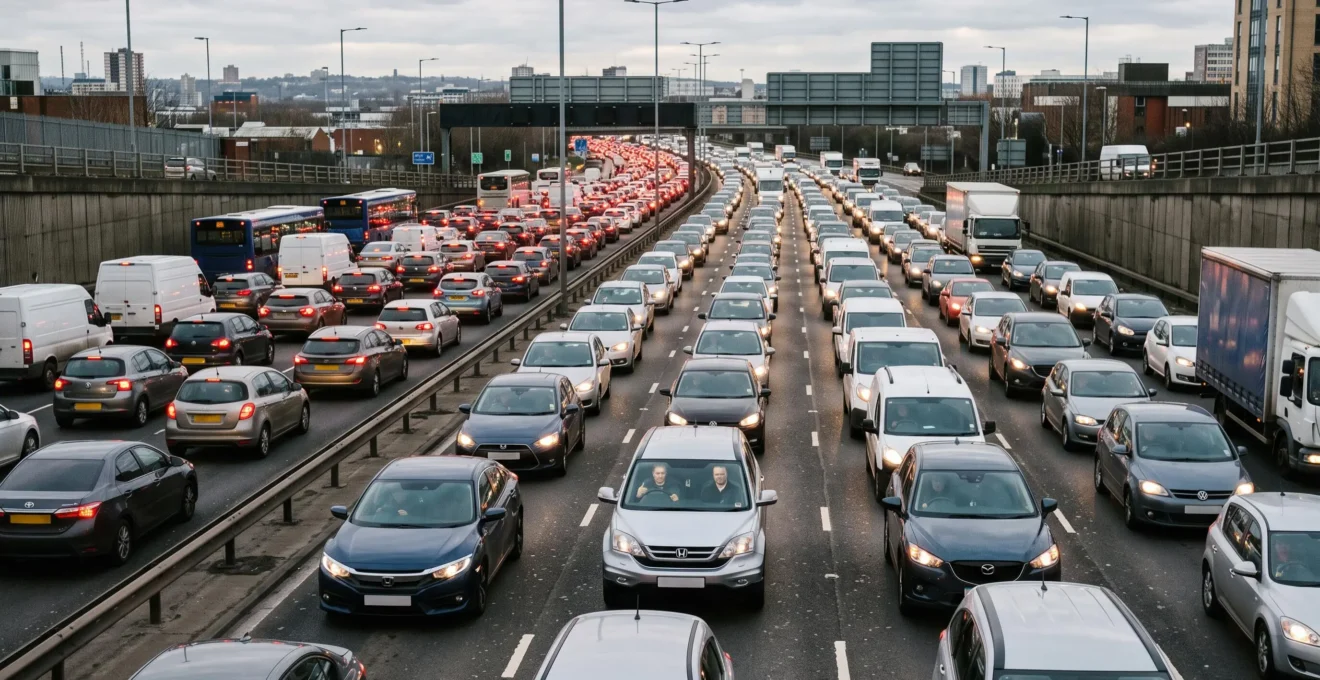
Heavy traffic can turn an ordinary commute into a demanding sequence of braking, accelerating, checking mirrors and anticipating what other drivers might do next. Even when vehicles barely move, the constant adjustments can make the journey feel exhausting.
The safest way through congestion is not necessarily to find the fastest lane. It is to maintain a manageable following distance, anticipate changes in traffic flow, minimise unnecessary manoeuvres and keep vulnerable road users in view. These habits help preserve the space and time needed to respond when something unexpected happens.
Traffic conditions also require different techniques. A nearly stationary queue calls for a practical stopping gap, while moving traffic requires greater following distance as speed increases. Junctions, merging lanes and cyclists filtering alongside vehicles introduce additional risks.
By making a few decisions before entering congestion and applying a consistent driving routine, motorists can reduce avoidable pressure without sacrificing safety. The principles below apply broadly, although traffic laws, lane conventions and insurance rules vary between countries.
Heavy traffic driving: the essentials
- Keep enough space to stop safely, even when queues move only a short distance at a time.
- Choose lanes according to road markings, traffic conditions and your next manoeuvre rather than chasing small speed advantages.
- Check mirrors, blind spots and changing road signs regularly, especially near cyclists, pedestrians and merging traffic.
- Why Do Low-Speed Traffic Jams Still Produce So Many Minor Collisions?
- How Can You Keep a Safe Gap in Stop-Start Traffic Without Losing Your Position?
- Middle, Inside or Outside Lane: Which Position Works Best in Dense Traffic?
- Why Can Repeated Lane Changes Make Congested Journeys Riskier?
- When Should You Avoid a High-Traffic Route Rather Than Drive Through It?
- How Can You Scan Busy Roads Without Missing Cyclists or Pedestrians?
- Which Road Warning Signs Should Drivers Prioritise in Heavy Traffic?
- How Can You Make a Daily Car Commute Safer and Less Stressful?
Why Do Low-Speed Traffic Jams Still Produce So Many Minor Collisions?
Low-speed traffic jams create collision opportunities because vehicles repeatedly close gaps, stop unexpectedly and move again. Drivers may underestimate the attention required when travelling slowly, particularly after spending a long time in a queue. A short lapse can be enough to cause a rear-end impact, even when the resulting vehicle damage appears minor.
Congestion creates a misleading sense of security. At walking pace, a driver may assume there is enough time to react to anything happening ahead. Yet the vehicle in front can brake abruptly while the driver behind is accelerating into a newly opened gap.
Stopping safely requires both the distance travelled before the driver reacts and the distance needed for braking. Neither disappears simply because traffic is moving slowly. Following too closely leaves little margin if attention shifts briefly towards navigation, mirrors or another road user.
The UK Highway Code’s rules on stopping distances and congested traffic advise maintaining enough space to stop safely and allowing room to manoeuvre if necessary. Rule 126 also recommends a minimum two–second following gap on faster-moving roads, with greater distances in poor conditions. This is not a fixed two-second requirement for stationary queues.
Repeated stop-start movements add another challenge. Each short advance involves observing the vehicle ahead, releasing the brake, checking the surroundings and deciding when to stop again. Repeating those decisions throughout a commute can become mentally tiring. Drivers should therefore treat the final part of a congested journey with the same attention as the beginning, rather than assuming the remaining distance is routine.
Minor collisions can also create consequences beyond a scratched bumper. In a hypothetical three-car queue, a rear impact might push the middle vehicle into the car ahead. Determining responsibility then requires examining the sequence of impacts, available evidence and applicable insurance rules. There is no universal rule that automatically assigns responsibility in every such case.
Photographs of vehicle positions, damage and the surrounding road can help document an incident once everyone is safe. Prevention remains preferable to resolving a dispute about how a collision unfolded.
The practical response is to leave enough room for an unexpected stop instead of relying on the assumption that slow traffic is harmless.
How Can You Keep a Safe Gap in Stop-Start Traffic Without Losing Your Position?
Maintain a gap that allows you to stop without contacting the vehicle ahead, while adjusting it to your speed and road conditions. In a stationary queue, the point where the preceding vehicle’s rear tyres meet the road can provide a useful visual reference. When traffic moves faster, increase your following distance rather than relying on that reference alone.
One practical low-speed habit is to stop far enough back that you can see the rear tyres of the vehicle ahead touching the road. This is an informal positioning aid, not a universal stopping-distance standard. It cannot replace judgment about vehicle size, slope, weather, visibility or the space needed to manoeuvre.
At higher speeds, use a time-based following gap and extend it when braking conditions deteriorate. A comfortable safety margin matters more than maintaining an exact position in the queue.
Drivers can also reduce unnecessary braking by anticipating the movement of the queue. Rather than accelerating sharply whenever the vehicle ahead moves, release the brake progressively and follow at a controlled pace. Where conditions allow, a smoother, slightly slower approach may let a small gap absorb some fluctuations in traffic speed.
This is not an instruction to create an excessively large opening, impede traffic or travel at a dangerously low speed. The aim is to follow predictably without repeatedly rushing towards stationary vehicles.
A common concern is that leaving space encourages drivers in neighbouring lanes to merge into it. That can happen, but protecting a particular position should never become more important than avoiding a collision.
If another vehicle signals and enters the gap safely, ease off and restore your following distance. If a vehicle is approaching the opening but has not yet merged, maintain a predictable speed and position rather than accelerating to block it. Where merging in turn is appropriate, cooperate with the traffic flow.
The gap has an additional benefit when a vehicle behind fails to stop. Space ahead may reduce the chance of being pushed into another vehicle, although it cannot guarantee protection or determine insurance responsibility for the impacts involved.
Once following distance becomes consistent, choosing the right lane becomes easier because there is less pressure to react to every small difference in traffic speed.
Middle, Inside or Outside Lane: Which Position Works Best in Dense Traffic?
The best lane in dense traffic is the one that legally and safely supports your next manoeuvre, not necessarily the lane moving fastest. Choose according to road markings, upcoming exits, junctions and merging vehicles. Lane labels and driving conventions vary internationally, so no single inside, middle or outside lane is universally preferable.
On a multi-lane urban road, each lane presents different demands. A lane near frequent entrances may expose drivers to merging traffic. A lane next to parked vehicles or a pavement may require extra attention to pedestrians, cyclists and vehicles pulling out. A central lane may involve traffic on both sides and therefore more observation before any manoeuvre.
The choice should begin with your destination. If an exit is approaching, prepare to enter the appropriate lane early enough to avoid cutting across others. If your route continues straight, follow the locally applicable lane-use rules instead of remaining in a lane merely because it appears faster.
The following comparison illustrates factors to assess on a multi-lane road. Actual lane use must always follow local law and signs.
| Lane position | Potential advantage | Main consideration |
|---|---|---|
| Lane serving an upcoming exit or turn | Allows timely preparation for the intended manoeuvre | May contain turning queues or merging vehicles |
| Central through lane | May reduce the need to cross several lanes later | Requires awareness of traffic approaching from both sides |
| Lane beside an entrance or roadside activity | May be appropriate for the intended route | Can involve frequent merges, turning vehicles or vulnerable road users |
Available space matters more than apparent speed. Look ahead for a clear stopping area, anticipate vehicles entering your lane and avoid positioning the car where an unnecessary lane change will soon be required.
A possible escape route is also worth considering, but only as part of defensive observation. An adjacent lane may be occupied when an emergency occurs, and a road shoulder must not be treated as a normal driving lane or an automatically safe refuge.
Insurance consequences provide another reason to avoid ambiguous manoeuvres. A sideswipe during a lane change may involve conflicting accounts about who moved first, whether signals were given and whether sufficient room existed. Liability depends on the evidence and governing rules; a standard 50/50 allocation should not be assumed.
After selecting a suitable lane, remaining there consistently can be safer and less demanding than repeatedly switching in search of a short-lived advantage.
Why Can Repeated Lane Changes Make Congested Journeys Riskier?
Repeated lane changes increase the number of situations in which a driver must judge another vehicle’s speed, check blind spots and enter a limited gap. In congested traffic, those manoeuvres can interrupt surrounding vehicles and create additional braking. A lane that briefly moves faster may offer little lasting advantage once traffic patterns change again.
Consider a hypothetical commute where the adjacent lane starts moving while your own lane remains stationary. Changing lanes might advance your position temporarily. Moments later, however, the new lane could stop while your previous lane begins moving. The apparent opportunity may disappear before it creates a meaningful time saving.
Every change adds several decisions: Is the target lane permitted? Is the gap large enough? Is a motorcycle filtering between vehicles? Could the vehicle behind need to brake sharply?
The driver entering the gap may also affect surrounding traffic. If another motorist brakes to accommodate the manoeuvre, following drivers may respond in sequence, creating additional speed fluctuations. This is one reason stable and predictable movement benefits the wider traffic stream.
Rule 134 of the UK Highway Code advises against unnecessary lane changes in congested conditions. That recommendation does not prohibit changes needed to follow the road, avoid an obstruction or prepare for a turn.
A practical decision test is to change lanes only when:
- The manoeuvre is legal and genuinely useful for the route or a sustained traffic condition.
- There is enough space ahead and behind in the destination lane.
- Mirrors and blind spots have been checked, including for filtering motorcycles and cyclists.
- The driver can signal appropriately and move without forcing others into sudden braking.
The observation process deserves particular attention. Check mirrors to understand surrounding traffic, assess blind spots with a brief direct glance when safe and necessary, signal the intended manoeuvre, then make a final safety assessment before moving. Signalling communicates intention; it does not create priority or guarantee a gap.
Sometimes the more effective decision is made before reaching the queue: selecting a route or departure time that avoids repeated merging and lane changes altogether.
When Should You Avoid a High-Traffic Route Rather Than Drive Through It?
Consider an alternative route when expected congestion creates substantially more delay, repeated stopping or difficult merging than another practical option. Compare total journey time, route familiarity, road conditions and your own alertness before deciding. A longer journey may feel calmer, but extra distance and unfamiliar roads introduce risks that should not be ignored.
Congestion is not automatically a reason to divert. A familiar urban route with predictable queues may be easier to navigate than an unfamiliar network of narrow streets, complicated junctions or pedestrian-heavy residential roads.
Three variables provide a useful personal decision framework:
- Expected delay: Is the queue a brief disruption or a sustained part of the journey?
- Stop-start intensity: Will the route involve continuous braking and restarting, or relatively steady slow movement?
- Merging exposure: Does the route contain frequent lane drops, busy junctions or entrances requiring repeated gap judgments?
Imagine two hypothetical routes. Route A is shorter but frequently involves a prolonged queue near a motorway interchange. Route B is longer but follows familiar roads with steadier movement. Route B may be preferable on particularly demanding days, provided it is lawful, suitable and does not add excessive travel time.
The relevant threshold should be personal and practical rather than presented as a universal number of minutes or stops per kilometre. If congestion regularly leaves you fatigued or forces complex manoeuvres, identify a credible alternative before the next journey.
Live traffic information can support the choice. Check predicted delays before departure, compare recurring patterns by day and time, and save a small number of familiar alternatives. Navigation adjustments should be made while parked or through lawful hands-free arrangements that do not distract from driving.
A different departure time may be more useful than a different route. Even modest flexibility around recurring peak periods can sometimes make the journey more predictable, although actual benefits depend on local conditions.
Whatever route you choose, dense urban environments still require careful observation of cyclists and pedestrians, particularly around queues and junctions.
How Can You Scan Busy Roads Without Missing Cyclists or Pedestrians?
To spot cyclists and pedestrians in heavy traffic, scan beyond the vehicle directly ahead and check mirrors, blind spots, junctions and gaps between stationary cars. Give particular attention to people who may be hidden by larger vehicles or filtering alongside queues. Before turning or changing lanes, confirm that the intended path is clear.
Slow traffic can conceal vulnerable road users. A cyclist may travel between queued vehicles, while a pedestrian may emerge from behind a parked van or cross between stationary cars. Looking only through the centre of the windscreen can leave these movements unnoticed until the available response time becomes short.
Build a regular observation pattern around changing conditions rather than relying on a rigid interval. Scan the road ahead, glance at mirrors when safe and look towards areas where people could enter your path. Before manoeuvring, make a deliberate blind-spot check where necessary.
The Highway Code’s guidance on mirrors, blind spots and road positioning recommends frequent mirror checks and warns that mirrors cannot show every area around a vehicle. It also highlights cyclists and motorcyclists filtering through traffic.
At intersections, look for movement in the narrow spaces between vehicles. A bicycle wheel, helmet or pedestrian’s head may become visible before the rest of the person, although these are supplementary visual cues rather than a substitute for a full observation of the intended path.
Turning across a cyclist’s path deserves special care. Before turning, check the relevant mirrors and blind spots, indicate appropriately and give way whenever required. Do not assume that a cyclist alongside the vehicle will stop merely because the indicator is operating.
The same principle applies to pedestrians near crossings and junctions. Reduce speed where visibility is restricted, observe pavements and crossing areas, and be prepared to stop. Avoid advancing across a crossing or cycle facility without ensuring the movement is lawful and safe.
Collisions involving vulnerable road users can produce serious injuries even at relatively low vehicle speeds. Responsibility is not assigned automatically in every jurisdiction, but a failure to observe or yield when required may have significant legal and insurance consequences.
Visual attention must also extend beyond people and vehicles to road signs, especially when overhead signals communicate hazards hidden farther along a queue.
Which Road Warning Signs Should Drivers Prioritise in Heavy Traffic?
Prioritise signs and signals that require an immediate change in speed, lane choice or stopping behaviour. These include mandatory speed restrictions, lane closures, queue warnings, pedestrian crossings and merging instructions. Informational signs remain important for navigation, but urgent safety instructions should receive attention first when traffic conditions change.
A driver following the bumper ahead may not notice an overhead warning until the relevant hazard is close. In congested traffic, this is particularly problematic because a queue can obscure a stationary vehicle, roadworks or a closed lane farther along the road.
Variable message signs help communicate conditions that are not yet visible. The Department for Transport’s motorway signs and signals guidance explains the use of electronic warnings, lane-control signals and variable speed limits in Great Britain.
Under the British motorway sign system, variable speed limits shown inside a red circle are mandatory, while speed figures without that circle are generally advisory maximum speeds. A red X accompanied by flashing red signals identifies a lane that must not be used. Other countries may use different symbols or legal conventions.
The important habit is to act on a warning before the hazard becomes visible. If a lane closure is indicated, assess available gaps and prepare to merge safely in accordance with the signs and local merging rules. Do not make an abrupt lane change merely because the sign has appeared.
Warning signs can also influence following distance. A queue-ahead sign is a reason to anticipate braking and increase the space available as conditions require. A pedestrian-crossing warning calls for attention to the roadside, while a merging sign requires awareness of vehicles entering the traffic stream.
In practice, distinguish immediate instructions from information that can be processed later. The following routine can help.
Five actions for reading road signs safely in congestion
- Identify the next mandatory speed or lane-control signal. Confirm which restriction applies to your lane.
- Check for a queue, incident or roadworks warning. Identify the corresponding hazard to anticipate.
- Look ahead for a lane-drop or merging instruction. Identify the lawful lane and a safe opportunity to position your vehicle.
- Check crossing and junction warnings. Identify where pedestrians, cyclists or vehicles could enter your path.
- Review the next exit or diversion sign when safe. Confirm your route before an urgent manoeuvre becomes necessary.
Integrate sign awareness into normal observation. After checking the road ahead and surrounding traffic, look towards relevant overhead and roadside signs without allowing a prolonged glance to interfere with steering or hazard detection.
These observations become most useful when combined with consistent following distance, predictable lane positioning and a commuting routine that limits unnecessary stress.
Key takeaways before your next commute
- Prepare your route and understand likely congestion points before driving, rather than making rushed navigation decisions in a queue.
- Preserve predictable movement by combining stopping space, early observations and only necessary lane changes.
- Check that the vehicle and insurance arrangements suit your routine commute, not just occasional leisure journeys.
How Can You Make a Daily Car Commute Safer and Less Stressful?
A safer and less stressful commute begins before the engine starts. Choose a suitable route, allow realistic travel time and check the vehicle’s condition. Once moving, maintain a safe gap, position yourself for upcoming manoeuvres and scan for hazards consistently. Repeating this simple routine reduces the need for rushed decisions in heavy traffic.
Start by checking traffic conditions before departure and identifying any road closures or major incidents. Where your schedule allows, choose a departure window that avoids predictable pressure. Prepare navigation, adjust mirrors and secure loose items while parked.
During the journey, use a repeatable sequence: observe the road ahead, maintain sufficient stopping distance, check mirrors, anticipate signs and avoid unnecessary lane changes. At junctions, give additional attention to cyclists and pedestrians who may be partially concealed by stationary traffic.
Stress management matters because frustration can encourage hurried decisions. When stationary and safely secured at a red light, relax your grip and take a few comfortable, unforced breaths while remaining attentive to signals and traffic. Avoid using relaxation exercises that distract from observation or delay your response when movement resumes.
Audio can make a commute more pleasant, but it should remain secondary to driving. Keep the volume low enough to hear important external sounds and avoid interacting with a phone or entertainment system while the vehicle is moving.
Vehicle preparation also supports predictable braking and handling. Check tyre condition and pressure, follow the manufacturer’s servicing schedule and address unusual brake behaviour promptly. Do not wait for a demanding stop-start commute to reveal a maintenance problem.
Insurance deserves a separate check. In the United Kingdom, commuting and business use may fall into different insurance classifications. Travelling regularly to a normal workplace is not necessarily treated the same as driving between locations for professional duties.
MoneyHelper’s explanation of car insurance declarations highlights the importance of accurately describing vehicle use and updating insurers when circumstances change. Specific coverage depends on the policy and jurisdiction, so drivers outside the UK should consult their own insurer’s definitions.
Knowing what to do after a minor collision can also limit unnecessary uncertainty. Before an incident occurs, familiarise yourself with your insurer’s reporting requirements and the information normally requested. If a collision happens, first prioritise personal safety, obtain assistance where necessary and follow local rules on stopping, exchanging details and reporting.
A commuting routine should evolve over time. Roadworks, traffic restrictions and seasonal travel patterns may change which route feels manageable. Periodically review departure times, recurring bottlenecks, vehicle condition and any insurance changes linked to how the car is used.
Before your next commute, choose one specific improvement to practise: preparing an alternative route, leaving more stopping space or checking blind spots more deliberately. Once that behaviour becomes consistent, build on it with another. Safer congestion driving comes from predictable, repeatable decisions rather than attempts to control the entire queue.
Should you use cruise control in stop-start traffic?
Only use a cruise-control or adaptive cruise-control system under conditions approved by the vehicle manufacturer. Conventional cruise control is generally unsuitable for repeated stopping. Some adaptive systems support low-speed following, but drivers must remain attentive, supervise the system and be ready to brake. Never assume driver assistance can reliably detect every stationary vehicle, cyclist or pedestrian.
Is it better to brake repeatedly or maintain a steady speed in congestion?
Where conditions allow, smooth and predictable movement can reduce unnecessary acceleration and braking. However, always brake when required to maintain safe stopping space. A steady pace is useful only when it remains appropriate for the traffic flow, road conditions and surrounding vehicles.
What should you do when another driver follows too closely?
Maintain a calm, predictable speed and preserve enough space ahead to avoid abrupt braking where possible. Do not brake deliberately to warn the following driver or accelerate beyond safe conditions. If a lawful and safe opportunity arises to let the vehicle pass, consider using it. Your priority is to avoid escalating the situation.
Can driving slowly through heavy traffic still cause fatigue?
Yes. A journey involving repeated observation, braking, restarting and close interactions with other road users can be mentally demanding despite low speeds. If concentration is declining, consider stopping at a safe, legal location for a break. Feeling frustrated, distracted or unusually tired is a reason to reassess whether you are fit to continue driving.
What should you do if traffic suddenly stops on a motorway?
Reduce speed promptly but smoothly where possible, maintain control and leave sufficient space to stop behind the vehicle ahead. Stay aware of following traffic without allowing mirror checks to distract from braking. Use hazard warning lights when appropriate under local rules to warn following drivers, and obey lane-control signals. If you come to a complete stop, remain attentive to further movement and emergency instructions.