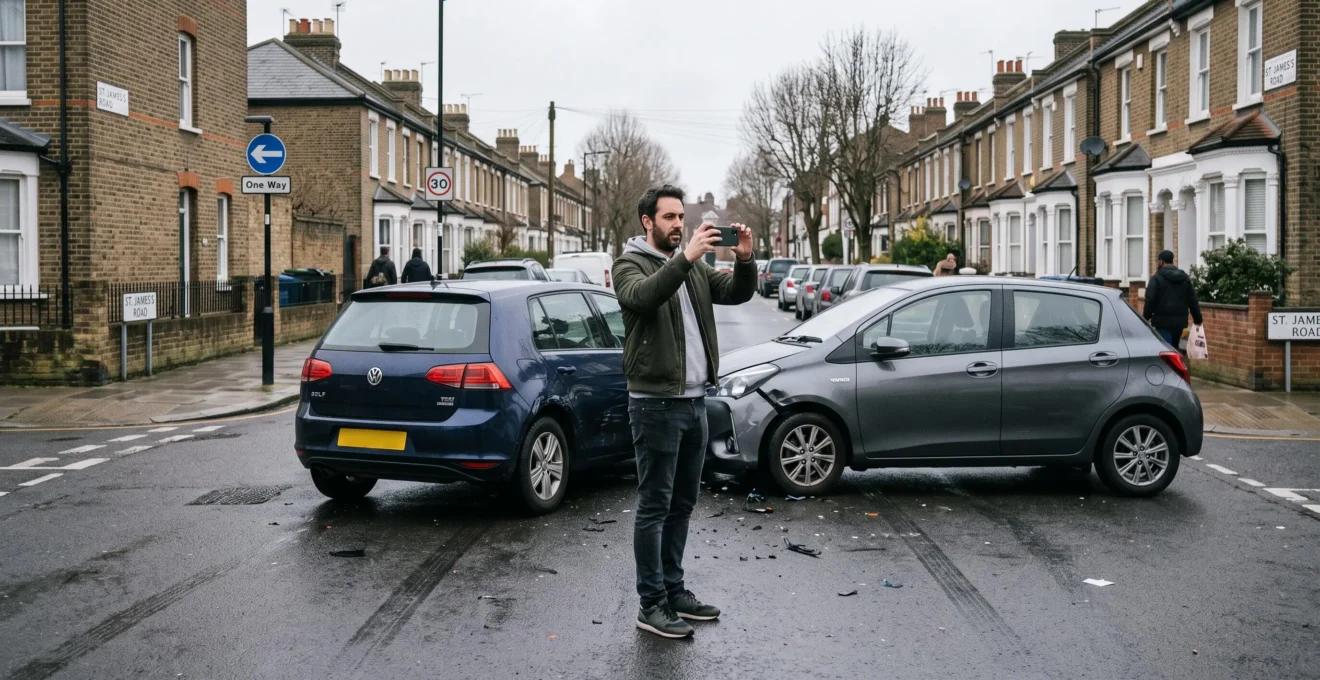
Immediately after a road accident, collect evidence that shows where the collision happened, how the vehicles were positioned, what damage occurred and who witnessed the event. Photographs, videos, written notes, vehicle information and witness contacts can help an insurer reconstruct the circumstances when different accounts emerge.
However, evidence collection must never take priority over safety. First check for injuries, contact emergency services when necessary, move to a safe location and follow applicable local rules. Photographing vehicles before moving them is useful only when doing so does not expose anyone to danger or obstruct an emergency response.
Once the immediate risks are controlled, a systematic approach makes the process more manageable. Record the wider surroundings before focusing on damage, preserve original digital files and distinguish what you personally observed from assumptions about responsibility. The objective is not to construct an argument against another driver, but to preserve an accurate, verifiable account of the incident.
Essential road accident evidence to preserve
- Record the scene safely: photograph vehicle positions, damage, road markings, traffic controls and any visible debris or skid marks.
- Identify everyone involved: exchange appropriate driver and insurance details, and obtain witness contact information where possible.
- Preserve original records: save photos, dashcam footage and dated notes promptly, without editing or replacing the original files.
- Why Can Minor Accident Details Become Important During a Claim?
- How Can You Collect Accident Evidence Without Missing Critical Details?
- Photos, Video or Notes: Which Accident Evidence Is Most Useful?
- Which Accident-Scene Evidence Mistakes Can Weaken a Claim?
- When Should You Record Accident Evidence Before Moving the Cars?
- How Can You Protect Your Position After a Crash Without Admitting Responsibility?
- How Should You Ask a Witness for Details After a Collision?
- How Can a Witness Statement Help Clarify What Happened in a Road Accident?
Why Can Minor Accident Details Become Important During a Claim?
Minor accident details become important when insurers need to distinguish between conflicting accounts of a collision. A vehicle’s final position, a road marking, a traffic signal or a patch of standing water may help establish the sequence of events. Information recorded immediately can be compared with later statements, damage assessments and witness evidence.
Insurance investigations do not depend solely on which driver presents the more convincing explanation. Claims representatives may examine photographs, vehicle damage, road rules, police reports and witness accounts. The ICBC‘s explanation of how crash responsibility is assessed describes how these sources contribute to responsibility decisions in British Columbia. Its procedures are jurisdiction-specific, but they illustrate why apparently minor observations can matter.
Consider a hypothetical collision at a junction. Driver A maintains that Driver B crossed a stop line without yielding. Driver B disputes that account. A photograph taken immediately afterward shows the stop line, the direction of travel and the vehicles’ final positions. That photograph alone cannot prove who failed to yield, but it provides a reference against which the statements and damage can be assessed.
Without that photograph, the investigation may have to depend more heavily on recollections or other available evidence.
Details also become harder to recover after a collision scene changes. Vehicles are removed, debris is cleared, traffic resumes and temporary conditions disappear. Stress may affect what participants notice and remember, although no particular rate of memory deterioration should be assumed.
The practical consequence of missing information is greater uncertainty. An insurer may need additional enquiries, particularly where the available evidence does not clearly establish what happened. In some cases, uncertainty can contribute to disputed responsibility or influence how a claim is assessed, without making any particular settlement outcome inevitable.
Useful early observations include:
- The precise location, time and direction of travel.
- The vehicles’ positions relative to lanes and road markings.
- Traffic signs, signals and visibility conditions.
- Skid marks, scattered debris and areas of vehicle contact.
- Relevant road and weather conditions.
The next priority is to capture those details consistently, without allowing documentation to interfere with safety or required emergency procedures.
How Can You Collect Accident Evidence Without Missing Critical Details?
Collect accident evidence in a consistent sequence: secure your safety, document the overall scene, capture relevant close-ups, exchange identifying information and save the records. This method reduces reliance on memory during a stressful event. If the location is dangerous, move to safety first and document whatever remains accessible afterward.
The National Association of Insurance Commissioners‘ auto insurance consumer guide recommends recording the collision’s time and location, vehicle details, witness contacts, road and weather conditions, and any visible skid marks. It also advises photographing or sketching the scene and obtaining relevant police-report information.
Begin with wide photographs showing the accident location from different safe viewpoints. A full-circle photographic record, when practical, can show the relationship between vehicles, traffic controls, adjacent lanes and nearby landmarks. It is a useful documentation technique, not a universal legal requirement.
Move next to medium-distance images of the vehicles and close-ups of identifiable damage. Include registration plates, relevant road markings and detached parts without touching or rearranging physical evidence.
Record the following information where applicable and legally appropriate:
- Names, contact details and insurance information for the drivers involved.
- Vehicle registration numbers, makes, models and other identifying details.
- Company or fleet operator details when a business-owned vehicle is involved.
- Witness contact details and the locations from which they observed the event.
- The exact collision location, date, time and any police incident or report reference.
- The attending officer’s identification and instructions for obtaining a report, where available.
Phone photographs often contain date and time metadata, although device settings can be inaccurate. Preserve the original files to retain whatever metadata exists. If a dashcam recorded the incident, save the relevant footage before the system’s recording cycle overwrites it. Keep an unedited original and use copies for sharing.
Five actions for a usable accident evidence record
- Confirm scene safety: record the emergency or police incident reference if one is provided.
- Capture the surroundings: save a series of wide photographs showing the accident location and relevant road layout.
- Document physical evidence: save close-ups of vehicle damage, registration plates, debris and road markings where safely accessible.
- Record people and vehicles: create a dated note containing exchanged details, witness contacts and relevant vehicle information.
- Preserve the evidence: place original photos, video and notes in a clearly named folder, with a separate backup where feasible.
If injury, shock or a dangerous location prevents you from taking photographs, do not attempt to complete the sequence. A passenger may be able to help safely, or you may later rely on police documentation, witness information and vehicle inspections. Ask others for assistance without directing them into traffic or compromising an investigation.
Once the basic record exists, consider what each evidence format can actually establish and where it may leave unanswered questions.
Photos, Video or Notes: Which Accident Evidence Is Most Useful?
Photographs, video and notes serve different purposes after a road accident. Photographs preserve visible conditions at particular moments, video may show movement and sequence, and notes record observations or conversations that cameras miss. The most useful evidence record usually combines these formats rather than depending on one of them alone.
A photograph can show final vehicle positions, the extent of visible damage and the surrounding road layout. It cannot necessarily establish how a collision unfolded. Similarly, video may capture the sequence of events but miss relevant activity outside the camera’s field of view.
Written notes add context. They can document what a driver said, where a witness stood, the time of a conversation or the weather conditions you observed. They should distinguish direct observations from estimates and should be dated as soon as practical.
The following comparison helps determine which format to use.
| Evidence type | What it can help establish | Important limitation |
|---|---|---|
| Photographs | Visible damage, vehicle positions, road markings, signs and debris. | Show selected moments and may omit context outside the frame. |
| Video | Movement, timing and the sequence visible within the recording. | May miss the impact, lack detail or have an obstructed viewpoint. |
| Written notes | Conversations, observations, times and details not visibly recorded. | Depend on accurate recording and may be disputed or incomplete. |
For photographs, start with establishing shots from several safe directions. Follow with medium-distance images showing both vehicles and then close-ups of damage. Where possible, include fixed reference points so the relative positions can be understood later.
For video, preserve original dashcam footage and any relevant recording made safely from the roadside. Avoid editing the original or adding annotations to the evidence copy.
For notes, a short voice memo can help capture context while it is fresh. Identify the date, location and what you personally observed. Clearly mark any uncertainty. Recording other people’s speech may be subject to local consent and privacy requirements, so a written note of what was said may be more appropriate.
Consistency between evidence formats matters more than the quantity of files. A time-stamped photograph, a dashcam recording and a dated note may support one another, but a discrepancy does not automatically mean that someone is being dishonest. The investigator must consider camera angles, timing and the reliability of each observation.
Evidence is most valuable when its original context remains intact. The next challenge is avoiding actions that make reliable information harder to interpret or recover.
Which Accident-Scene Evidence Mistakes Can Weaken a Claim?
Accident evidence can become less useful when essential details are omitted, original files are altered, witness contacts are lost or observations are replaced with speculation. Moving vehicles without documenting their positions may also remove useful context when photography could have been done safely. These mistakes can complicate reconstruction, although none automatically defeats an insurance claim.
One common omission is photographing only your own vehicle. That may preserve evidence of damage but leave unanswered questions about the other vehicle’s contact points or the relationship between the vehicles after the impact.
Another is focusing exclusively on damaged bodywork. Traffic signals, give-way markings, lane boundaries, road surfaces and visibility conditions may be equally relevant. Some physical traces disappear once the road is reopened.
Professional College of Policing guidance on serious road-collision investigations identifies vehicle positions, marks, debris, roadway infrastructure, photographs and witness accounts as potentially important evidence. This guidance concerns professional investigations of fatal and serious-injury collisions; it does not impose the same investigative duties on motorists involved in minor incidents.
Other avoidable mistakes include:
- Leaving without witness contacts: identifying an independent observer later may be difficult.
- Overwriting dashcam footage: the original recording may no longer be available when the insurer requests it.
- Sharing only compressed images: reduced resolution or missing metadata may limit later examination.
- Guessing the cause: an unsupported statement about speed, distraction or fault may conflict with subsequent evidence.
- Editing the originals: cropping, marking or replacing source files can make their context harder to verify.
An apology or spontaneous statement about responsibility may create an additional dispute about what was meant. An expression of concern is not necessarily a legal admission, and its effect depends on the circumstances and applicable law. The safer evidential practice is to report observations accurately rather than speculate.
If you later discover missing evidence, recovery may still be possible. Ask the insurer or investigating authority about police records, additional photographs, witnesses or potential CCTV sources. Nearby businesses and public authorities may hold relevant footage, but access and retention rules vary. Contacting an appropriate holder promptly may improve the chance of preservation without guaranteeing access.
The most immediate judgement often concerns whether photographing the vehicles is possible before they have to be moved.
When Should You Record Accident Evidence Before Moving the Cars?
Photograph vehicle positions before moving the cars only when it is safe and lawful to do so. If vehicles create an immediate hazard, obstruct traffic or must be moved under police instructions or local rules, prioritise safety and compliance. Useful photographs should never require standing in moving traffic or delaying emergency assistance.
In a safe, low-risk setting where the vehicles can temporarily remain in position, take several wide photographs before clearing the scene. Include the vehicles’ final resting points, their relationship to lanes and junctions, nearby traffic controls and any visible debris or tyre marks.
These images can help investigators understand the physical layout that existed immediately after the collision. Photograph from a safe pedestrian area or another protected position rather than stepping into traffic to obtain a particular angle.
Where applicable, the UK Highway Code rules on breakdowns and road incidents place personal safety, warnings to other road users and compliance with police or traffic-officer directions ahead of accident documentation. Their requirements apply within their stated jurisdiction and should not be treated as universal rules.
A useful decision sequence is:
- Check for injuries and immediate dangers, including moving traffic, smoke, fire or unstable vehicles.
- Contact emergency services where necessary and follow their instructions.
- If conditions permit, take a few wide photographs from a safe location before moving a vehicle.
- Move vehicles when required for safety or by applicable rules or official instructions.
- Complete the remaining documentation from a safe place.
If the cars must be moved immediately, do not attempt to preserve their positions at the expense of safety. Dashcam footage, passenger observations, later photographs and a dated diagram may help explain the original arrangement.
For a diagram, mark the road layout, travel directions, approximate pre-movement positions and locations of visible debris. Label estimated information clearly rather than presenting it as a measurement.
Moving a car does not make evidence collection pointless. Damage photographs, witness details, road features and official reports can still contribute to reconstruction after the vehicles have been relocated.
With the scene secured and evidence documented, the next priority is communicating accurately without making unsupported statements about responsibility.
How Can You Protect Your Position After a Crash Without Admitting Responsibility?
Protect your position after a crash by cooperating fully with necessary safety procedures and information exchanges while describing facts rather than assigning blame. Explain what you observed, provide accurate identifying details and assist anyone who needs help. Avoid unsupported conclusions about speed, negligence or responsibility before the available evidence has been assessed.
Factual cooperation and admitting legal responsibility are different matters. Drivers may have legal duties to stop, provide identifying information, assist injured people or report an incident, depending on the jurisdiction. These obligations should be fulfilled regardless of uncertainty about fault.
Statements made immediately after a collision can be incomplete because neither driver necessarily has a full view of what happened. A driver might know that the impact occurred while turning but not whether the other vehicle entered a lane unexpectedly or whether a traffic signal changed at a particular moment.
Useful factual language includes:
- “I was travelling along this lane when I felt the impact.”
- “I saw the other vehicle approaching, but I cannot reliably estimate its speed.”
- “This is where my vehicle stopped after the collision.”
- “I am not certain which traffic signal was displayed at the moment of impact.”
These statements are appropriate only when they accurately reflect your observations. Do not substitute them for facts you know, or use uncertainty to conceal relevant information.
Be cautious about promising to pay for repairs or declaring yourself responsible based on an initial impression. Even where you believe your actions contributed to the collision, responsibility may involve several factors. Some insurance assessment systems recognise shared or partial responsibility, rather than treating every incident as entirely one driver’s fault.
Politeness is still appropriate. Asking whether someone is hurt or expressing concern is different from deliberately accepting liability, although the treatment of apologies varies between legal systems.
If another driver says they caused the accident, record the statement accurately with its context and date, preferably in contemporaneous notes. Avoid pressuring the person to repeat it or sign a statement. An admission may be relevant to an investigation but is not necessarily binding on insurers or courts.
The same neutrality is particularly important when speaking with someone who may have witnessed the incident independently.
How Should You Ask a Witness for Details After a Collision?
Approach a collision witness calmly, ask whether they are willing to share contact information and use open questions about what they personally observed. Record where they were positioned and whether they saw the collision itself or only its aftermath. Avoid describing your preferred account before asking for their observations.
A witness may be a pedestrian, cyclist, nearby driver, shop worker or another person who happened to see part of the incident. Not every bystander will have seen the relevant sequence, so establishing the limits of their observation is essential.
Begin with a brief, neutral request, such as: “Did you see what happened, and would you be willing to provide your contact details for the insurance investigation?”
If the person agrees, ask for their name and a reliable contact method. Then establish their viewing position and what they saw without suggesting an answer.
Useful questions include:
- “Where were you standing or travelling when you first noticed the vehicles?”
- “What did you see immediately before the collision?”
- “Did you see the impact, or did you turn around after hearing it?”
- “Was anything obstructing your view?”
- “Would you be willing to provide an account to an insurer or investigating officer?”
Avoid leading questions such as “You saw the other driver run the red light, didn’t you?” They introduce a conclusion that the witness may not have formed independently.
Record whether the witness knows either driver, was travelling in either vehicle or has another connection that may be relevant to assessing their independence.
If the witness is willing to provide a short written account, ask them to describe events in their own words and include the date. Do not compose the statement for them or suggest corrections that change its meaning.
If someone declines to become involved, respect that decision. Where appropriate, you may give the investigating officer a factual description of a potential witness or a lawfully observed vehicle registration. Do not pursue, pressure or attempt to identify someone through improper means. Authorities may be able to follow up, but there is no guarantee that a statement can be obtained.
Witness information should also be handled responsibly. Share relevant contact details with the insurer or appropriate authority rather than circulating them publicly.
Once contact information is available, the usefulness of any subsequent witness statement depends on what the person actually saw and how their account fits with the physical evidence.
Key takeaways before relying on witness evidence
- A witness who observed the critical sequence may help resolve a disagreement that photographs alone cannot explain.
- Record the witness’s viewing position and the limits of their observations, not merely their conclusions.
- Keep witness accounts separate from your own and preserve supporting photographs, footage and incident records for comparison.
How Can a Witness Statement Help Clarify What Happened in a Road Accident?
A witness statement can help clarify a road accident by providing an additional account of events when the drivers disagree. Its usefulness depends on what the witness observed, their opportunity to see the incident and the consistency of their account with other evidence. A witness statement supports an investigation but does not automatically determine responsibility.
Imagine a hypothetical collision at a roundabout where both drivers claim to have entered correctly. An independent pedestrian says they saw one vehicle enter after the other was already circulating. That observation may help establish the sequence, particularly if photographs, vehicle damage or other records support it.
The witness’s account must still be evaluated. Their viewpoint might have been obstructed, or they may have seen only the final seconds before impact. The statement is useful because it adds information, not simply because it favours one driver.
Witnesses can differ considerably in the observations they are able to provide:
- Full-sequence witnesses: saw the vehicles before, during and immediately after the collision.
- Partial-sequence witnesses: saw an approach, manoeuvre or impact but not the entire event.
- Aftermath witnesses: arrived or looked toward the scene after the impact and can describe subsequent positions or behaviour.
These categories describe the scope of the observation rather than a universal hierarchy of evidential value. A partial observation supported by reliable footage might prove more useful than a confident but inaccurate full-sequence recollection.
Independence is another consideration. Someone who has no relationship with either driver may have fewer obvious personal interests in the outcome, but independence alone does not establish accuracy. Passengers and acquaintances may also provide relevant evidence that an investigator needs to assess fairly.
A written, dated statement recorded promptly can preserve what the witness recalls before further discussion or exposure to competing accounts. However, a prompt statement is not automatically reliable. Witnesses can misjudge distances, speed, timing and the direction from which a sound originated.
During the claim investigation, insurers may compare the statement with driver accounts, visible vehicle damage, photographs, dashcam recordings and police material where available. If disagreement continues and proceedings become necessary, a witness account may also be considered under the applicable rules of evidence.
No single format should be treated as conclusive simply because it appears objective. Physical evidence may be incomplete, footage may omit the decisive moment and witnesses may misunderstand what they saw. The strongest reconstruction is one that accounts for the available information and acknowledges uncertainty.
Before submitting your claim, organise these materials chronologically, keep the originals unchanged and provide a factual description of what you know. Identify any uncertainties rather than filling gaps with assumptions, and follow the insurer’s reporting instructions and the legal requirements applicable where the collision occurred.
What if I forgot to take photographs at the accident scene?
You can still photograph vehicle damage and any unchanged features of the location. Make a dated note explaining what you remember and when the later photographs were taken. Ask your insurer whether police records, witnesses, dashcam footage or nearby CCTV may provide additional information. Do not present later photographs as images taken immediately after the collision.
Should I send edited photographs to my insurance company?
Preserve the original photographs and provide them when requested. If you need to highlight a feature or create an enlarged crop, make a separate copy and identify it as annotated or modified. Keep the original file available so its broader context and any retained metadata can be examined.
Can dashcam footage be useful if it does not show the collision itself?
Yes. Depending on what it records, footage may help establish the approach to a junction, vehicle movements, road conditions or events immediately after impact. Its usefulness depends on camera position, image quality, timing and the questions being investigated. Preserve the relevant original recording rather than selecting only a short clip that supports one interpretation.
How long should I keep road accident photographs and notes?
Keep the original records throughout the claim and any related dispute. Ask your insurer or legal adviser about relevant retention requirements before deleting them. The appropriate period varies by jurisdiction, policy and the possibility of further proceedings. Store the evidence securely and limit access to people who need it.
What should I do if the other driver refuses to exchange information?
Do not confront or pursue the person. Prioritise safety, record identifying details that you can lawfully observe and preserve any available photographs or witness information. Contact the police where required or appropriate under local rules, and notify your insurer. Reporting duties and the information drivers must provide vary by jurisdiction.