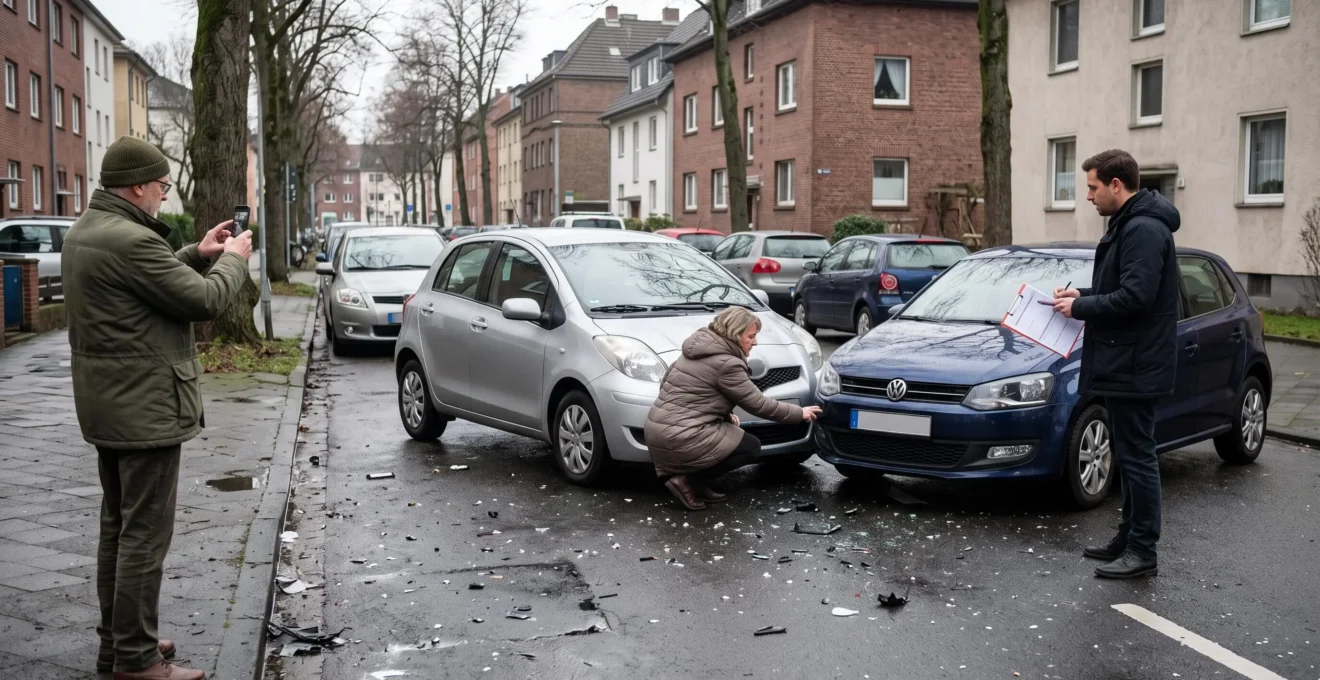
When drivers disagree about how a road accident occurred, an independent witness can provide observations that neither driver can establish alone. A clear account of vehicle movements, traffic signals or the sequence of events may help an insurer assess disputed facts, particularly when photographs and vehicle damage leave important questions unanswered.
However, a witness statement is not automatically reliable simply because its author was uninvolved in the collision. Its usefulness depends on what the person actually saw, where they were standing, when their attention was drawn to the incident and whether their recollection is consistent with other evidence.
Collecting that information correctly matters. Leading questions, delayed conversations and assumptions presented as observations can undermine an otherwise useful statement. The practical goal is to preserve an accurate account without influencing the witness or overstating what their evidence proves.
Insurance procedures and legal rules differ between English-speaking jurisdictions. The principles below explain how to document witness evidence carefully while distinguishing general good practice from country-specific claims requirements.
Road accident witness statements: essential points
- An independent witness can help clarify disputed facts, but their actual opportunity to observe matters more than their label.
- Ask open questions, record the witness’s position and preserve uncertainties rather than suggesting answers.
- Compare witness accounts with photographs, dashcam footage, vehicle damage and official records before drawing conclusions about responsibility.
- What Evidence Should You Collect Immediately After a Road Accident?
- Why Can an Independent Witness Matter More Than a Passenger’s Account?
- How Should You Ask a Witness for Details After a Collision?
- Independent Witness or Passenger Statement: Which Carries More Weight?
- Which Mistakes Can Reduce the Value of a Witness Statement?
- When Is a Witness Statement Most Valuable in a Motor Claim?
- Dashcam, Witness or Vehicle Damage: Which Can Clarify Liability Best?
- Police Report, Witness or Dashcam: Which Evidence Can Clarify Responsibility?
What Evidence Should You Collect Immediately After a Road Accident?
Immediately after a road accident, prioritise personal safety and medical assistance, then document the scene if it is safe to do so. Useful evidence includes vehicle positions, photographs, registration numbers, road conditions, contact details and independent witnesses. Collecting information promptly preserves details that may become unavailable once vehicles move or people leave.
The first priority is always to avoid further injury. Follow applicable emergency and reporting requirements, and do not remain in traffic or delay necessary medical assistance to take photographs. When the situation is safe, build a factual record of the collision.
The National Association of Insurance Commissioners‘ advice on filing an auto claim recommends recording the precise location, date and time, skid marks, weather and road conditions, vehicle details and witness contact information. It also recommends photographs or a scene diagram.
A practical collection sequence is:
- Record the overall scene. Photograph the road layout, traffic signs, signals, vehicle positions and relevant surroundings before they change, where safe and lawful.
- Capture physical details. Photograph visible damage, debris, road markings and any relevant tyre marks without disturbing them.
- Identify the vehicles and drivers. Record registration numbers and exchange the information required locally, including insurance details where applicable.
- Locate potential witnesses. Ask nearby pedestrians, motorists or residents whether they directly observed the collision and whether they are willing to provide contact information.
- Document the conditions. Note lighting, visibility, weather, road surface and any temporary obstruction that could affect how the incident happened.
Physical evidence and narrative evidence serve different purposes. Photographs preserve visible conditions at a particular moment; statements describe a person’s recollection of events. Neither should be treated as a complete reconstruction without considering its limitations.
Some evidence can disappear quickly. Vehicles may be moved for safety, debris may be cleared and witnesses may leave before their details are recorded. Memories can also be influenced by conversations and information encountered afterwards.
Avoid assembling an undated collection of emotional accounts. Keep each person’s observations separate, identify when the account was obtained and distinguish what someone saw from what they were subsequently told.
Five actions to create an initial accident evidence file
- Take safe overview and detail photographs, producing a dated collection of scene images.
- Record the road location, weather, lighting and traffic conditions in a short scene note.
- Document vehicle identifiers, driver details and relevant insurance information in a contact record.
- Collect willing witnesses’ contact details and observation positions in a separate witness list.
- Preserve each initial account with its date, author and source, creating an organised evidence folder for the claim.
A well-organised record makes subsequent witness statements easier to assess. The next question is whether the relationship between an observer and a driver affects the value of their account.
Why Can an Independent Witness Matter More Than a Passenger’s Account?
An independent witness may be particularly useful because they do not have an obvious personal connection to either driver. Their account can provide a perspective separate from the people involved in the collision. However, independence does not guarantee accuracy, and a passenger’s statement should not be dismissed solely because of their relationship to a driver.
There are two different dimensions to consider when evaluating an observer.
Personal independence concerns the witness’s relationship with the parties. A pedestrian who does not know either driver may have fewer apparent personal interests in the outcome than someone travelling in one of the vehicles.
Observational independence concerns what the person could actually perceive. An uninvolved person standing behind a building may have a poorer view than a passenger looking directly towards the hazard before the collision.
This distinction prevents a common mistake: assuming that a witness is reliable merely because they were outside both vehicles.
For example, consider a hypothetical collision at a junction. A pedestrian standing near the traffic lights sees the signal change before impact. A passenger remembers the driver braking but cannot see the traffic signal because of their seating position. Both accounts may be sincere, but they establish different facts.
The pedestrian’s account could help clarify the traffic signal, while the passenger’s account could provide additional information about what happened inside the vehicle.
A passenger statement can therefore corroborate other evidence, identify a potential inconsistency or supply details unavailable to outside observers. Its reliability should be evaluated rather than presumed.
The apparent independence of an outside witness also deserves verification. If the person later turns out to be a friend, relative or colleague of one driver, that connection should be disclosed. Concealing a relationship may create avoidable questions about the statement’s credibility.
In UK motor insurance complaints, the Financial Ombudsman Service considers whether an insurer’s decision was reasonable on the available evidence. Its approach does not establish an automatic rule that independent witnesses outrank passengers.
Once a potential witness has been identified, the quality of the account depends heavily on how their recollection is obtained.
How Should You Ask a Witness for Details After a Collision?
Ask a road accident witness to describe events in their own words, beginning with what they noticed before the collision and continuing through the impact and aftermath. Record where they were, what they could see and any uncertainty they express. Avoid leading questions, preserve their original meaning and ask permission for later contact.
Start with a neutral invitation such as, “Please describe what you saw.” Let the witness complete their first explanation before asking for clarification.
The College of Policing guidance on witnesses’ own words and open questioning recommends allowing witnesses to give accounts using their own language. Its evidence review indicates that open questions generally support more accurate and informative accounts than unnecessarily restrictive questioning.
Although this guidance concerns police witness interviews rather than private motor claims specifically, its questioning principles offer a useful starting point.
Organise the conversation chronologically without forcing the witness to construct a complete explanation of the collision.
- Before impact: “What first drew your attention to the road?” and “What could you see before the vehicles made contact?”
- During impact: “Describe what happened next” and “What did you notice about the vehicles’ movements?”
- After impact: “What happened immediately afterwards?” and “Where did the vehicles come to rest?”
Next, establish the conditions of observation. Note the witness’s position, approximate distance, direction of view, potential obstructions and whether they were watching the road before the incident or turned around after hearing a noise.
A person who saw only the vehicles’ final positions may provide useful evidence of the aftermath, but not necessarily of the manoeuvre that caused the impact.
Preserve uncertainty accurately. If a witness says they cannot remember which traffic light was illuminated, record that uncertainty rather than encouraging a confident guess. Do not replace “the vehicle appeared fast” with a claim that the driver exceeded the speed limit.
Where the witness is willing, obtain their name and suitable contact information, ask whether they agree to be contacted by the insurer, and invite them to review a short written account. Any statement should reflect their own recollection, and applicable formal requirements should be checked before it is submitted.
Even a carefully collected statement still needs to be assessed alongside other available accounts, particularly when a passenger describes the same incident differently.
Independent Witness or Passenger Statement: Which Carries More Weight?
Neither an independent witness statement nor a passenger statement automatically carries more weight in every motor claim. Insurers may examine the observer’s independence, visibility, timing, consistency and agreement with physical evidence. A passenger who clearly observed the critical manoeuvre may offer more useful information than an independent witness who saw only the aftermath.
The most useful comparison looks beyond the identity of the person giving the account.
| Assessment factor | Independent witness | Passenger witness |
|---|---|---|
| Relationship to the drivers | May have no apparent connection, subject to verification | Has a direct connection through travel in an involved vehicle |
| Opportunity to observe | Depends on location, visibility and attention | Depends on seating position, visibility and attention |
| Timing of observation | May have noticed events before or after impact | May have observed events throughout the journey |
| Internal consistency | Requires assessment of the account’s details and uncertainties | Requires the same assessment |
| Agreement with physical evidence | Can strengthen or weaken the account’s plausibility | Can strengthen or weaken the account’s plausibility |
These are practical assessment considerations, not a statutory ranking or numerical formula used uniformly by all insurers.
Consider a hypothetical case in which a pedestrian hears an impact, turns around and sees two cars stopped diagonally across a junction. A passenger, meanwhile, observed a vehicle changing lanes immediately before the collision.
The pedestrian can support the final-position evidence but cannot independently establish the lane-change sequence. The passenger may have more direct information about that manoeuvre, even though their relationship to one driver should be considered.
Corroboration across different kinds of evidence is particularly useful. If a passenger’s description agrees with an independently collected witness account and the location of vehicle damage, the combined evidence may be more persuasive than any statement alone.
Conversely, disagreement does not automatically mean one witness is dishonest. Different viewpoints, timing and attention can produce genuinely different recollections. The investigation should identify what each person actually perceived before trying to resolve conflicting conclusions.
Reliability can also be affected by events after the accident, including the way witnesses discuss the incident and how their accounts are later summarised.
Which Mistakes Can Reduce the Value of a Witness Statement?
A witness statement can lose evidential value when it contains suggested answers, unexplained changes, assumptions presented as facts or details borrowed from other people’s accounts. Missing contact information and unclear observation conditions also make verification harder. The safest approach is to preserve the witness’s original recollection, including uncertainties, and document how the statement was obtained.
One common problem is leading the witness. Asking “The other car went through the red light, didn’t it?” introduces a possible answer before the person has described what they saw. A neutral question about the traffic signal is less likely to influence the response.
A second problem is allowing witnesses to compare recollections before providing separate accounts. People may unintentionally incorporate another person’s description into their own memory.
The College of Policing guidance on post-event information exposure reviews research into this effect. Of Studies examining co-witness discussion that found participants exposed to information from other witnesses were significantly more likely to report details they had not directly observed, 14 of 16 studies found that participants exposed to information from other witnesses were significantly more likely to report details they had not directly observed.
These are findings from research on witness recollection generally, not a measured error rate for road accident insurance claims. They nevertheless support the practical value of obtaining separate initial accounts.
14 of 16 studies
In the College of Policing’s reviewed research on co-witness discussion, 14 studies identified a significant increase in reporting information not directly observed after exposure to another witness’s account. This does not mean every witness discussion produces an inaccurate statement.
College of Policing, Advice on information exposure, 2020.
Other avoidable mistakes include:
- Combining the driver’s interpretation and the witness’s observations into one unsigned narrative.
- Omitting when, where and by whom the account was recorded.
- Turning approximate impressions about speed or distance into exact measurements.
- Leaving out contradictions because they make the account less convenient.
- Failing to obtain permission for follow-up contact or losing the witness’s details.
Apparent consistency is not always proof of independent accuracy. Two witnesses may agree because they observed the same event, but agreement can also be influenced by information exchanged afterwards. The important question is how each account was formed.
If an account contains uncertainty or inconsistencies, retain the original wording and seek clarification without pressuring the witness. A transparent statement that identifies its limits may be more useful than a polished narrative claiming certainty about everything.
Once the statement has been recorded accurately, its practical value depends on the unresolved questions in the insurance claim.
When Is a Witness Statement Most Valuable in a Motor Claim?
A witness statement is especially valuable when drivers give conflicting versions of a collision and other evidence does not clearly establish the sequence of events. Independent observations may help resolve disputes about traffic signals, priority, vehicle movements or the point of impact. Their influence is strongest when the account addresses the disputed fact directly and remains consistent with available evidence.
Not every motor claim needs the same level of witness evidence. When both drivers agree about the circumstances and physical records support their accounts, a statement may add little new information.
Its importance can increase in several situations:
- Traffic-light disputes: an observer actually saw the relevant signal when the vehicle entered the junction.
- Priority disputes: a witness saw the approach of both vehicles and their respective movements.
- Conflicting collision accounts: independent observations may help establish which manoeuvre preceded contact.
- Missing recordings: a witness may provide information about events not captured by a camera.
- Disputed driver accounts: a separately obtained statement may corroborate or challenge a material assertion.
Timing within the claims process also matters. At the initial notification stage, witness details help the insurer identify potential sources of evidence. During investigation, the statement can be compared with photographs, vehicle inspections and the drivers’ accounts.
If a liability decision is disputed, a previously recorded statement may be reconsidered alongside the other material available. However, its existence does not oblige an insurer to reach a particular conclusion.
The UK Financial Ombudsman Service explains that many motor insurance policies permit insurers to make decisions about accepting liability. In complaints, the service examines whether the insurer made a reasonable decision using the evidence available at the time, rather than independently deciding who caused the accident.
Consider a hypothetical situation in which both drivers claim they had a green light, but no recording shows the signals. A witness who watched the lights before the collision may provide important evidence. Someone who arrived after the impact cannot establish the signal sequence simply by repeating what a driver said.
The statement is also more useful when follow-up verification remains possible. A named witness who agrees to answer reasonable clarification questions may help resolve uncertainty that an anonymous oral remark cannot address.
The next step is to compare those human observations with recordings and physical damage, without assuming any one category must always prevail.
Dashcam, Witness or Vehicle Damage: Which Can Clarify Liability Best?
Dashcam footage, witness accounts and vehicle damage clarify different aspects of a road accident. Video can preserve visible movements, witnesses can describe observations beyond the camera’s field of view, and physical damage can help establish contact locations. No single category is universally decisive. The strongest assessment considers whether these sources independently support the same sequence of events.
Dashcam footage can offer a useful record of events before and during a collision, provided the relevant moment was captured clearly. Its reliability as a recording does not make every interpretation of the footage correct.
A camera may miss a traffic signal outside its frame, obscure a hazard behind another vehicle or fail to show the full relationship between road users. Lighting, image quality and camera position can also limit what is visible.
Vehicle damage provides a different kind of information. The location and pattern of deformation may help an engineer evaluate contact between vehicles. However, similar damage patterns may arise in different collision sequences, and damage alone does not necessarily identify which driver breached a traffic rule.
A witness can help interpret behaviour or identify an event that the camera did not capture. The witness may have seen a driver turn unexpectedly, noticed a signal change or observed the approach of a vehicle outside the recorded frame.
The comparison is therefore about evidential coverage, not simply objectivity.
| Evidence | Potential strength | Important limitation |
|---|---|---|
| Dashcam footage | Preserves a recorded view of visible events | Limited by field of view, recording quality and missing footage |
| Witness statement | Describes observed events and contextual details | Depends on perception, memory and how the account was obtained |
| Vehicle damage | Provides physical information about contact and deformation | May be compatible with more than one collision sequence |
If dashcam footage exists, preserve the original recording where possible and avoid relying exclusively on an edited excerpt. Some recording systems overwrite older files, making prompt preservation important. The admissibility, privacy implications and disclosure requirements for recordings vary by jurisdiction.
When evidence conflicts, identify the precise disagreement. A witness may say one vehicle was already stationary, while footage shows movement moments before impact. It may be necessary to examine camera timing, visibility and the witness’s observation point before deciding which account is better supported.
The Financial Ombudsman Service’s approach to UK disputed motor claims reflects the importance of considering several forms of evidence, including witness accounts, engineering reports and CCTV, rather than assuming a universal evidential hierarchy.
A complete assessment may also involve an official police report, whose contents and legal significance require separate consideration.
Key takeaways before reviewing official accident records
- Separate what a police officer directly observed from statements the officer recorded from others.
- Preserve original recordings and independent accounts, even when an official report is available.
- Check the applicable reporting and insurance procedures rather than assuming that one country’s rules apply everywhere.
Police Report, Witness or Dashcam: Which Evidence Can Clarify Responsibility?
A police report, witness statement and dashcam recording can all help clarify responsibility for a road accident, but they serve different purposes. A police report documents an official response or investigation, a witness describes perceived events, and a dashcam records part of the scene. Their significance depends on content, reliability and the applicable legal framework.
A police report may contain identifying information, scene observations, diagrams, recorded statements or an officer’s assessment. However, not every statement appearing in a police report represents a fact independently verified by the officer.
For example, if a driver tells the responding officer that another vehicle ignored a red light, the report may record that allegation without proving it. Distinguishing recorded claims from independent observations is essential when the accident circumstances remain disputed.
Similarly, an officer’s conclusions may be relevant to an investigation without being conclusive in every insurance or legal proceeding. The evidential status of reports, statements and opinions depends on local rules and the purpose for which they are used.
These three sources of information can complement each other:
- Police reports may identify witnesses, record contemporaneous observations and document official actions.
- Witness accounts may explain movements or conditions that were not captured elsewhere.
- Dashcam recordings may help confirm the timing and sequence of visible events or reveal inconsistencies requiring investigation.
The absence of a police report does not automatically make a motor claim impossible to investigate. A claim may still be supported by photographs, driver information, witness statements, recordings and vehicle inspections, subject to local requirements.
Reporting obligations differ substantially across countries and, in some places, between states, provinces or territories. Some jurisdictions require police involvement or notification in defined circumstances, such as injuries or particular types of damage. Others have different reporting thresholds and procedures. The supplied evidence does not establish a single rule applicable throughout the English-speaking world.
Drivers should therefore check the reporting requirements where the collision occurred and follow the applicable insurer notification procedure. In the United States, the NAIC recommends obtaining the attending officer’s identifying information and finding out how to obtain the accident report when an officer responds.
For a disputed claim, assemble a consistent evidence package containing the available official report, each separately identified witness statement, relevant original recordings, photographs and any technical inspection findings. Clearly label the source and date of each item, and identify unresolved contradictions without rewriting evidence to make it appear consistent.
Before submitting or challenging a motor insurance claim, review what each item actually proves, confirm that witness accounts accurately reflect the observers’ words and provide the insurer with the relevant material through its established claims process. Where responsibility remains disputed, request clarification of the insurer’s reasoning and use the complaint or legal procedures available in the applicable jurisdiction.
Can a witness statement help if there is no dashcam footage?
Yes. A witness who directly observed the relevant manoeuvre, traffic signal or sequence of events may provide useful evidence when no recording is available. The statement should identify the observation conditions and be considered alongside photographs, vehicle damage and the drivers’ accounts. It does not automatically establish liability.
Does a road accident witness statement need to be signed?
A dated and signed statement can help establish who provided the account and confirm that the witness reviewed its wording. However, formal requirements vary by insurer, jurisdiction and intended use, particularly if the statement may become court evidence. Check the relevant requirements rather than assuming that a signature is universally mandatory or sufficient.
What if a witness changes their account after the accident?
Preserve the original account and any later clarification with their respective dates. Ask neutral questions about the difference, including whether the witness has seen new information or discussed the collision with others. A changed account requires assessment; it does not, by itself, prove dishonesty or make every observation unusable.
Can an anonymous witness provide useful accident evidence?
An anonymous account may identify a detail worth investigating, but it can be harder to verify because the insurer may be unable to confirm the observer’s position, recollection or independence. If the witness is willing, obtain suitable contact details and permission for follow-up. The weight given to anonymous evidence depends on the circumstances and applicable procedures.
What should you do if a witness refuses to give a written statement?
Do not pressure the person. If they consent, record their contact details and the observations they voluntarily provide, clearly identifying the account as informal and noting when it was obtained. Inform the insurer that a potential witness exists and explain the limits of the available information. Any later contact should respect the witness’s wishes and applicable privacy requirements.