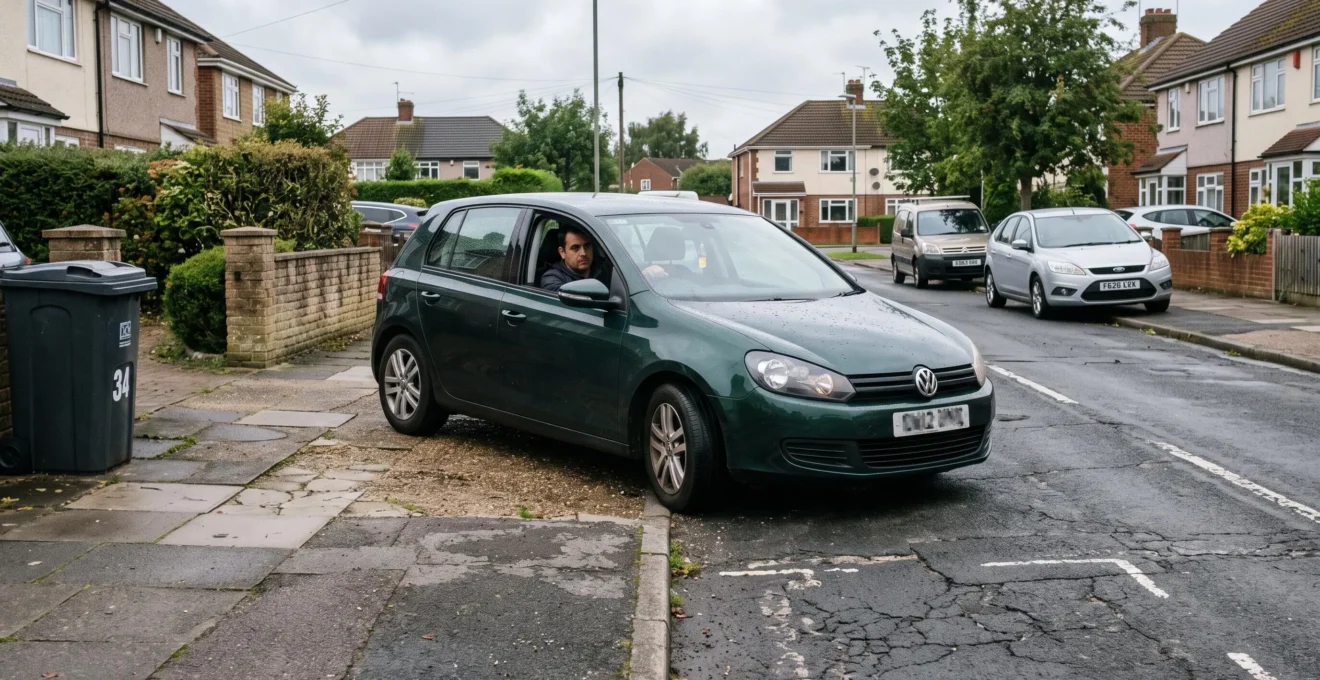
Driving a vehicle onto a public road changes the legal requirements governing the driver, the vehicle and its insurance. A journey that appears straightforward on private land may become unlawful as soon as the vehicle enters a road or another place covered by traffic legislation. The distinction matters whether the journey involves a family car, a vehicle being repaired or an off-road vehicle returning from rough terrain.
The difficulty is that private ownership does not necessarily mean an area is exempt from road traffic law. Supermarket car parks, privately maintained access roads and other locations open to the public can be subject to important driving obligations, even when the landowner is not a public authority.
This guide uses Great Britain as its principal legal example, drawing on official Highway Code guidance and UK legislation. Other English-speaking jurisdictions, including Northern Ireland, Ireland, the United States, Canada, Australia and New Zealand, have their own definitions and requirements. The same practical questions are useful across jurisdictions, but specific legal conclusions must be checked locally.
Public-road driving: the essential legal distinctions
- A privately owned car park or access road may still fall within road traffic law when the public has access.
- Driving entitlement, appropriate insurance, vehicle condition and applicable registration or inspection requirements must be checked separately.
- A short movement from private land onto a public road can trigger full road-use obligations, regardless of distance or destination.
- Why Can a Car Park Sometimes Be Treated Like a Public Road?
- How Can You Tell Whether an Area Is Publicly Accessible for Driving Rules?
- Public Road or Private Land: Which Driving Rules Still Apply?
- Which Location Assumptions Can Create Illegal Vehicle Use?
- When Do Road-Legal Requirements Begin During a Journey From Private Land?
- How Should You Check Your Vehicle Before Driving on Rough Terrain?
- Why Can a Roadworthy Car Still Be Illegal to Drive?
- Which Driving Obligations Apply Every Time You Use a Vehicle?
Why Can a Car Park Sometimes Be Treated Like a Public Road?
A car park can fall within road traffic law because the public is permitted to use it, even when the land belongs to a private business. In Great Britain, some driving offences apply on roads and other public places. The legal status therefore depends on public access and the wording of the relevant law, not ownership alone.
The distinction is particularly important in supermarket car parks, hospital parking areas and privately owned roads serving commercial developments. A landowner may retain responsibility for the site while allowing members of the public to enter and drive around it.
The Highway Code guidance on road traffic law explains that many roads and driveways on private land, including many car parks, fall within the scope of road traffic legislation. It also distinguishes the legal definitions applicable in England and Wales from those used in Scotland.
There are two important classifications to consider:
- A road: a location meeting the relevant statutory definition, which may include privately owned roads accessible to the public.
- Another public place: an area accessible to the public that may not necessarily qualify as a road but can still fall within legislation covering particular driving offences.
For example, a driver might assume that moving a vehicle while intoxicated inside a supermarket car park is outside normal traffic law. That assumption can be wrong because drink-driving legislation may apply in a public place even where the precise road classification differs.
The same reasoning explains why a privately owned car park is not automatically a suitable place for an uninsured driver to practise driving. The public-access element may trigger compulsory insurance requirements.
However, no single characteristic makes every car park a road. The actual use of the site, who can enter and the statutory provision involved all matter. A restricted staff-only area may raise different legal questions from a customer car park open to visitors.
The next practical question is how to assess public access when the physical boundaries are unclear.
How Can You Tell Whether an Area Is Publicly Accessible for Driving Rules?
To assess whether an area is publicly accessible, examine who is allowed to enter, whether access is genuinely restricted and how the land is used. Signs, gates and barriers provide useful evidence but are not decisive on their own. Where the status is uncertain, check with the landowner or relevant public authority before relying on an exemption from driving rules.
Start by separating the location into three broad categories. These are practical classifications rather than universal legal definitions.
- Public roads: highways and other roads falling within the jurisdiction’s legal definition.
- Publicly accessible private land: privately owned locations admitting customers, visitors or other members of the public, potentially including car parks and access roads.
- Land genuinely closed to public access: areas where entry is restricted to authorised users and the public is not generally admitted.
Next, consider the evidence available at the entrance and throughout the site. A height barrier might restrict the types of vehicles allowed without excluding the public. Conversely, a secured industrial yard with controlled entry might indicate a more restricted location.
Grey areas include gated residential developments, privately maintained estate roads, access routes serving several properties and industrial estates that admit delivery drivers or visiting customers. A gate might regulate entry without settling whether the public has access for the purpose of a particular law.
Where the answer matters legally, follow a verification sequence:
- Read entrance signs and any published access conditions.
- Determine whether ordinary members of the public can enter or whether individual permission is required.
- Identify the landowner and, where possible, the authority responsible for maintaining or regulating the route.
- Check highway records, relevant land records or official guidance where appropriate.
- Ask the insurer about coverage and seek jurisdiction-specific legal advice if the classification remains disputed.
Land ownership records can help identify who controls the property, but ownership records alone do not prove whether road traffic legislation applies.
Once the location is classified, each driving obligation must be considered separately rather than assuming that every traffic rule either applies or disappears.
Public Road or Private Land: Which Driving Rules Still Apply?
Driving rules do not divide neatly into public-road rules and private-land exemptions. In Great Britain, compulsory motor insurance applies on roads and other public places, while requirements such as vehicle taxation and particular traffic restrictions may depend on the location’s legal status. Genuinely restricted private land can be treated differently, but permission, safety and insurance conditions still matter.
The clearest example is compulsory insurance. Section 143 of the Road Traffic Act 1988 prohibits using a motor vehicle on a road or other public place without the required insurance, subject to the legislation’s applicable provisions and exceptions.
To understand the difference between locations, consider each obligation independently.
| Requirement | Public road | Private land or publicly accessible area |
|---|---|---|
| Driving licence | Valid entitlement normally required for the vehicle and use. | Some licensing requirements extend to public places; genuinely restricted land may be treated differently. |
| Motor insurance | Compulsory cover normally required. | Also required on other public places within the statutory rules; private-use policy coverage needs separate checking. |
| Vehicle condition | Applicable roadworthiness and construction requirements must be met. | Requirements depend on the provision and location; unsafe use can also create other liabilities. |
| Vehicle tax and registration | Relevant registration and taxation requirements apply, subject to exceptions. | Not automatically identical to public-road obligations; vehicle status and actual use must be checked. |
| Speed limits and traffic controls | Applicable statutory limits and traffic controls must be obeyed. | Enforceability depends on the road’s classification and the legal basis of the restriction. |
| Enforcement | Road traffic offences may be investigated and enforced. | Offences extending to roads or public places may still be enforceable, with powers depending on the circumstances. |
This table describes general distinctions rather than deciding the status of any individual site. A privately owned road can, for example, fall within a statutory road definition even though the maintenance responsibility remains private.
Rights of passage introduce another complication. Some privately owned routes carry public access rights or qualify as roads under legislation despite not being publicly maintained. A private-road sign therefore does not necessarily remove statutory obligations.
Insurance deserves an additional check. Compulsory third-party insurance and contractual cover for damage to the driver’s own vehicle are different questions. A policy may satisfy legal minimums while excluding or restricting certain off-road activities, vehicle uses or types of damage.
Drivers should inspect the policy’s geographical scope, permitted uses, named or authorised drivers and relevant exclusions. A policy covering ordinary road driving should not automatically be assumed to cover organised off-road activities or specialist terrain.
This layered approach also exposes the assumptions most likely to turn an ordinary vehicle movement into an unlawful one.
Which Location Assumptions Can Create Illegal Vehicle Use?
Illegal vehicle use often begins with an incorrect assumption about where driving rules apply. Common mistakes include believing that private ownership removes legal requirements, that missing signs grant permission or that moving a vehicle a few metres is exempt. Another risk is assuming insurance applies automatically to every location and activity. Each belief can be wrong.
Four assumptions deserve particular attention.
- “It’s private property, so road rules do not apply.” A privately owned area may still be a road or other public place under the applicable legislation.
- “There are no signs, so driving must be allowed.” The absence of restrictions on a sign does not establish permission to enter, lawful vehicle use or exemption from traffic rules.
- “I’m only moving the car a short distance.” Traffic offences generally do not disappear because a journey is brief. Even a short movement can amount to driving in a regulated location.
- “My insurance covers driving anywhere.” Policy conditions, driver eligibility and permitted activities require separate verification.
Consider a hypothetical example. A driver intends to move an uninsured vehicle from one side of a retail car park to another. The land is privately owned, and the movement is short. However, if the area is a public place under the relevant motor insurance legislation, the private ownership and short distance do not remove the compulsory insurance requirement.
The reverse assumption can also cause problems. Land excluded from public access does not automatically become available for recreational driving. A person may need the landowner’s permission, and unauthorised vehicle use can involve civil liability or criminal offences depending on local law and the circumstances.
Insurance consequences should be evaluated carefully. Breaching a policy condition does not automatically mean every claim can lawfully be rejected. The outcome depends on the contract, compulsory insurance legislation and applicable insurance law. An insurer’s duties toward third parties may differ from its obligations to reimburse the policyholder.
Five checks before driving in an unfamiliar location
- Identify the area: record the location and whether access is public, restricted or uncertain.
- Verify permission: retain a photograph of relevant signs or written authorisation from the landowner where needed.
- Check your driving entitlement: confirm that the intended driver is authorised for the vehicle and record the relevant licence category.
- Confirm insurance: check the intended location and activity against the policy and retain written clarification when necessary.
- Review vehicle status: record the insurance, registration, tax and inspection status relevant to the planned use before moving the vehicle.
This routine turns uncertain location-based assumptions into evidence that can be reviewed before a journey. It cannot replace a legal determination where public access or highway boundaries are genuinely disputed.
The exact point where a journey enters a regulated road environment is the next issue to establish.
When Do Road-Legal Requirements Begin During a Journey From Private Land?
Full public-road requirements must be satisfied before a vehicle enters a public road. The relevant boundary may include a pavement, verge or access crossing rather than simply the visible edge of the carriageway. Some duties, particularly compulsory insurance, can apply earlier if the vehicle is already being used in another public place.
Imagine a car parked in a private garage. While it remains on genuinely restricted private land, certain road-use requirements may not apply in the same way as they would on the highway. That changes when the planned movement reaches a legally regulated area.
The driver’s practical timeline should therefore begin before the vehicle moves:
- Establish the legal status of the starting location.
- Identify whether the route crosses a public place, highway, pavement or verge.
- Confirm that the driver and vehicle meet all obligations applicable to each part of the route.
- Do not proceed across a regulated boundary unless the necessary conditions are satisfied.
A common problem occurs when an untaxed, uninsured or otherwise non-compliant vehicle needs to be moved from a driveway to another property. Calling the trip a short transfer does not create a general exemption.
For vehicles subject to the UK’s Statutory Off Road Notification system, DVLA guidance on Statutory Off Road Notification explains the restricted circumstances in which a SORN vehicle may be driven on a public road, including travel to or from a pre-booked MOT or other testing appointment.
That exception should not be interpreted as permission for an arbitrary journey or as an exemption from every other applicable driving requirement.
When a vehicle cannot lawfully be driven onto the road, a suitable trailer or vehicle transporter may provide a practical alternative. Any transport arrangement must itself comply with applicable towing, loading, vehicle and driver requirements.
Trade plates or other movement permissions may offer alternatives in limited circumstances, but they are governed by specific eligibility and use conditions. They should never be treated as a universal solution for moving an unregistered or untaxed vehicle.
Property boundaries and highway boundaries also need distinguishing. A driveway may meet a pavement or pass over a verge forming part of the public highway. The point at which the vehicle reaches the main carriageway is not necessarily the first point at which public-road requirements become relevant.
For vehicles returning from off-road activities, the legal transition also makes their mechanical condition immediately relevant.
How Should You Check Your Vehicle Before Driving on Rough Terrain?
Before driving on rough terrain, inspect the tyres, brakes, steering, suspension, underbody and recovery equipment. Check the route, weather, load security and available communications as well. The vehicle must be suitable for the terrain, and any damage or modification must be reassessed before returning to a public road.
Rough ground introduces mechanical risks that ordinary road journeys may not expose. Rocks can damage tyres or underbody components, deep ruts can affect suspension or steering, and prolonged low-speed driving can place different demands on vehicle cooling and drivetrain systems.
A useful inspection has three stages.
First, check mechanical condition. Inspect tyres for damage and assess their suitability for the surface. Confirm that brakes and steering operate correctly, look for fluid leaks and examine accessible suspension and underbody components. Any tyre-pressure adjustment should follow vehicle and tyre manufacturer guidance for the intended terrain, load and speed.
Recovery equipment also needs attention. Recovery points must be suitable for their intended loads, and recovery should be attempted only with appropriate equipment and competence.
Second, check the load and equipment. Loose tools, luggage and recovery gear can become dangerous when the vehicle pitches or tilts. Secure the load and ensure that it does not exceed the relevant vehicle limits.
Third, review the operating conditions. Ground firmness, rainfall, visibility, distance from assistance and mobile coverage can all affect whether a route is sensible. Confirm that driving is permitted on the land before entering it.
The legal connection is particularly important after the journey. Off-road use may damage lamps, number plates, tyres, exhaust components or other equipment needed for lawful road driving.
Modifications also require care. Alternative tyres, raised suspension, lighting changes and emissions-system modifications may have road-legality implications depending on the jurisdiction and the modification itself. Off-road suitability does not establish public-road compliance.
Finally, inspect insurance terms before entering rough terrain. A standard motor policy should not be assumed to cover every off-road activity, even when the vehicle remains insured for ordinary road use.
A vehicle can nevertheless be mechanically sound and still fail other legal conditions required for public-road driving.
Why Can a Roadworthy Car Still Be Illegal to Drive?
A roadworthy car can still be illegal to drive because mechanical condition is only one part of road-use compliance. The driver may lack the necessary licence, the vehicle may not meet registration or taxation requirements, or the insurance may not cover the intended driver or use. A valid inspection certificate does not resolve these separate obligations.
For a conventional passenger car used on public roads, legal compliance can be divided into three main areas.
- Driver entitlement: the driver must hold the appropriate valid licence and comply with any conditions, restrictions or supervision requirements.
- Vehicle status: applicable registration, taxation, periodic inspection and construction requirements must be satisfied.
- Insurance: an appropriate policy must be in force for the actual vehicle, driver and intended use.
Consider a mechanically sound vehicle that has passed its required safety inspection. If the driver is not insured to operate it, the inspection result does not make the journey lawful.
Likewise, a registered and appropriately insured vehicle may be unsafe because a tyre is badly damaged or a critical brake component has failed. Valid documents do not excuse an unroadworthy condition.
This illustrates an important distinction between inspection status and actual vehicle safety. An inspection establishes compliance with the relevant test requirements at the time of examination. It is not a permanent guarantee of the vehicle’s condition.
Different jurisdictions also treat outstanding safety recalls differently. A recall should be investigated promptly, but it must not be assumed that every outstanding recall automatically makes the vehicle illegal to drive in every country.
A practical compliance review should compare the licence, insurance, vehicle registration, applicable tax and inspection status with the proposed journey. Relevant expiry dates should be recorded, and changes in drivers or vehicle use should trigger another review.
For example, using a vehicle commercially or allowing a different person to drive may require checks beyond the ordinary annual renewal cycle.
The objective is to treat driving entitlement, vehicle condition and administrative compliance as connected but independent requirements.
Key takeaways before every public-road journey
- Assess where road traffic legislation applies before relying on the location’s private ownership or restricted appearance.
- Check driver eligibility, vehicle status and insurance independently; one valid document cannot compensate for another missing requirement.
- Reassess compliance whenever a vehicle changes location, driver, intended use or mechanical condition.
Which Driving Obligations Apply Every Time You Use a Vehicle?
Every public-road journey requires the driver and vehicle to meet the legal conditions applicable in that jurisdiction. These normally include appropriate driving entitlement, compulsory motor insurance, required vehicle registration and taxation, and a roadworthy vehicle. Periodic inspections and other requirements apply where prescribed. The journey’s short duration or familiar destination does not remove these obligations.
A useful way to organise these requirements is to separate checks that must remain continuously valid from checks that should be repeated before driving.
| Area | What to verify | When to review |
|---|---|---|
| Driver entitlement | Correct licence category, validity and applicable conditions. | Before driving, especially after changes in driver or vehicle category. |
| Insurance | Required cover is active and appropriate for the driver and use. | Before use and whenever the policy, driver or activity changes. |
| Registration and tax | Vehicle records and applicable fees or taxes are compliant. | At relevant renewal dates and before returning a vehicle to the road. |
| Vehicle inspection | Any legally required periodic inspection remains valid. | At the inspection interval prescribed by local law. |
| Roadworthiness | Tyres, brakes, steering, lights, visibility and other safety-critical systems are serviceable. | Before journeys as appropriate, and after damage, repairs or demanding off-road use. |
The Highway Code guidance on vehicle documentation, set out in Annex 3, identifies separate requirements for driving licences, insurance, MOT testing, vehicle registration and Vehicle Excise Duty. These requirements illustrate why a vehicle’s legal status cannot be determined by checking only one document.
For ordinary cars and motorcycles in Great Britain, MOT testing normally begins three years after first registration and continues annually, subject to applicable exemptions and specific vehicle rules. Inspection schedules elsewhere can differ substantially.
The consequences of non-compliance also depend on the specific offence. In Great Britain, road traffic violations can involve fines, penalty points, driving disqualification or vehicle seizure where the relevant legal conditions are met. Driving without the required insurance can also expose a person to significant financial consequences after an incident.
However, penalties and liability should not be treated as automatic or identical for every offence. A taxation issue, licensing offence and dangerous vehicle condition involve different legal provisions and potential outcomes.
For recurring compliance, maintain a single record of licence validity, insurance arrangements, vehicle registration, inspection deadlines and tax status. Supplement that record with practical vehicle checks before driving and additional reviews after damage or changes in use.
The same framework applies when a vehicle is moved from private premises, collected after repairs or returned from rough terrain. The driver should establish the legal classification of the route and ensure that all relevant requirements are satisfied before entering it.
Before the next journey, verify the intended route, the driver’s entitlement, the vehicle’s mechanical and administrative status, and the insurance conditions against current official guidance in the relevant jurisdiction. If any essential requirement remains uncertain, resolve it before driving.
Can a learner driver practise in a supermarket car park?
A supermarket car park may qualify as a road or other public place under relevant legislation. In Great Britain, this means learner-driver requirements and compulsory insurance rules may apply. A learner should not treat the car park as exempt private land simply because the supermarket owns it. Applicable supervision, licensing and insurance requirements must be established before practising.
Does a private-road sign mean ordinary driving laws do not apply?
No. A sign identifying private ownership does not, by itself, establish exemption from road traffic legislation. Public access, the road’s statutory classification and the particular offence or obligation determine which rules apply. The route may also carry public passage rights despite private ownership.
Can an uninsured vehicle be moved across a public pavement?
In Great Britain, using a motor vehicle on a road or other public place without the required insurance is generally prohibited, subject to statutory exceptions. A pavement can form part of the public highway, so crossing it is not automatically exempt merely because the movement begins and ends on private property. The precise location and legal circumstances must be checked.
Does third-party motor insurance cover off-road damage to your own car?
Compulsory third-party insurance is intended to meet the applicable third-party liability requirements, not necessarily to pay for damage to the insured vehicle. Cover for the driver’s own car depends on the policy, and off-road activities may be restricted or excluded. The insurer should confirm the intended use before the activity.
Can a vehicle with a SORN be driven to a pre-booked MOT test?
UK government guidance recognises a limited exception allowing a SORN vehicle to be driven on a public road to or from a pre-booked MOT or other testing appointment. This does not create general permission for other journeys and does not remove unrelated applicable requirements, including insurance and vehicle safety obligations.