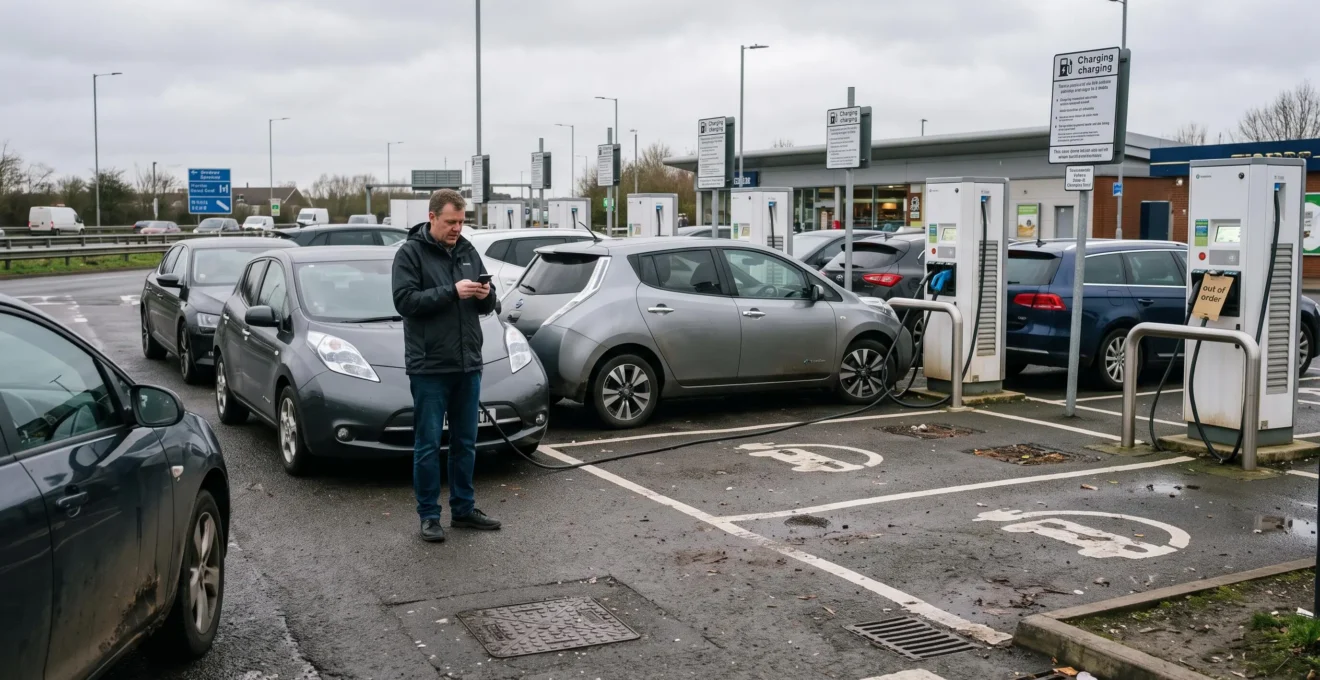
Reliable electric vehicle charging in the UK depends less on finding a large number of charge points than on knowing which ones will work for your car, your timetable and your normal driving pattern. A nearby charger offers little practical benefit if it is regularly occupied, inaccessible when needed or difficult to pay for.
The most dependable approach begins with a realistic weekly charging routine. Drivers with off-street parking may be able to charge overnight, while those relying on public infrastructure need to identify convenient charging opportunities, compare running costs and establish alternatives before problems arise.
Longer journeys introduce further considerations: charging speeds, seasonal range changes, busy motorway services and uncertainty at the destination. Changes in driving habits can also affect insurance declarations and estimated annual mileage.
By matching charging infrastructure to actual vehicle use, drivers can reduce unnecessary detours, avoid preventable delays and make a better-informed decision about whether an electric car suits their circumstances.
EV charging planning: the essentials
- Build your charging routine around dependable access, suitable connectors and realistic weekly mileage, not charger numbers alone.
- Choose a primary charging option and an independent backup, particularly if you cannot charge at home.
- Prepare for longer journeys with reserve battery capacity, alternative stops and insurance details that reflect how you actually use the vehicle.
- Why Can an Area With Many EV Chargers Still Be Difficult for Drivers?
- How Can You Plan Charging if You Cannot Install a Home Charger?
- Home, Workplace or Public Charging: Which Best Fits Your Weekly Driving?
- Which Charging Habits Can Leave EV Drivers Stranded or Delayed?
- When Should You Charge Earlier Before a Long Electric-Car Journey?
- When Should You Update the Vehicle-Use Class on Your Policy?
- When Do Road-Legal Requirements Begin During a Journey From Private Land?
- How Can You Estimate Annual Mileage Without Guessing Too Low or Too High?
Why Can an Area With Many EV Chargers Still Be Difficult for Drivers?
An area can have numerous public EV chargers yet remain difficult to use because charger numbers do not establish real-time availability, reliability or compatibility. Broken equipment, occupied bays, queues, restricted access and unsuitable connectors can all prevent charging. Drivers should therefore assess usable charging options, including backups, rather than relying on the number of installations shown on a map.
UK charging statistics demonstrate why infrastructure coverage needs careful interpretation. According to the Department for Transport public EV charging statistics for July 2026, the UK had 121,171 publicly available chargers on 1 July 2026, including 28,887 rated at 50 kW or above.
These figures describe recorded infrastructure, not whether a particular charger will be available when a driver arrives. The distribution also varies substantially between locations and charging speeds.
121,171 public EV chargers
Recorded across the United Kingdom on 1 July 2026. This historical infrastructure count does not measure live availability, queues or suitability for individual vehicles.
Department for Transport, public electric vehicle charging infrastructure statistics, July 2026.
A driver searching for rapid charging may find that most nearby installations are slower destination chargers. Alternatively, a suitable rapid charging hub may contain several connectors but be heavily used during a holiday departure period.
Charging redundancy is therefore more useful than charger density alone. Before depending on a location, identify another accessible site within the vehicle’s realistic remaining range. Ideally, the alternative should use a different charging operator so that a single network disruption does not affect both options.
UK regulations also distinguish technical reliability from a driver’s immediate experience. The UK government guidance on public charging reliability and payment requirements explains the annual average 99% reliability requirement for public rapid charging networks. This is measured across an operator’s qualifying network, not guaranteed for every charger at every moment.
Operators must also provide specified availability information, including updates to relevant equipment status data within 30 seconds of a change. However, this does not guarantee that every third-party application presents the same information instantly.
Before a time-critical journey, cross-check the network operator’s own app with an independent service such as Zapmap or Electroverse. Confirm the connector type, power, payment method, access restrictions and recent availability status. A phone call or alternative stop may be sensible when information conflicts.
Once availability is assessed as a practical service rather than a map statistic, the next question becomes whether that service can support your ordinary week without home charging.
How Can You Plan Charging if You Cannot Install a Home Charger?
Drivers without a home charger can make electric-car ownership practical by combining dependable workplace charging, nearby public facilities and charging during existing activities. The essential test is whether these options provide enough energy, at an acceptable cost, within normal weekly routines. If access is unreliable or regularly requires inconvenient dedicated trips, an EV may not be the right choice yet.
Start by estimating your typical weekly distance and the electricity your car needs to cover it. Then investigate charging options within realistic reach of your home, workplace, shopping locations and other regular destinations.
The objective is to identify charging opportunities that are available when the car would otherwise be parked.
| Charging option | Best suited to | Main limitation to check |
|---|---|---|
| Workplace charging | Drivers who park at work for several hours on regular days | Shared availability, access rules and changing employment patterns |
| Local rapid charging | Drivers needing predictable, relatively short charging sessions | Tariffs, queues and dependence on local infrastructure |
| Supermarket or destination charging | Drivers whose shopping or leisure stops allow meaningful charging time | Charger power, parking limits and whether spaces are available |
| Combined charging routine | Drivers with several recurring opportunities but no single dependable option | Coordination and the need for independent backups |
Opportunity charging means treating charging as part of an activity you already undertake. For example, a driver who spends a regular period shopping can use an accessible supermarket charger rather than arranging a separate charging trip.
Charging economics matter equally. Public charging can cost substantially more than electricity supplied under a suitable domestic overnight tariff. Without access to home charging, a prospective buyer should calculate likely weekly electricity expenditure rather than assuming that every electric vehicle delivers the same running-cost advantage.
For a personalised calculation, multiply the electricity purchased in kilowatt-hours by the applicable price per kilowatt-hour. Include any session charges, parking fees and the effect of charging losses where relevant.
As an explicitly hypothetical illustration, purchasing 60 kWh in a week at 30p/kWh would cost £18, while purchasing the same quantity at 70p/kWh would cost £42. These are calculation examples, not verified UK market tariffs. Actual pricing and charging conditions must be checked.
Some drivers may also benefit from on-street infrastructure, such as lamppost charging or community charging arrangements. Cross-pavement cable channels provide another potential route to domestic charging where dedicated off-street parking is unavailable.
However, these options are not automatically available or lawful at every address. The government guidance on cross-pavement EV charging in England makes clear that installations on public highways depend on local authority decisions and site-specific considerations. The guidance applies to England; arrangements elsewhere in the UK require separate checking.
A workable combination should cover ordinary driving without relying on perfect availability. The next step is to decide which charging location deserves to become your primary option.
Home, Workplace or Public Charging: Which Best Fits Your Weekly Driving?
Home charging generally offers the greatest scheduling flexibility for drivers with suitable parking and electrical arrangements, while workplace charging can be convenient when access is dependable. Public charging provides essential flexibility but may introduce higher costs or waiting time. The best choice depends on weekly mileage, time spent parked, energy prices and how reliably each option is available.
Charging speed alone is a poor basis for choosing a routine. A slower charger that reliably supplies electricity while a car is parked overnight may be more useful than a rapid charger requiring a detour and a dedicated stop.
Compare each option using three criteria: cost per mile, dependable access and charging speed. The importance of each criterion changes with individual circumstances.
| Criterion | Home | Workplace | Public |
|---|---|---|---|
| Cost per mile | Depends on domestic tariff and installation costs | Depends on employer pricing and access conditions | Depends on operator, location, power and additional fees |
| Reliability | Usually under the driver’s control when a suitable dedicated charger is available | Depends on shared demand and workplace rules | Depends on location, occupancy, equipment and access |
| Charging speed | Usually suited to longer parking periods | Often suited to time spent at work | Ranges from slower destination charging to high-power rapid charging |
| Practical convenience | Charging can happen while the vehicle is parked at home | Can overlap with working hours | Can support routine errands, unexpected journeys and longer trips |
The main mistake is to mistake low cost for dependable convenience. A workplace charger may offer attractive pricing but become impractical if too many employees compete for limited spaces. Conversely, a more expensive public location might be easier to use consistently.
Before treating an option as your primary solution, observe its availability over two to four representative weeks. Record whether charging is possible on the days you need it, how much electricity you obtain and whether interruptions require additional journeys.
A useful charging strategy has three distinct layers:
- Primary charging: the option expected to cover most ordinary weekly driving.
- Backup charging: an accessible alternative when the main option is unavailable.
- Journey charging: facilities selected for occasional longer trips rather than everyday dependence.
Independence matters. Two chargers operating on the same restricted site or affected by the same network outage may not provide a genuinely separate fallback.
Charging arrangements can also influence insurance information. If the car is routinely left overnight in a public car park rather than on a private driveway, check whether the parking location declared to your insurer remains accurate.
Once a suitable routine is established, keeping sufficient battery reserve and avoiding predictable charging mistakes becomes the next priority.
Which Charging Habits Can Leave EV Drivers Stranded or Delayed?
EV drivers are most likely to encounter avoidable charging problems when they repeatedly run the battery close to empty, depend on one charging provider, ignore changing weather conditions or arrive without enough range to reach another charger. More reliable habits involve smaller planned top-ups, multiple payment options and a reserve based on real-world driving conditions.
Waiting until the battery is nearly depleted may appear efficient, but it leaves little flexibility if the intended charger is occupied, defective or inaccessible. The immediate problem is not necessarily insufficient total driving range; it is the loss of alternative options.
Charging little and often can therefore be more practical than consistently seeking the lowest possible battery percentage before stopping. This does not mean every journey requires a full battery. It means maintaining enough usable range to respond to foreseeable disruption.
Dependence on one network creates a separate vulnerability. Even a normally reliable operator can experience payment problems, connection failures or local equipment faults. Setting up alternative payment arrangements before a journey reduces the need to troubleshoot accounts while waiting at a charger.
Seasonal conditions also affect planning. Cold weather can reduce usable driving range through battery temperature effects, cabin heating and other operating demands. The size of the reduction depends on the vehicle, journey and conditions, so a routine tested in mild weather should not automatically be assumed sufficient in winter.
Reassess how much reserve your vehicle needs under the conditions you actually encounter. The objective is to arrive with enough energy to reach a viable alternative if the planned charging stop cannot be used.
Five actions for a dependable charging routine
- Record your normal weekly mileage and energy consumption, producing a realistic estimate of how much electricity your routine requires.
- Identify one primary charging location and one independent alternative, saving both locations and their access details.
- Check connector compatibility, opening restrictions and payment arrangements, creating a short list of chargers your vehicle can actually use.
- Set up and test suitable payment methods or charging accounts in advance, confirming that at least one alternative method is available where supported.
- Review recent real-world range in colder or demanding conditions and establish a personal minimum arrival reserve that leaves a reachable backup.
None of these habits can eliminate charging disruption entirely. Their value lies in preventing an ordinary delay from becoming a situation where the driver has no practical alternative.
These safeguards become especially important on longer journeys, where one unsuitable stop can affect the entire itinerary.
When Should You Charge Earlier Before a Long Electric-Car Journey?
Charging earlier is sensible when a long journey involves uncertain charging availability, busy travel periods, cold weather or limited facilities at the destination. Starting with ample battery capacity makes the first planned charging stop less critical and protects flexibility after arrival. The aim is not always to charge to 100%, but to begin with enough energy for realistic alternatives.
A useful long-distance charging plan considers two separate needs: the energy required to complete the journey and the reserve needed when you reach your destination.
The second is often overlooked. A driver may successfully reach a hotel, holiday property or rural destination only to discover that the expected charger is occupied, inaccessible or unavailable overnight.
Charging before departure, where practical, reduces reliance on an early motorway stop. Drivers with suitable home charging can prepare the vehicle the previous evening, subject to the manufacturer’s battery charging guidance.
Charging to a high state of charge is not always the fastest strategy during a journey. Many electric vehicles accept power more slowly as their batteries become fuller, so additional charging time must be weighed against the range gained.
A well-designed route uses realistic arrival estimates and identifies alternative charging locations for each important leg. It should also consider whether the destination has dependable facilities or whether additional charging before arrival would be prudent.
For example, consider a hypothetical journey with a planned rapid-charging stop after the first substantial driving leg. If the driver begins with a larger usable reserve, the intended stop may be postponed when charging facilities are crowded. With minimal reserve, the same interruption could become unavoidable.
Holiday traffic adds uncertainty because charger occupancy may change significantly during busy departure and return periods. Cold weather introduces a different problem by affecting consumption and potentially charging performance.
For demanding journeys, leave extra time, compare the availability of planned stops shortly before departure and avoid treating a single charger as indispensable.
After deciding how and where to charge, the same travel patterns should be reflected in the information provided to your motor insurer.
When Should You Update the Vehicle-Use Class on Your Policy?
Review your vehicle-use class whenever your actual driving changes, particularly when you start commuting, change jobs, begin making business journeys or substantially alter how you use the car. Switching to an EV does not automatically require a different use class, but new charging and travel routines can expose differences between declared and actual use that should be checked with the insurer.
UK motor insurance policies commonly distinguish between social or domestic use, commuting and business use. Definitions and available cover vary between insurers, so the wording of the individual policy is decisive.
Social-only use may not include commuting. Social and commuting cover may include travelling to a regular workplace but not automatically cover journeys made as part of paid work. Business use can apply where the vehicle is used for work-related travel beyond ordinary commuting.
Changing to an electric car can alter these patterns. A driver might begin travelling to a different workplace to take advantage of charging, use the EV for additional business visits or make more frequent journeys because it becomes the household’s preferred vehicle.
Relevant triggers for reviewing the policy include:
- Starting a new job or changing the normal workplace.
- Beginning to commute when the policy previously covered social use only.
- Driving to meetings, customer locations or other destinations for work purposes.
- Taking on additional driving duties or changing how the vehicle is shared.
- Increasing annual mileage beyond the estimate originally provided.
- Changing the location where the vehicle is normally kept overnight.
An incorrect declaration may have financial consequences if it materially affects the risk or the cover purchased. Depending on the circumstances, policy terms and applicable insurance law, an insurer may have grounds to adjust its response to a claim. This should not be presented as automatic cancellation or refusal whenever a discrepancy exists.
The practical approach is to contact the insurer when a relevant change occurs, explain the new driving circumstances and obtain confirmation of any required amendment.
Insurance also matters when charging or storing a vehicle in shared spaces, where the difference between privately owned land and a legally public place may not be obvious.
When Do Road-Legal Requirements Begin During a Journey From Private Land?
In Great Britain, compulsory motor insurance generally becomes relevant when a motor vehicle is used on a road or another public place, even if that location is privately owned. A journey beginning on private land does not necessarily remain outside these obligations until the vehicle reaches a publicly maintained road. The precise legal position depends on the location and circumstances.
This distinction matters for EV drivers because charging often takes place in shared car parks, residential developments, retail facilities or privately managed spaces accessible to other people.
Under section 143 of the Road Traffic Act 1988, a motor vehicle must have the required insurance when used on a road or other public place, subject to statutory qualifications and exceptions. This provision applies in England, Wales and Scotland. Northern Ireland has a separate legislative framework that should be checked independently.
Ownership does not settle whether an area qualifies as a public place. A privately owned car park may be accessible to the public, while a genuinely private residential space may present different circumstances. The relevant legal classification cannot be determined solely from a sign describing the land as private.
For an EV owner, the distinction can become important when moving a vehicle between a driveway, shared charging facility and adjoining road.
It is also important not to treat compulsory insurance as the only road-legal requirement. Other obligations may apply according to the vehicle’s registration, tax status, roadworthiness and use. Their precise application must be checked separately rather than inferred from the insurance rule alone.
Two practical checks are particularly useful. First, confirm whether the areas routinely used for charging or manoeuvring are accessible to members of the public. Second, check that the insurance policy accurately describes where the vehicle is normally kept and the use for which it is insured.
Where the status of a location is genuinely uncertain, seek clarification from the site operator, insurer or an appropriately qualified legal adviser. Do not assume that the presence of charging infrastructure determines whether a site is legally public or private.
With charging access and legal obligations understood, the final planning task is to translate actual travel into a credible annual mileage estimate.
Key takeaways before estimating mileage
- Record how much you actually drive after switching vehicles, not simply the mileage of the car you previously owned.
- Separate routine journeys from occasional longer trips so annual estimates reflect the full pattern of use.
- Use measurable information to support both charging requirements and insurance declarations, reviewing the figures when circumstances change.
How Can You Estimate Annual Mileage Without Guessing Too Low or Too High?
Estimate annual mileage by combining recorded odometer readings, regular weekly journeys and foreseeable longer trips. For EV drivers, the calculation should reflect how the electric car will actually be used, especially if it replaces journeys previously made in another household vehicle. A measured estimate, reviewed periodically, is more dependable than choosing a low figure simply to reduce an insurance quote.
Begin with any available mileage history. A recent MOT record can provide a useful reference for an existing vehicle, although historic mileage should not automatically be treated as a forecast for a new electric car.
Next, record odometer readings over a representative period of two to four weeks. Include commuting, shopping, family journeys and other recurring activities. Where the sample is unusually busy or quiet, adjust the estimate using known differences in the normal schedule.
Annual mileage can be calculated using a simple model:
Estimated annual mileage = representative weekly mileage × 52 + additional journeys not included in the weekly average.
Avoid double-counting holidays or longer trips already included in the observed driving sample. Likewise, make allowances for periods when commuting or other regular journeys do not occur.
As a hypothetical example, a driver covering 160 miles during a representative week would calculate 8,320 miles over 52 weeks before adjusting for annual leave, additional travel or other known variations. This is a mathematical illustration, not an estimate of typical UK EV mileage.
The calculation also provides a useful link to charging requirements. If the vehicle’s observed energy consumption is known, estimated weekly distance can be used to calculate approximate electricity demand and evaluate whether available charging windows are sufficient.
Deliberately understating annual mileage to seek a cheaper premium can create unnecessary insurance risk. Equally, substantially overestimating mileage may mean paying for an inaccurately described risk. A sensible approach is to choose a realistic figure with appropriate allowance for foreseeable variation, rather than assuming either extreme is automatically preferable.
If actual mileage begins to exceed the declared estimate materially, contact the insurer to check whether an update is needed. The implications of inaccurate mileage information depend on policy wording, materiality and the circumstances; they are not identical across all policies.
Review your odometer, charging records and insurance declarations together after a representative period of EV ownership. A short, evidence-based review can help ensure your charging plan, expected costs and declared vehicle use remain aligned with the journeys you actually make.
Can you run an electric car using only public chargers?
Yes, provided that suitable public charging is reliably accessible and affordable for your driving needs. Before buying, assess weekly mileage, charger power, parking restrictions, payment methods and likely costs. Have an alternative location available if your regular charger becomes unavailable.
Does a 99% charging reliability requirement guarantee that a rapid charger will work when you arrive?
No. The UK’s 99% rapid charging reliability requirement is measured as an annual average across a qualifying operator network, rather than as a guarantee for each individual charge point. An operational charger may also be occupied. Checking current status and identifying a backup remains sensible.
Is it safe and permitted to run an EV charging cable across a pavement?
Do not assume that placing a cable across a public pavement is permitted simply because it connects your home to your vehicle. In England, permanent cross-pavement charging solutions depend on local authority decisions and applicable safety and accessibility requirements. Temporary cable covers are not automatically authorised by the government guidance on permanent solutions. Check the relevant local authority’s rules before proceeding.
Should you always charge an EV battery to 100% before travelling?
Not necessarily. A higher starting charge can provide useful flexibility on longer journeys, but the appropriate charging limit depends on the vehicle, battery guidance, route and available facilities. Follow the manufacturer’s recommendations and plan sufficient reserve to reach an alternative charger when needed.
Can charging in a public car park affect your motor insurance?
It can be relevant if the vehicle is normally kept somewhere different from the location declared on the policy, or if its use has changed. A shared or publicly accessible car park may also raise questions about compulsory insurance obligations. Check the policy terms and discuss material changes with the insurer rather than assuming every public charging session requires a policy amendment.