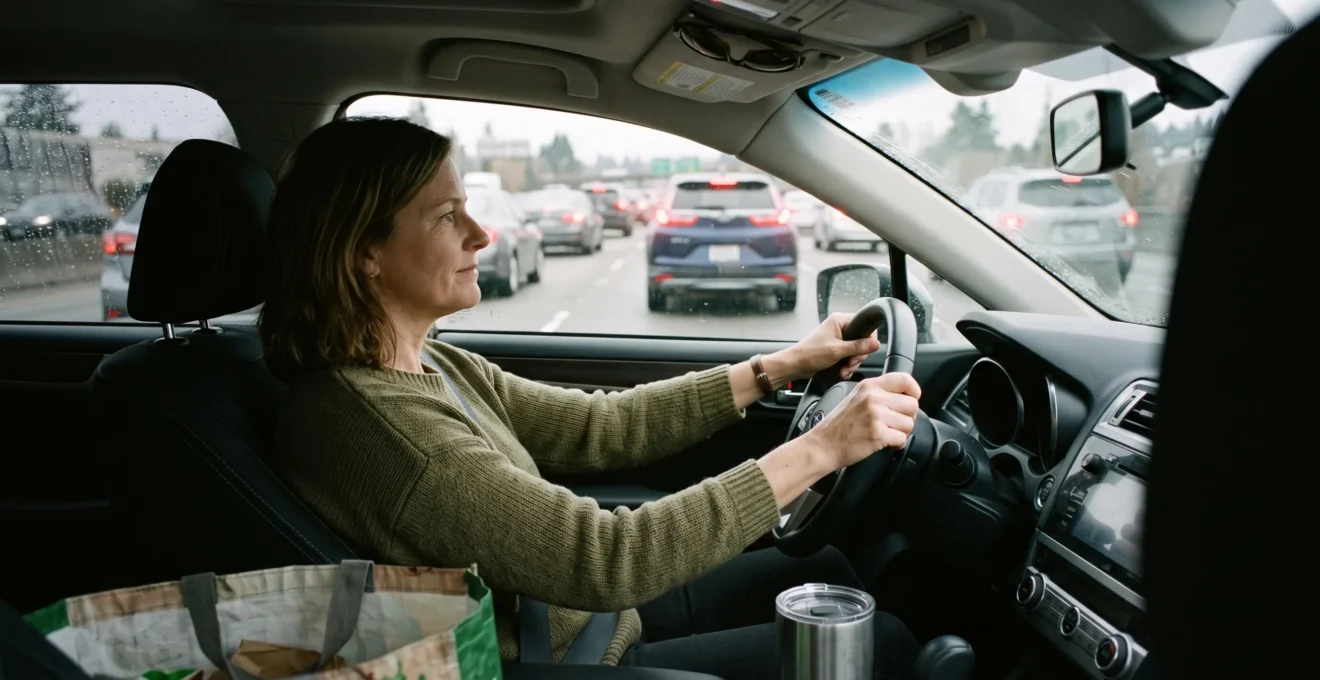
A daily car commute can feel exhausting even when the route is familiar. Congestion, unpredictable delays and pressure to arrive on time make an ordinary weekday journey more demanding than its distance suggests. Repeating the same roads can also encourage drivers to rely on expectations rather than actively observing changing conditions.
Making a commute safer starts before turning the ignition. Preparing the vehicle, choosing a reliable route and allowing realistic travel time reduce the number of decisions made under pressure. Once on the road, maintaining a safe following distance, avoiding distractions and responding calmly to congestion help preserve essential safety margins.
The goal is not to achieve a perfect journey or eliminate every delay. It is to make everyday driving more predictable without sacrificing attention, comfort or safety. A few deliberate changes to preparation and driving habits can make even a congested commute easier to manage.
Daily commuting: the essentials
- Prepare your route, vehicle settings and belongings before driving so secondary tasks do not compete with road awareness.
- Choose routes and departure times based on travel-time reliability, not simply the fastest predicted journey.
- Keep safe stopping distances, resist aggressive lane changes and maintain active observation even on familiar roads.
- Why Does Driving the Same Commute Every Day Reduce Your Attention?
- How Can You Prepare for the Morning Commute Without Starting the Journey Under Pressure?
- Fastest or Most Predictable Route: Which Is Better for a Daily Commute?
- Which Rush-Hour Habits Make Commuting More Dangerous?
- When Is Leaving 15 Minutes Earlier Worth Changing Your Routine?
- Why Do Familiar Routes Sometimes Make Drivers Less Alert?
- Which Time-Pressure Mistakes Make Otherwise Safe Drivers Take More Risks?
- How Can You Drive Safely Through Heavy Traffic Without Constant Stop-Start Stress?
Why Does Driving the Same Commute Every Day Reduce Your Attention?
Driving the same route repeatedly can reduce the attention devoted to actively processing road conditions because familiar surroundings require less conscious interpretation. This does not mean drivers automatically become unsafe, but it creates opportunities for expectations to replace observation. Maintaining deliberate visual awareness is particularly important when routine surroundings conceal unexpected hazards.
Route familiarity changes how drivers distribute their mental resources. Repeated journeys make road layouts, junctions and recurring landmarks easier to recognise. This can simplify navigation, but it may also reduce the cognitive effort devoted to interpreting the immediate driving environment.
A 2026 Scientific Reports study on route familiarity and driver attention examined ten participants driving an approximately 60 km route on public roads in Japan over six days. Researchers recorded physiological measures associated with attention and observed changes consistent with reduced allocation of attentional resources as familiarity increased.
The findings provide evidence of an association between route repetition and attention-related processing. However, the small sample and short observation period limit generalisation. The study did not establish that familiar routes directly increase collision rates, shorten hazard-glance durations or produce a universal neurological autopilot state.
The important distinction is that a familiar route is not a static environment. A junction may occupy the same position every morning while the vehicles, cyclists, pedestrians and visibility conditions around it change continuously.
Drivers sometimes describe arriving at work with little detailed memory of individual road segments. This experience can prompt reflection, but memory gaps alone do not establish that driving was unsafe or that attention disappeared. More useful warning signs include unexpectedly late reactions, overlooked changes in road conditions and recurring lapses in observation.
For example, a driver accustomed to an unobstructed residential street may approach it expecting yesterday’s conditions. A newly parked delivery vehicle can now conceal a pedestrian or require an earlier reduction in speed.
The protective habit is to replace assumptions with current observations: identify what has changed, check potential conflict areas and continuously reassess the road ahead.
Because attention is easier to preserve when competing demands are reduced, the next opportunity for a safer commute begins before leaving home.
How Can You Prepare for the Morning Commute Without Starting the Journey Under Pressure?
Prepare for the morning commute by checking traffic and weather, choosing a realistic departure time and completing vehicle adjustments before moving. Secure belongings, set navigation and remove potential distractions while parked. This simple routine reduces the need to divide attention between driving and avoidable tasks during the journey.
The final ten minutes before departure provide a useful preparation window. The exact duration is not a scientifically established requirement; it is a practical way to organise tasks that otherwise compete for attention once the vehicle enters traffic.
Begin with conditions outside the car. Check whether the usual route is affected by congestion, roadworks or adverse weather. If travel conditions appear unusually difficult, reassess the departure time rather than assuming the journey will follow its normal pattern.
Next, complete the tasks that require looking away from the road. Adjust mirrors and the seat, set the cabin temperature, secure loose belongings and configure the navigation system while stationary.
The NHTSA evidence summary on distracted-driving risks reports observational research linking several secondary tasks with increased crash odds. These include manipulating handheld phones, reaching for objects and adjusting vehicle controls. The strength of the association varies by task.
This evidence supports reducing unnecessary in-vehicle distractions. It does not establish that the first five minutes of every commute carry a uniquely high collision risk, nor does it measure the effectiveness of a particular preparation checklist.
Preparation also addresses the emotional consequences of starting late. A driver who leaves behind schedule may feel pressure to recover lost time by accelerating, following more closely or taking marginal gaps. Establishing departure expectations beforehand makes these responses less tempting.
Your five-step pre-commute preparation checklist
- Review tomorrow’s schedule. Record the required arrival time and planned departure time in a calendar or reminder.
- Check journey conditions. Confirm the intended route and note any weather warning, closure or significant disruption.
- Organise essentials. Place keys, work materials and necessary belongings together, with a closed, ready-to-carry bag.
- Prepare the vehicle. Before moving, confirm mirrors, seating, navigation and temperature settings are suitable.
- Set a distraction boundary. Put the phone somewhere it will not require handling and confirm that no loose object needs attention during driving.
A useful evening rule is to plan around a realistic difficult journey rather than the shortest possible travel time. This does not mean expecting severe disruption every day, but allowing for the variation regularly observed on the route.
Once preparation is under control, the next decision is whether the shortest route is genuinely the best route for everyday travel.
Fastest or Most Predictable Route: Which Is Better for a Daily Commute?
The most predictable route is often preferable when arriving on time matters more than saving a few minutes on an ideal day. A slightly longer journey with consistent duration can make scheduling easier and reduce pressure to recover unexpected delays. However, route safety, road conditions and actual travel-time variability should all influence the decision.
Navigation applications often emphasise estimated travel time, but an average journey duration does not reveal how much that duration changes across different days.
The Federal Highway Administration publication on travel-time reliability distinguishes average journey time from variability. Traffic incidents, weather, roadworks and fluctuating demand can all make the same journey take different amounts of time.
A route that regularly takes longer than expected may create more scheduling uncertainty than a slightly slower route whose travel time remains relatively consistent.
Consider this explicitly hypothetical example: Route A usually takes 25 minutes but sometimes takes 45 minutes. Route B usually takes 30 minutes and rarely exceeds 35 minutes. Route A appears faster by its typical duration, yet Route B may better serve a commuter who must arrive at a fixed time.
Travel-time reliability is not, by itself, a measurement of collision risk. A predictable route may still contain difficult junctions or considerable pedestrian activity.
The following comparison helps evaluate practical trade-offs.
| Decision factor | Fastest-route priority | Predictable-route priority |
|---|---|---|
| Travel time | Lowest estimated duration | More consistent duration across days |
| Congestion | May involve variable bottlenecks | Known congestion patterns are easier to plan around |
| Junctions | May include unfamiliar shortcuts | Allows assessment of recurring conflict points |
| Pedestrians and cyclists | Must still be evaluated | Must still be evaluated |
| Navigation decisions | May involve frequent route changes | Supports a stable default journey |
| Best practical use | When conditions genuinely favour it | When consistent arrival time is important |
To compare alternatives, test them across several weekdays at your normal departure time. Record actual journey duration, recurring bottlenecks and locations requiring extra attention. A short trial is an informal personal assessment, not a statistically validated transport study.
A hybrid approach often offers flexibility: use a familiar, reasonably reliable route by default and select another route when pre-departure information identifies a meaningful disruption.
When changing routes, make the decision while parked rather than interacting with navigation controls in moving traffic.
Whatever route is chosen, the benefit depends on maintaining safe behaviour when traffic becomes dense or surrounding drivers act impatiently.
Which Rush-Hour Habits Make Commuting More Dangerous?
Rush-hour driving becomes more dangerous when drivers follow too closely, change lanes impulsively, block junctions or allow distractions to compete with road awareness. These habits reduce reaction time or create additional conflict opportunities. Heavy traffic does not justify adopting unsafe behaviour simply because surrounding motorists appear to be doing the same.
Dense traffic encourages decisions based on preserving position rather than maintaining space. Drivers may close the gap ahead to discourage other vehicles from merging, but doing so leaves less room to respond if traffic stops suddenly.
Frequent lane changes create additional interactions with nearby vehicles, including motorcycles that may be harder to notice. In heavily saturated traffic, moving into a temporarily faster lane can also produce little meaningful improvement in overall journey time.
Another problematic habit is entering an intersection when there is insufficient space to clear it. A driver may technically be moving with the queue, yet end up obstructing crossing vehicles, cyclists or pedestrians.
The UK Highway Code rules on safe driving and slow-moving traffic provide useful guidance on stopping distances, distractions and consideration for other road users. Rule 126 addresses following distance, while Rule 151 covers safe behaviour in slow-moving traffic.
For higher-speed roads, Rule 126 recommends at least a two–second separation in specified conditions, with greater margins on wet or icy surfaces. Drivers must adapt spacing to visibility, speed and actual stopping requirements. These are UK recommendations and rules; legal requirements may differ elsewhere.
Some unsafe commuting habits are especially easy to rationalise:
- Following the flow above the speed limit: other motorists’ behaviour does not make excessive speed safe or lawful.
- Tailgating because traffic is slow: a short gap still leaves less room for unexpected braking.
- Using a traffic queue to handle calls: conversations and device interactions can distract from sudden changes around the vehicle.
- Switching lanes to relieve frustration: unnecessary manoeuvres can increase exposure to neighbouring vehicles.
Traffic behaviour can become contagious in a social sense: when aggressive movements seem normal, drivers may feel pressure to imitate them. Establishing personal boundaries before departure helps counter that temptation.
For instance, decide not to accelerate beyond the limit to keep up with a faster driver, and avoid changing lanes solely because another queue has briefly moved ahead.
The goal is not passive driving. Safe driving still requires appropriate merging, clear signalling, awareness of vulnerable road users and timely responses to changing conditions.
When impatience is driven by the fear of arriving late, adjusting departure time may be more effective than trying to change behaviour only after congestion begins.
When Is Leaving 15 Minutes Earlier Worth Changing Your Routine?
Leaving 15 minutes earlier is worthwhile when it meaningfully reduces the likelihood of arriving late or allows you to avoid a recurring congestion peak. It is not a universal solution. The useful departure-time adjustment depends on observed travel-time variation, work schedules, local traffic patterns and the effect on sleep.
Start by establishing how long your commute actually takes rather than relying exclusively on a navigation app’s current estimate.
For two to three weeks, record the departure time, arrival time, approximate journey duration and any unusual conditions. Include difficult days instead of recording only journeys that run smoothly.
This informal log can reveal patterns that an overall average obscures. A route might be reasonably consistent on certain weekdays and substantially less reliable on others.
For example, consider a hypothetical commuter who typically needs 30 minutes but occasionally needs 42 minutes. A departure plan based on 30 minutes provides no allowance for those longer journeys. An additional 15 minutes could cover the variation observed in that example, though future delays could still exceed it.
Professional transport analysis uses measures such as percentile travel times to describe reliability. A short personal log is not sufficient to estimate high-percentile journey times precisely, but it can help identify practical scheduling patterns.
Leaving earlier may be especially useful when:
- A small shift moves the commute outside a recurring congestion peak.
- School-term traffic makes certain junctions noticeably less predictable.
- Weather or seasonal darkness regularly increases required travel time.
- A fixed arrival deadline creates significant pressure when delays occur.
There are also important limits. If leaving earlier requires sacrificing necessary sleep, the resulting fatigue may undermine the intended safety improvement. Similarly, departing earlier may provide little benefit when congestion lasts throughout the entire travel window.
A worthwhile adjustment should deliver measurable practical value: fewer late arrivals, more comfortable departure conditions or a more manageable scheduling buffer.
Review the log after the trial and compare the benefit with the personal time required. The right buffer may be smaller or larger than 15 minutes.
Even with an effective departure schedule, familiar roads can still invite lapses in observation. Managing that tendency requires attention to how driving feels and how hazards are detected.
Why Do Familiar Routes Sometimes Make Drivers Less Alert?
Familiar routes can make drivers less alert because expected road layouts and repeated traffic patterns encourage reliance on memory. This may reduce active evaluation of the current scene, particularly when nothing unusual seems likely to happen. Regular self-checks and deliberate hazard scanning help restore attention without introducing additional distractions.
The challenge is not simply knowing a road too well. It is allowing stored expectations to influence what receives attention.
Imagine a commuter approaching a junction that has been unchanged for several years. If temporary roadworks alter the available lanes, the driver’s familiar mental model may no longer match the scene. Failing to notice that change promptly is a possible example of expectation-driven oversight.
This resembles the broader phenomenon of change blindness, in which people may fail to detect alterations in a visual scene. However, the source research provided for this article does not specifically quantify change blindness on familiar commuting routes.
A personal attention audit can help identify recurring situations that deserve more care.
After each journey, while safely parked, consider whether:
- You noticed changes in roadworks, parked vehicles or pedestrian activity.
- You reacted later than intended to a developing traffic situation.
- You experienced a near-miss or overlooked a relevant road sign.
- You felt distracted, rushed or unusually tired.
- Similar lapses seem more common on familiar roads than unfamiliar ones.
This exercise is a reflection tool rather than a validated diagnostic test. A near-miss deserves attention regardless of which route it occurred on.
One practical approach is active hazard anticipation. Before reaching a row of parked vehicles, consider whether a door could open or a pedestrian could emerge. Before a junction, check for changing signals, crossing traffic and road users outside the main forward view.
Use landmarks to prompt appropriate mirror checks and wider observation, while ensuring that fixed routines never replace looking whenever the actual traffic situation requires it.
Simply adding stimulation is not an equivalent solution. Loud audio, complicated podcasts, phone conversations or eating may introduce competing demands rather than improve road awareness.
If attention lapses are associated with sleepiness, difficulty keeping the eyes open or repeated drifting from the driving task, stop somewhere safe and address fatigue rather than trying to compensate through entertainment.
Maintaining attention is particularly difficult when another source of mental pressure dominates the journey: the feeling that time is running out.
Which Time-Pressure Mistakes Make Otherwise Safe Drivers Take More Risks?
Time pressure can push otherwise cautious drivers toward smaller gaps, higher speeds, rushed junction decisions and unnecessary overtaking. The desire to recover lost minutes competes with the need to assess hazards carefully. When lateness becomes unavoidable, accepting the delay and maintaining normal safety standards is safer than trying to compensate through aggressive driving.
Running late changes the immediate objective of a journey. Instead of focusing primarily on safe progress, the driver may become preoccupied with the remaining minutes before an appointment or work start time.
This can encourage several practical mistakes: accelerating toward a signal that is about to change, entering a junction without sufficient room to clear it or accepting a merging gap that would normally feel uncomfortable.
These are plausible behavioural consequences of time pressure, not effects quantified by the source pack for this article. The exact response varies between drivers and circumstances.
Pressure can also persist into the final part of the journey. A commuter may remember to slow down near the destination but still rush the parking manoeuvre, overlook a mirror check or reverse without sufficiently checking for pedestrians.
Shortcuts introduce another trade-off. A familiar residential street may appear to offer a way around congestion, but it can involve lower speed limits, parked vehicles, pedestrians and junctions requiring greater care.
Trying to save time can also become self-defeating. A risky manoeuvre may lead to hard braking, a conflict with another road user or an incident that creates a much longer delay than the original congestion.
A practical recovery protocol is straightforward:
- Recognise that the original arrival estimate is no longer realistic.
- Accept the delay instead of treating it as time that must be recovered through speed.
- If someone needs an update, communicate while safely parked, or use an appropriate non-driving alternative.
- Continue at lawful speeds with ordinary stopping distances and full observation.
- Review the departure plan after arriving rather than making rushed corrections during the journey.
The central distinction is between a scheduling problem and a driving problem. Being late may require changing expectations, but it does not reduce stopping distances or make risky gaps more acceptable.
Workplace flexibility can also help where available. Agreeing on realistic arrival expectations or alternative start arrangements may remove unnecessary pressure from recurring commutes.
Once the urgency to recover time is removed, heavy traffic becomes easier to manage as a driving environment rather than an obstacle that must constantly be beaten.
Key takeaways before entering heavy traffic
- Decide how to respond to delays before congestion tests your patience; trying to recover lost minutes should never determine your safety margins.
- Use a stable observation routine that includes the immediate stopping area, nearby road users and developing changes farther ahead.
- Prioritise controlled progress and comfortable spacing over frequent acceleration, braking and opportunistic lane switching.
How Can You Drive Safely Through Heavy Traffic Without Constant Stop-Start Stress?
Drive more safely through heavy traffic by maintaining enough space to respond smoothly, anticipating changes ahead and avoiding unnecessary lane changes. Gentle acceleration and progressive braking, when conditions allow, can reduce the constant stop-start effort. Accepting congestion as part of the journey also helps prevent frustration from influencing driving decisions.
Stop-start traffic demands frequent adjustments to speed and position. Repeated braking and acceleration can feel tiring, particularly during long queues or when a manual-transmission vehicle requires frequent clutch operation.
One useful technique is to observe traffic beyond the vehicle immediately ahead. Watching the movement of several vehicles, while continuing to monitor nearby hazards, may help identify deceleration developing before the nearest vehicle brakes.
This does not replace maintaining a safe stopping gap. The distance to the vehicle in front must remain sufficient for the actual speed, visibility, road surface and traffic conditions.
When the queue begins moving, accelerate progressively instead of rushing to close every available space. If traffic ahead slows again, easing off the accelerator early may allow a smoother reduction in speed where safe and appropriate.
Such techniques must never involve obstructing other road users, ignoring necessary braking or maintaining an impractically large gap that disrupts traffic.
Smoother driving can also reduce repeated mechanical demands. Avoiding unnecessary acceleration and braking may limit brake use and make the journey more comfortable. Actual maintenance and fuel-consumption outcomes depend on the vehicle, traffic conditions and driving circumstances; no specific savings are established by the supplied sources.
Lane discipline plays an equally important role. Moving repeatedly between queues can demand more observation, merging decisions and close interaction with surrounding vehicles. A lane change remains appropriate when required for navigation, safety or lawful road positioning, but frustration alone is a poor reason to make one.
The emotional experience of congestion also matters. When a delay is unavoidable, treating it as an expected part of road travel can reduce the temptation to compete with other drivers.
Comfortable cabin temperature, appropriate ventilation and audio selected before departure can make the environment easier to tolerate. Audio should remain at a level that allows necessary awareness of the road and emergency signals.
It may help to use a simple mental rule: traffic conditions determine the pace; safe observation determines the response. That distinction shifts attention away from attempts to force progress and toward decisions the driver can actually control.
For longer journeys, take a safe break if fatigue, discomfort or concentration difficulties begin to affect driving. Never use a queue as an opportunity to handle a phone or become absorbed in unrelated tasks.
On the next commute, choose one manageable improvement: prepare the route before departure, protect a realistic time buffer or practise smoother spacing in queues. Review how it affects the journey over several days, and retain the habit if it helps without compromising road safety.
Is it safer to use a different route every day?
Not necessarily. Changing routes can introduce unfamiliar junctions, unexpected road layouts and additional navigation demands. Familiarity can reduce some of those demands while also encouraging complacency. A reasonable approach is to maintain active observation on a known route and choose alternatives when conditions make them appropriate.
Can listening to a podcast make commuting less stressful?
Some drivers find preselected audio enjoyable, but its effect on stress is not established by the supplied research. Complex or absorbing content may compete with driving attention. Set audio before moving, keep the volume appropriate and reduce or switch it off when road conditions demand greater concentration.
Should you always follow a navigation app’s fastest-route recommendation?
No. A predicted fastest route may not be the most reliable or easiest to drive safely. Compare actual travel times, recurring delays, road complexity and current conditions. If an alternative is preferable, select it before departure or while safely stopped rather than making distracting navigation changes while driving.
What should you do if heavy traffic makes you repeatedly late for work?
Record actual journey durations over several weeks, identify recurring congestion patterns and adjust your departure buffer accordingly. Where possible, discuss flexible start times or other travel arrangements. During the journey, do not attempt to recover lost time by speeding, tailgating or taking unnecessary risks.
Does a shorter daily commute automatically mean less driving risk?
No. Journey duration is only one consideration. A shorter route may involve busy intersections, poor visibility, vulnerable road users or demanding traffic patterns. Route choice should account for road conditions, driver alertness and safe driving requirements as well as travel time. The supplied evidence does not establish a universal safety ranking based on commute length alone.