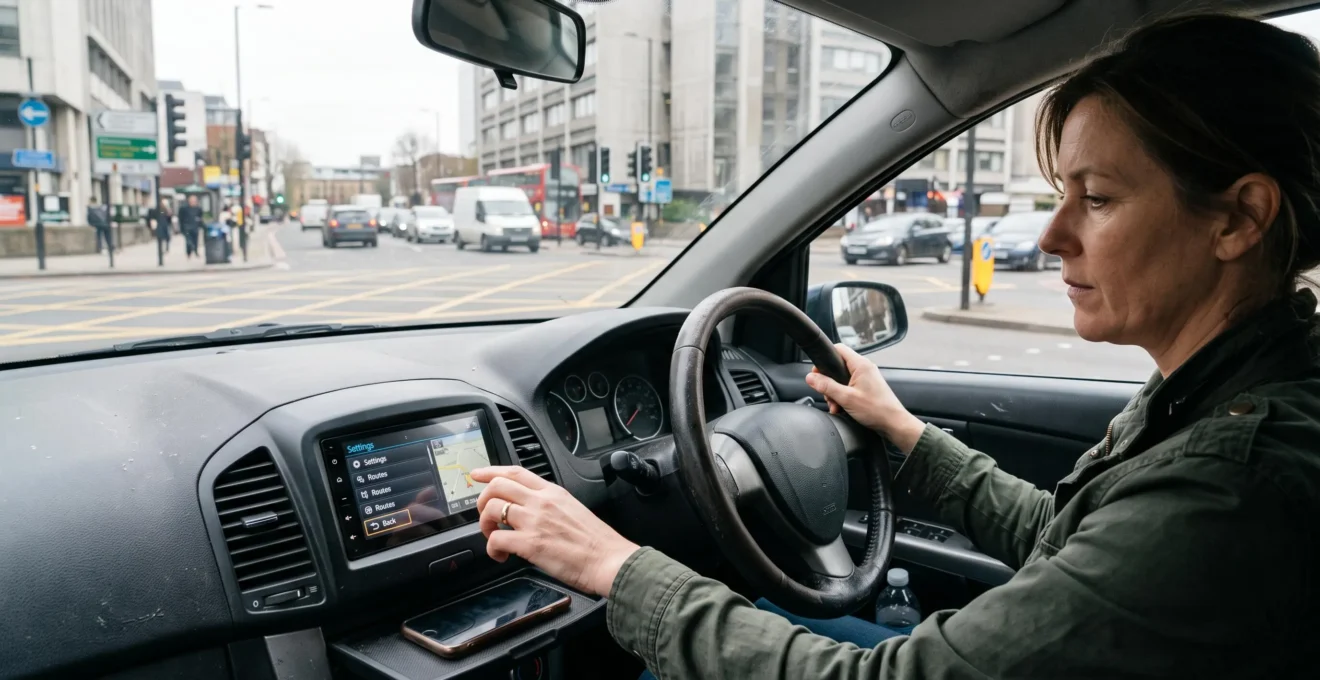
The most dangerous in-car distraction is not always the most obvious one. Reading a message takes your eyes off the road, but a hands-free phone conversation can reduce your awareness even when you look straight ahead. Passengers, dashboard touchscreens and seemingly routine adjustments can also compete for the attention needed to detect hazards.
These distractions operate differently. Some require looking away, others involve taking a hand off the wheel, and others consume the mental capacity needed to interpret traffic. A single activity may combine all three. The risk also changes with road conditions: a task that seems manageable on an empty road can become hazardous at a busy junction.
According to the US National Highway Traffic Safety Administration (NHTSA), people died in crashes involving distracted drivers in the United States 3,208 in 2024. That figure describes recorded crash involvement, not a universal measure of distraction risk across countries.
Reducing everyday driving distraction therefore requires more than putting your phone down. It means preparing your cabin, recognising attention-intensive activities and knowing when driving demands your full concentration.
In-car distractions: what matters most
- Eyes on the road are not enough: hands-free conversations can consume the cognitive attention needed to recognise hazards.
- Prepare before departure: set navigation, mirrors, climate controls and phone notifications while stationary.
- Adapt to conditions: postpone non-essential interactions whenever traffic, visibility or road complexity increases.
- Why Can a Hands-Free Conversation Still Reduce Driving Attention?
- How Can You Set Up the Car Before Driving to Reduce Cabin Distraction?
- Phone, Passenger or Touchscreen: Which Distraction Demands the Most Attention?
- Which Everyday In-Car Tasks Should Wait Until You Stop?
- When Should Drivers Minimise Every Possible In-Car Distraction?
- Why Are So Many Rear-End Collisions Avoidable?
- How Can You Interrupt Autopilot Driving Before It Causes a Mistake?
- Which Common Collisions Can Drivers Most Often Prevent?
Why Can a Hands-Free Conversation Still Reduce Driving Attention?
A hands-free conversation can reduce driving attention because speaking and listening consume mental resources needed to recognise hazards, interpret traffic and react appropriately. Keeping both hands on the wheel and looking ahead does not guarantee full awareness. The more demanding the conversation becomes, the harder it may be to divide attention safely.
Driver distraction has three important dimensions: visual distraction takes attention away from what is happening on the road, manual distraction interferes with vehicle control, and cognitive distraction diverts mental resources from driving. The NHTSA explains these mechanisms in its human-factors research on driver distraction.
A hands-free phone call primarily creates cognitive demand. The driver may continue looking at the road but process less of the information entering their field of vision.
This helps explain a phenomenon known as inattentional blindness. Research reviewed by Strayer and Drews found that participants conversing by phone during simulated driving were less likely to retain information about objects they had looked directly at. Looking towards a pedestrian or another vehicle is therefore not always equivalent to consciously registering that hazard.
The research review on phone-related driver distraction also discusses differences between remote callers and passengers. A passenger can observe changing road conditions and may naturally pause when the driver approaches a complicated situation. A remote caller generally lacks that visual context.
However, passenger conversations are not automatically safe. An emotional disagreement, complicated discussion or conversation requiring sustained mental effort can distract regardless of who is speaking.
Consider three situations:
- Routine conversation: a brief, uncomplicated exchange may impose less cognitive demand than discussing a difficult decision.
- Complex conversation: problem-solving, arguing or processing emotional news can compete strongly with traffic awareness.
- Demanding road environment: even a simple conversation may become inappropriate when merging, navigating a busy junction or driving in poor visibility.
A useful rule is to postpone conversations whenever the road requires continuous decisions. If a call has already started, tell the caller that driving needs your attention and end the conversation when it is safe to do so.
The practical goal is not to avoid every word spoken inside a car. It is to prevent unnecessary cognitive demand from occupying the attention that traffic conditions may suddenly require.
How Can You Set Up the Car Before Driving to Reduce Cabin Distraction?
The simplest way to reduce cabin distraction is to complete routine adjustments before the vehicle moves. Set your destination, position the seat and mirrors, prepare climate and audio controls, and silence or stow your phone. A consistent pre-drive routine prevents small tasks from interrupting hazard detection later.
Many modern vehicles combine navigation, entertainment, climate settings and communication functions in a central touchscreen. Some adjustments that once required a familiar physical control now involve navigating several on-screen menus.
This makes preparation particularly important. A driver searching through a menu must divide attention between identifying the correct option and monitoring the road. Repeated glances can interrupt awareness of changing traffic, even when each interaction feels brief.
Before departure, enter the complete navigation destination and review the route. Set the cabin temperature, choose an audio source and position essential controls so they can be used without unnecessary searching.
Phone settings deserve particular attention. Driving-focus or do-not-disturb functions can suppress incoming notifications automatically, reducing the temptation to decide whether every message requires a response. Where available, these settings can be configured to activate when the phone detects driving or connects to the vehicle.
The phone should also be positioned so that incoming alerts do not repeatedly attract the driver’s attention. If navigation is running on the device, enter the route beforehand and use an appropriate mount that does not obstruct visibility.
Drivers who share vehicles should repeat this preparation each time. The seat position, mirror angles, interface layout and preferred settings in a family car may differ from those in a work van. Familiarity with one vehicle does not guarantee that another vehicle’s controls will be intuitive.
Your five-step pre-drive attention checklist
- Confirm the driving position: adjust the seat, steering wheel and mirrors until the controls and surrounding traffic are clearly visible. Check that the position feels comfortable and secure.
- Prepare navigation: enter the destination and review the planned route. Confirm that guidance is ready before moving.
- Preset cabin controls: select the temperature and audio settings. Verify that no immediate menu adjustments remain necessary.
- Activate phone boundaries: enable driving focus or do-not-disturb, then secure or stow the phone. Confirm that routine notifications are suppressed.
- Agree on passenger responsibilities: ask passengers to handle non-essential requests or wait until a stop. Confirm that everyone understands when the driver needs quiet.
Completing these five steps creates a simple departure check: driving position ready, route entered, cabin controls prepared, phone managed and passenger expectations established.
Once the vehicle is moving, the next challenge is recognising which remaining sources of distraction deserve the greatest attention.
Phone, Passenger or Touchscreen: Which Distraction Demands the Most Attention?
No single distraction is consistently the most demanding in every driving situation. Texting and complicated touchscreen tasks combine visual, manual and cognitive demands, while phone conversations can reduce mental awareness without requiring a glance away. Passengers can also create substantial distraction, particularly when conversations become intense or the driver must attend to their needs.
The important distinction is not simply whether a device is being used. It is which attention resources the activity consumes, how long it lasts and how often it occurs.
For example, typing a message involves reading, selecting characters and thinking about a reply. A phone conversation may require no screen interaction but still occupy working attention. A lively passenger conversation may also demand repeated responses, emotional engagement or glances towards another person.
The following comparison helps identify common exposure patterns without suggesting a universal collision-risk ranking.
| Distraction | Main attention demands | Practical control |
|---|---|---|
| Reading or typing a phone message | Visual, manual and cognitive | Silence notifications and respond only after stopping |
| Hands-free phone conversation | Primarily cognitive | Postpone demanding calls, especially in complex traffic |
| Touchscreen navigation or settings | Visual, manual and cognitive | Complete menu-based tasks before departure |
| Passenger conversation | Primarily cognitive, sometimes visual | Ask passengers to pause when driving becomes demanding |
| Attending to a child in the rear seat | Potentially visual, manual and cognitive | Stop safely before providing direct assistance |
Duration and repetition also matter. A driver may avoid sending messages yet adjust the infotainment system repeatedly during a journey. Although each glance seems minor, recurring interactions create repeated periods of reduced visual monitoring.
The NHTSA’s human-factors framework recognises both task demands and frequency of use as relevant to distraction. However, this does not establish that several short touchscreen glances carry the same collision risk as one prolonged phone conversation.
Passenger behaviour deserves similar scrutiny. A child asking for help, a heated discussion or a group of passengers speaking loudly can require attention that would otherwise be directed towards the road. Drivers who never touch their phones may therefore still experience considerable cognitive distraction.
To identify your own biggest distraction source, consider three questions:
- Who usually calls or messages while I am driving, and do I feel pressured to respond?
- Which dashboard settings do I repeatedly adjust after departure?
- Do my passengers understand that conversations and requests may need to stop during difficult driving?
The answers form a personal distraction profile. Rather than assuming one activity is always the most dangerous, prioritise the tasks that repeatedly interrupt your awareness or demand several kinds of attention at once.
Once those habits are identified, the next decision is straightforward: distinguish activities that can remain part of normal driving from those that should never compete with vehicle control.
Which Everyday In-Car Tasks Should Wait Until You Stop?
Any in-car task requiring reading, typing, searching for an object or navigating several menus should wait until the vehicle is safely stopped. These activities divert attention from traffic and may require one or both hands. Their apparent simplicity does not make them safe to perform while driving.
The National Highway Traffic Safety Administration identifies phone use, eating, passenger interactions and adjustments to navigation or entertainment systems among possible sources of distracted driving.
Its distracted-driving facts and statistics include a useful illustration: reading or sending a text can take a driver’s eyes away from the road for five seconds. At 55 mph, approximately 89 km/h, the vehicle travels roughly the length of an American football field in that time.
5 seconds
The NHTSA’s illustrative duration of visual distraction when reading or sending a text. It is not a measured duration for every message or dashboard interaction.
National Highway Traffic Safety Administration, distracted-driving safety information.
Several everyday activities are easy to underestimate:
- Replying to a message: reading, interpreting and composing an answer divert both visual and cognitive attention.
- Changing a destination: searching for an address or selecting a route requires more interaction than simply following existing guidance.
- Adjusting a child’s entertainment: reaching backwards or looking towards a rear-seat screen interferes with forward observation.
- Retrieving a dropped object: searching a bag, seat gap or footwell can compromise driving position and control.
- Exploring an unfamiliar menu: locating a setting through successive screens interrupts attention repeatedly.
These tasks do not all take the same amount of time, and no universal safe glance duration can be assigned to them. What they share is a demand for attention that should be reserved for driving.
The alternative is to plan opportunities to stop. A service area, petrol station or suitable parking place allows you to address the task without dividing attention between the road and the cabin. A traffic queue or red light is not an equivalent substitute: the vehicle remains in an active traffic environment, and local laws may still restrict device use.
An apparently urgent message creates a particular temptation. Instead of looking at the screen to establish whether it matters, let a passenger handle communication where appropriate or continue to a safe stopping place. If an emergency becomes apparent, stop safely before reading details or responding.
This approach turns postponement into a normal part of the journey. A message can wait until the next planned stop; a route change can be made in a parking area; a child needing assistance can be helped once the vehicle is secure.
The same task can become even more dangerous when weather, road layout or traffic conditions increase the attention required for safe driving.
When Should Drivers Minimise Every Possible In-Car Distraction?
Drivers should minimise non-essential cabin distractions whenever road conditions require greater concentration or leave less time to respond. Busy junctions, roadworks, heavy traffic, poor visibility, bad weather and unfamiliar routes all increase driving demands. In these conditions, even routine conversations or dashboard adjustments can interfere with timely hazard recognition.
Driving attention is a limited resource. On a familiar, lightly trafficked road, a driver may feel that conversation or background audio requires little effort. But road demand can increase suddenly when a vehicle brakes, a pedestrian steps towards the carriageway or a junction becomes complicated.
The difficulty lies in the delay between recognising rising road demand and disengaging from a distracting activity. A driver absorbed in a conversation may not immediately appreciate how much additional attention the situation requires.
This makes attention reserve an important practical concept. The aim is to preserve enough spare capacity to notice unexpected changes and respond without having to abandon an unrelated mental task first.
Situations deserving particular caution include:
- Complex junctions and roundabouts with several possible conflict points.
- Roadworks or temporary traffic arrangements that demand close interpretation.
- Heavy rain, fog, snow or other conditions that reduce visibility and grip.
- Night driving, especially where pedestrians or road edges are difficult to identify.
- Unfamiliar routes where navigation and traffic decisions require additional thought.
- School zones and pedestrian-heavy streets where hazards may emerge unexpectedly.
- High-speed roads where distance closes quickly and delayed reactions have greater consequences.
Rather than making a new distraction decision every few minutes, establish personal rules linked to driving conditions. For example, avoid calls whenever rain significantly reduces visibility, pause conversations while negotiating unfamiliar junctions and keep devices stowed in areas with frequent pedestrian activity.
These rules should apply before the situation becomes critical. Waiting until a hazard appears to end a conversation or abandon a touchscreen interaction defeats much of the preventive purpose.
Passengers can support this approach by allowing silence, postponing questions and handling non-essential arrangements. If an activity cannot be stopped promptly without additional distraction, choose a safe place to pull over.
The goal is not a completely silent cabin throughout every journey. It is a cabin where unnecessary demands can be reduced promptly and predictably as road complexity changes.
One of the clearest consequences of failing to preserve that attention is the rear-end collision, where a brief delay can remove the space available to react.
Why Are So Many Rear-End Collisions Avoidable?
Many rear-end collisions are preventable because drivers can influence two essential safety margins: following distance and reaction time. Keeping adequate space allows more time to respond when traffic slows, while maintaining attention helps detect braking sooner. Distraction weakens these protections, especially when a driver is already following too closely.
A rear-end collision often begins with an ordinary event: the vehicle ahead slows for congestion, a pedestrian crossing or an unexpected obstruction. The following driver must notice the change, interpret it and brake appropriately.
Two distinct attention failures can interrupt this process.
- Late detection: the driver is looking at a screen or elsewhere in the cabin and fails to notice the lead vehicle slowing promptly.
- Delayed response: the driver may be looking forward but is mentally occupied, slowing recognition of the hazard or the decision to brake.
Both failures consume available stopping distance. The less space separating the vehicles, the smaller the margin for recovering from delayed detection or response.
Consider a hypothetical vehicle travelling at 50 km/h. It covers approximately 13.9 metres each second. Two seconds of diverted attention therefore correspond to roughly 27.8 metres of travel; three seconds correspond to about 41.7 metres.
These figures illustrate travel distance during inattention, not a measured stopping distance or a prediction that a collision will occur. Actual braking outcomes depend on vehicle speed, available spacing, road grip, braking performance and the actions of other drivers.
A practical prevention strategy combines attention with sufficient following distance. Drivers should adapt their spacing to traffic speed, visibility, weather and road conditions while continuously monitoring the behaviour of vehicles ahead.
Looking beyond the nearest vehicle can also improve anticipation. Brake lights further ahead, queues forming near a junction or vehicles changing lanes may provide early indications that traffic is slowing.
Vehicle technology offers another layer of protection. The Insurance Institute for Highway Safety reports associations between front crash-prevention systems and reductions in certain rear-end collisions. However, collision-warning and automatic-braking functions should complement attentive driving rather than replace it.
There may also be insurance consequences when a rear-end collision occurs. Depending on local law and the circumstances, an insurer may examine following distance, driver conduct and other evidence when assessing fault or claims. No single liability rule applies across all English-speaking countries.
These protections remain essential even in vehicles fitted with technology that can assist with steering, braking or maintaining distance.
How Can You Interrupt Autopilot Driving Before It Causes a Mistake?
Drivers can interrupt overreliance on automated assistance by treating steering and braking support as assistance, not independent driving. Stay engaged with the road, understand the system’s limitations and know how to regain manual control. A driver who continuously monitors traffic is better prepared to intervene when the technology cannot handle a situation.
The term autopilot can create confusion because different vehicles offer different levels of assistance. Adaptive cruise control may regulate speed and following distance, while lane-centring assistance may help maintain road position. These functions do not necessarily make a vehicle capable of driving independently.
The IIHS research overview of advanced driver-assistance systems explains both the capabilities and limitations of partial driving automation.
A central concern is vigilance decay. When a system appears to manage routine driving successfully, the driver may begin monitoring less actively or overestimate what the vehicle can handle. This creates a mismatch between the driver’s readiness and the need for immediate intervention.
For example, a lane-support system may depend on clearly visible markings. Faded lines, roadworks, snow-covered roads or unusual lane layouts can make its task more difficult. Poor weather and low light may also affect some sensors.
The appropriate response is to remain mentally engaged while the system operates, not to wait for a warning before paying attention.
Before using driver assistance, establish a vehicle-specific takeover routine:
- Understand the controls: consult the owner’s manual to identify how the system is activated, overridden and disengaged.
- Maintain a ready driving position: follow the manufacturer’s requirements for hands on the wheel and remain prepared to steer or brake.
- Keep scanning the road: monitor traffic, lane boundaries, pedestrians and potential escape routes rather than focusing on the assistance display.
- Recognise system limits: anticipate reduced performance in poor visibility, unusual road layouts or difficult weather conditions.
- Intervene when necessary: regain direct control using the method appropriate to the vehicle, without relying on the system to resolve every hazard.
Different manufacturers use different controls and operating rules. Steering input, braking or a dedicated switch may override a particular function, but there is no universal takeover sequence suitable for every vehicle.
Legal responsibilities also vary by jurisdiction and by the system’s approved operating capabilities. Drivers using conventional driver assistance or Level 2 partial automation must remain responsible for supervising the driving task rather than assuming the vehicle is autonomous.
The safest approach combines a clear understanding of vehicle assistance with ordinary attention-management habits, so the driver remains ready for hazards that automated systems may not handle.
Key takeaways for preventing distraction-related collisions
- Protect detection time: remove visual and cognitive distractions before they delay your response to changing traffic.
- Build overlapping safeguards: adequate following distance, cabin preparation and sensible use of driver assistance work together.
- Match habits to conditions: use stricter attention boundaries when traffic, visibility or road complexity increases.
Which Common Collisions Can Drivers Most Often Prevent?
Drivers can help prevent several common collision types by controlling distraction, maintaining space and actively anticipating hazards. Rear-end impacts, lane departures, junction crashes and collisions involving pedestrians or cyclists can all involve failures of attention. Prevention is strongest when drivers combine preparation, continuous observation and appropriate responses to changing conditions.
Distraction does not explain every collision, and even attentive drivers cannot control every action taken by other road users. However, reducing avoidable attention loss improves the opportunity to recognise danger and act before a situation develops into a crash.
Different crash patterns illustrate why several preventive habits are needed.
| Collision type | Potential attention failure | Preventive habit |
|---|---|---|
| Rear-end collision | Delayed recognition of slowing traffic | Maintain adequate spacing and monitor vehicles ahead |
| Lane-drift or run-off-road crash | Looking at a device or losing awareness of road position | Keep visual attention directed towards driving and take breaks when fatigued |
| Junction collision | Missing signals, signs or approaching vehicles | Pause non-essential conversations and scan all conflict points |
| Pedestrian or cyclist collision | Failing to detect vulnerable road users promptly | Reduce speed appropriately and avoid cabin interactions in busy areas |
These are plausible distraction-related mechanisms, not claims that distraction causes most collisions in each category or that every listed collision can be prevented by one driver.
The most useful prevention strategy is layered. Preparation removes predictable tasks before departure. Deferring non-essential activities prevents distraction from interrupting vehicle control. Condition-based rules protect attention when the road becomes demanding. Understanding assistance technology reduces the risk of relying on capabilities the vehicle does not possess.
For an everyday journey, this means beginning with the seat, mirrors, route and phone prepared. Once moving, the driver monitors traffic rather than attempting to complete cabin tasks. If a new destination, message or passenger request demands attention, it waits until a suitable stopping place.
Where conditions become more difficult, stricter boundaries take effect. Conversations pause, unnecessary controls remain untouched and attention shifts fully towards road positioning, other vehicles and vulnerable road users.
Insurance is another reason to take prevention seriously. Collisions can lead to deductibles, repair expenses, claim disputes or changes to premiums and no-claims benefits, depending on the policy and jurisdiction. However, there is no general guarantee that adopting particular distraction-management habits will produce a direct insurance discount.
The lasting benefit is a more reliable driving routine. Instead of reacting to each notification or request, drivers can establish clear expectations for what happens before departure, what may happen while moving and what must wait until they stop.
Before your next drive, choose one recurring distraction you can eliminate, prepare the cabin before moving and decide where you will stop if another task needs attention. Repeat the routine until protecting your concentration becomes as familiar as checking your mirrors.
Is using a hands-free phone always legal while driving?
Rules differ between countries and, in some places, between states or other jurisdictions. A hands-free conversation may be permitted even where handheld use is restricted, but legality does not eliminate cognitive distraction. Check the applicable local rules and avoid demanding conversations when road conditions require greater attention.
Are voice commands safer than using a touchscreen?
Voice commands may reduce the need for manual input or visual interaction, depending on the system and task. However, listening to instructions, correcting misunderstood commands and making decisions can still create cognitive demand. Voice control should not be treated as automatically distraction-free, especially during complicated driving situations.
Can background music distract a driver?
Music can become distracting when its volume, emotional intensity or associated interactions interfere with traffic awareness. Searching for songs and changing settings can add visual and manual demands. Preparing a playlist before departure and keeping audio at a level that allows important traffic sounds to be noticed are sensible precautions.
Should a driver look at a phone notification while stopped at traffic lights?
A red light does not offer the same distraction-free environment as a safely parked vehicle. The driver still needs to monitor signals, traffic and nearby road users. Device restrictions may also apply while temporarily stopped in traffic. The more reliable approach is to leave notifications suppressed and review them after parking safely.
Does automatic emergency braking mean driver attention is less important?
No. Automatic emergency braking can help avoid or mitigate certain collisions, but its performance depends on the system, vehicle and operating conditions. Some hazards may not be detected or handled as expected. Drivers should maintain appropriate following distance, continue scanning the road and remain ready to brake or steer when necessary.