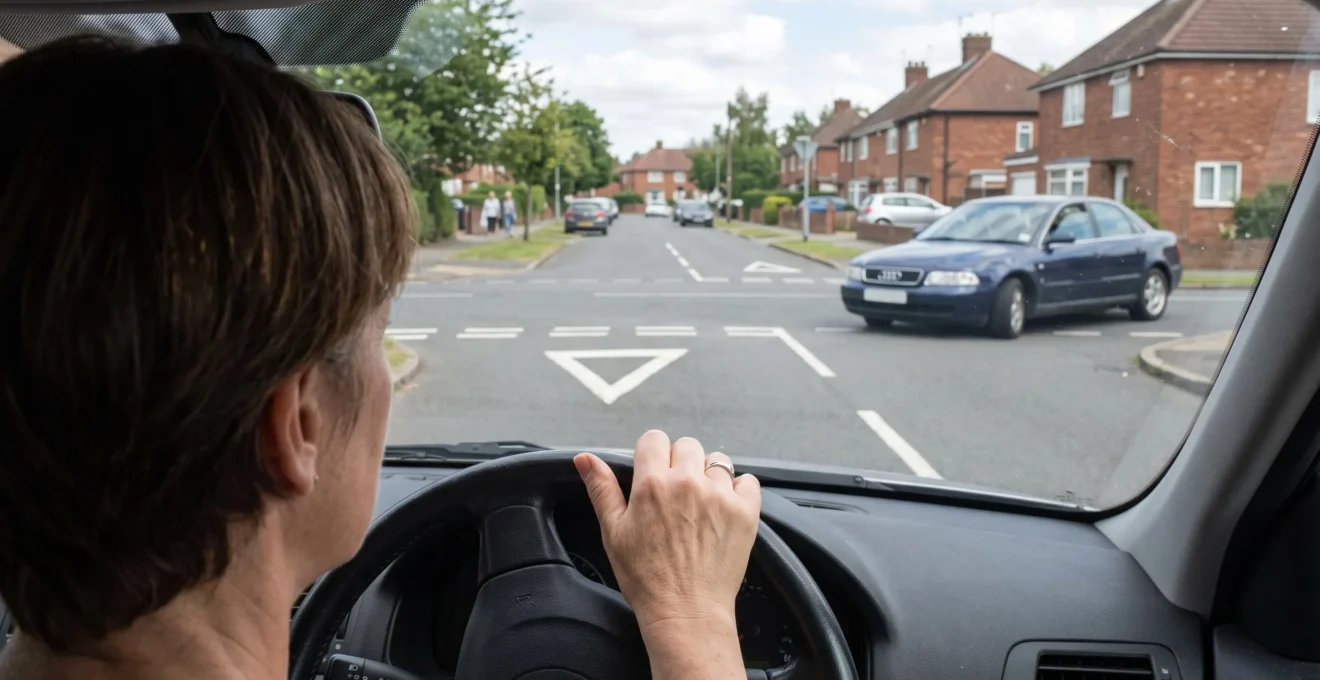
Everyday collisions often develop from situations that drivers could recognise before they become immediate emergencies. A vehicle approaching a junction, a pedestrian hidden behind parked cars or a sudden change in traffic speed can create a conflict within seconds. Defensive driving reduces exposure to these situations by making anticipation, observation and space management part of every journey.
The objective is not to predict every action accurately or react faster than everyone else. It is to maintain enough time, distance and visibility to respond when another road user makes an unexpected decision. That means selecting appropriate speeds, maintaining separation, checking blind spots and avoiding unnecessary confrontations in traffic.
These habits are useful on motorways, urban streets and residential roads alike. The exact rules differ between countries, but the underlying principle remains consistent: prepare for foreseeable mistakes without assuming that another person’s behaviour is necessarily unsafe.
Defensive Driving: The Essential Principles
- Anticipate possible mistakes by observing early warning signs rather than waiting for immediate danger.
- Maintain usable space ahead, beside and behind the vehicle to preserve safe options.
- Adjust speed, following distance and attention to traffic, visibility, weather and road conditions.
- Why Does Expecting Mistakes Make Defensive Drivers Safer?
- How Can You Build a Safety Buffer Around Your Car in Moving Traffic?
- Slower Speed or Bigger Gap: Which Gives You More Time to React?
- Which Reactions to Other Drivers Make Defensive Driving Less Effective?
- When Should Defensive Drivers Increase Their Safety Margin?
- How Can You Scan Busy Roads Without Missing Cyclists or Pedestrians?
- How Can You Keep a Safe Gap in Stop-Start Traffic Without Losing Your Position?
- Which Human Errors Cause the Most Avoidable Driving Risk?
Why Does Expecting Mistakes Make Defensive Drivers Safer?
Expecting mistakes makes defensive drivers safer because it shifts attention from immediate reactions to early hazard recognition. Instead of waiting until another vehicle enters their path, drivers consider what could happen next and preserve an opportunity to respond. This does not mean assuming everyone will behave dangerously; it means recognising situations where another road user’s decision could create a conflict.
Consider a vehicle approaching a junction from a side road. Its position, changing speed, front-wheel direction and restricted visibility may indicate that it could enter the main carriageway without yielding. A driver who recognises this possibility early can ease off the accelerator and maintain enough distance to stop if necessary.
The distinction between anticipation and suspicion is important. A vehicle approaching a junction is not necessarily about to pull out. Defensive driving uses observable information to prepare a proportionate response, rather than triggering unnecessary braking every time another vehicle is nearby.
A practical prediction habit involves three questions:
- What might the other road user do unexpectedly?
- Where could that movement create a conflict?
- Which safe response would remain available if it happened?
This process creates a contingency plan before a hazard becomes urgent. It also explains why legal priority should never be confused with guaranteed safety. The UK Highway Code explicitly states that its rules do not create an unconditional right of way and advises road users to give way when doing so can prevent an incident.
“Always give way if it can help to avoid an incident.”
Anticipation is particularly valuable at junctions, blind bends and locations where pedestrians may emerge unexpectedly. It allows drivers to adapt before braking or steering becomes an emergency response. The principle is not to surrender priority unnecessarily, but to avoid allowing another person’s potential mistake to determine the outcome.
Once a potential conflict has been identified, the next priority is preserving enough physical space to respond without abrupt manoeuvres.
How Can You Build a Safety Buffer Around Your Car in Moving Traffic?
A safety buffer is the usable space surrounding a vehicle, not simply the distance separating it from the car ahead. Defensive drivers manage forward separation, lateral positioning and awareness of approaching traffic behind them. Together, these elements provide more flexibility when traffic changes unexpectedly and reduce dependence on emergency braking or sudden steering.
The space ahead is the first priority because it allows the driver to slow down or stop if the leading vehicle brakes suddenly. A suitable following distance should account for speed, visibility, road conditions and the vehicle’s stopping capability.
Sideways space matters too. Remaining unnecessarily alongside a large truck, occupying a position beside another vehicle for an extended period or driving within a poorly visible area can restrict available options. Where traffic conditions permit, selecting a lane position with open space beside the car can provide additional flexibility.
However, an apparently open adjacent lane is not automatically an escape route. Before changing position, drivers must check mirrors, blind spots and the intended path. The road shoulder may contain stopped vehicles, pedestrians or other hazards. Emergency steering without confirming that the destination is clear can create a second collision risk.
Rear awareness also contributes to the buffer. Regular mirror observations help drivers understand whether following traffic is approaching quickly or maintaining an appropriate distance. This information can influence how gradually they brake and how much room they preserve ahead.
If another driver merges into the available space, the appropriate response is generally to rebuild the buffer progressively. Ease off the accelerator and allow the following distance to increase again. Accelerating to prevent the merge or braking aggressively to restore a preferred gap can create unnecessary danger.
The UK Highway Code supports these principles through its guidance on observation, blind spots, overtaking and road positioning. Its rules also emphasise that mirrors do not reveal every area around a vehicle and that cyclists and motorcyclists need particular consideration in traffic.
Even with good positioning, the available response time depends on speed as well as separation. Both must be considered when choosing a safe approach to changing traffic conditions.
Slower Speed or Bigger Gap: Which Gives You More Time to React?
A bigger following gap provides more time before a driver reaches a developing hazard, while a lower speed reduces the distance travelled during the response and generally decreases the distance needed to stop. Neither measure replaces the other. Defensive driving combines both according to the type of danger, the available visibility and the vehicle’s braking capability.
Reaction time and stopping distance describe different parts of the process. Reaction time is the interval between recognising a hazard and beginning an appropriate response. During that interval, the vehicle continues moving. Braking distance is the additional distance travelled after braking begins before the vehicle comes to a stop.
Increasing separation behind another vehicle creates a larger time margin if that vehicle brakes unexpectedly. Reducing speed, meanwhile, is essential when the hazard is not simply the behaviour of the vehicle ahead.
For example, approaching a pedestrian crossing at a lower speed gives the driver more opportunity to observe and stop for someone entering the road. A larger gap behind a leading vehicle does not remove the need to slow down near the crossing. The same reasoning applies to obstructed junctions, blind bends and areas with limited visibility.
Consider two hypothetical comparisons:
- Two cars travel at the same speed, but one follows with a larger time gap. The second driver has more time before reaching the position occupied by the leading vehicle if it brakes.
- Two cars maintain the same time gap, but one travels faster. The faster vehicle covers more road during the driver’s response and generally requires more distance to stop.
There is therefore no universally sufficient following interval for every road, vehicle and condition. Rule 126 of the UK Highway Code recommends at least a 2second gap on high-speed roads and in tunnels with reduced visibility, with at least twice that distance in wet conditions and substantially more on ice. These are UK-specific recommendations, not a universal guarantee of safety.
Driver assistance systems do not remove this responsibility. The Insurance Institute for Highway Safety explains that adaptive cruise control maintains a selected minimum following distance, while drivers remain responsible for steering and must be ready to intervene. Automatic emergency braking can provide an additional intervention, but its detection and operating capabilities vary.
Such systems are useful support rather than substitutes for appropriate speed selection, attention and separation.
Physical safety margins are only part of defensive driving. The driver’s response to other people’s behaviour can either preserve those margins or destroy them.
Which Reactions to Other Drivers Make Defensive Driving Less Effective?
Defensive driving becomes less effective when frustration, retaliation or panic replaces predictable decision-making. Accelerating to block a merge, following an aggressive driver too closely or braking to express annoyance can transform a minor traffic mistake into a more dangerous interaction. The safer response is usually to create distance and allow the situation to resolve without confrontation.
One common mistake is trying to defend a vehicle’s position at all costs. If another driver signals and begins moving into the lane, accelerating to close the gap may leave both vehicles with insufficient space. Allowing the merge and progressively restoring the following distance is generally a more controlled option.
Another problem is confusing decisive action with abrupt action. Imagine a vehicle unexpectedly moving into the driver’s lane. An immediate steering movement may appear necessary, but an adjacent vehicle, cyclist or road obstruction could make that movement dangerous. Checking the available space and selecting a proportionate response helps avoid introducing a second hazard.
Signals also require independent assessment. A turn indicator, hand gesture or apparent invitation does not prove that a manoeuvre is safe. The vehicle may change its intention, another road user may be approaching, or a pedestrian may be crossing the intended path. Drivers should acknowledge signals without treating them as a substitute for observation.
Emotional control is therefore a practical safety skill. After a stressful encounter:
- Stop trying to correct or punish the other driver’s behaviour.
- Maintain a predictable direction and speed where conditions permit.
- Increase separation rather than following closely.
- Return attention to junctions, mirrors and other potential hazards.
The UK Highway Code similarly advises consideration towards other road users when difficulties arise. The objective is not to reward dangerous behaviour but to prevent another person’s decision from dictating an unsafe response.
However, the same speed and distance that work in ordinary traffic may become inadequate when weather, visibility or vehicle condition deteriorates. Defensive drivers must recognise when to increase their safety margin.
When Should Defensive Drivers Increase Their Safety Margin?
Defensive drivers should increase their safety margin whenever visibility, traction, stopping performance or the predictability of surrounding traffic deteriorates. This may mean slowing down, increasing following distance or delaying a manoeuvre. The appropriate adjustment depends on how far ahead the driver can see, how effectively the vehicle can stop and whether another road user could enter the available space unexpectedly.
Weather is an obvious reason to reassess driving conditions. Rain reduces tyre grip and can make pedestrians, cyclists and vehicles harder to see through spray. Snow and ice further reduce traction, making sudden braking, acceleration or steering particularly hazardous.
The UK Highway Code provides useful examples of the scale of these changes. Rule 227 states that stopping distances in wet conditions are at least twice those required on dry roads. Rule 230 warns that stopping distances in snow and ice can be ten times greater than on dry roads. These figures are official guidance, not guaranteed measurements for every vehicle, tyre or road surface.
At least 2×
The UK Highway Code states that stopping distances in wet conditions are at least double those required on dry roads. Actual performance depends on vehicle and road conditions.
Department for Transport, Highway Code guidance for driving in adverse weather, rule 227.
Additional space may also be necessary in dry weather. A large vehicle ahead can restrict visibility, a blind bend can conceal stationary traffic, and parked cars can hide pedestrians preparing to cross. In these situations, the problem is not necessarily reduced tyre grip but the limited distance available to recognise and respond to a hazard.
Vehicle characteristics also influence the appropriate margin. A heavily loaded vehicle, a trailer or a vehicle with compromised braking performance may not respond like an unloaded car in familiar conditions. The Highway Code specifically highlights the additional length and weight of trailers when explaining manoeuvring, acceleration and braking considerations.
A practical adjustment check can be built around three questions:
- Can the driver see far enough ahead to stop within the visible clear road?
- Is traction, visibility or vehicle response reduced?
- Could another road user enter the available space unexpectedly?
If any answer identifies a significant limitation, the driver should consider reducing speed, increasing separation or postponing a manoeuvre. There is no single numerical adjustment that works in every combination of weather, vehicle and traffic.
These adjustments depend on detecting hazards early enough to act. That makes systematic observation particularly important around pedestrians and cyclists, who may be difficult to see in busy traffic.
How Can You Scan Busy Roads Without Missing Cyclists or Pedestrians?
Drivers can scan busy roads more effectively by alternating attention between the road ahead, the immediate driving area, roadside activity and mirrors. This repeatable approach helps prevent tunnel vision and makes it easier to identify pedestrians or cyclists approaching from locations that are temporarily obscured. Before turning or changing lanes, mirror checks must also be combined with appropriate blind-spot observations.
Looking only at the vehicle ahead is insufficient in urban traffic. A driver may maintain a suitable following distance while overlooking a pedestrian approaching a crossing or a cyclist travelling alongside the car. Observations should therefore cover potential conflict points, not just the centre of the driving lane.
Some locations deserve particular attention:
- Between parked vehicles: pedestrians may become visible only shortly before reaching the carriageway.
- Bus stops: passengers may step into the road or cross in front of a stopped bus.
- Junction corners: buildings, parked vehicles and street furniture can obstruct views of pedestrians and cyclists.
- Turning traffic: cyclists may travel alongside a vehicle and become difficult to see during a turn.
Drivers should anticipate possible movement from these locations and adapt their approach speed accordingly. This does not require constant braking. It requires recognising where visibility is restricted and allowing enough time to assess what may emerge.
Mirror observations are important but cannot replace a blind-spot check. Before changing lanes or turning, drivers should assess the road ahead, inspect the relevant mirrors, check the blind spot where necessary and make a final assessment of the intended path. This is especially important when cyclists are travelling alongside the vehicle.
Visual clutter creates another challenge. Advertising, parked vehicles, traffic signals and moving road users all compete for attention. Trying to monitor everything equally can make observation less effective. Prioritising crossings, junction entrances, turning paths and other likely conflict points gives the driver a more useful scanning strategy.
The Department for Transport‘s Highway Code rules on observation, overtaking and junctions explain why mirrors alone are insufficient, why blind spots require attention and why cyclists and pedestrians must be considered during manoeuvres. The guidance is specific to Great Britain, although the underlying observation principles are relevant in other driving environments.
When the relevant area cannot be checked adequately, delaying the manoeuvre is safer than proceeding on an assumption. A few seconds of patience can preserve the visibility and space needed to make a controlled decision.
Busy roads also require these habits when vehicles are barely moving. In stop-start traffic, maintaining separation can feel inconvenient, but the available space remains important.
How Can You Keep a Safe Gap in Stop-Start Traffic Without Losing Your Position?
Drivers can maintain a safe gap in stop-start traffic by allowing enough room to stop smoothly, anticipating changes in the queue and avoiding attempts to defend their position against merging vehicles. The objective is not to maintain a perfectly constant distance or prevent every vehicle from entering the gap. It is to preserve safe stopping and manoeuvring space while adapting to the changing traffic flow.
Following distance while moving and manoeuvring room after stopping serve related but different purposes. While the queue is moving, sufficient separation allows the driver to respond if the vehicle ahead brakes suddenly. Once traffic stops, additional space can help prevent the car from becoming positioned too closely behind another vehicle.
Looking beyond the nearest vehicle can make queue movement easier to anticipate when visibility permits. If several vehicles ahead begin slowing, the driver can release the accelerator early rather than waiting for the immediate vehicle to brake sharply. Gradual speed adjustments help reduce repeated hard braking and make the vehicle’s movement more predictable.
One frequent concern is that leaving a gap invites another driver to merge. Attempting to defend the space by accelerating or closing the distance creates a different risk: less room to stop and fewer options if traffic suddenly changes.
When another vehicle enters the gap, allow the merge and progressively rebuild the separation. The aim is to accommodate changing traffic without unnecessary confrontation.
Queue position should also never take priority over other road users’ safety. Drivers should avoid blocking junctions and pedestrian crossings, remain alert to cyclists and motorcycles passing nearby and accept a minor delay when preserving a safe position would otherwise create an obstruction.
There is an important distinction between keeping a useful gap and leaving excessive space without considering the traffic situation. The appropriate distance depends on speed, road layout, visibility and the possibility of sudden stops. The Highway Code’s guidance on stopping safely provides a practical starting point, but its recommendations must be adapted to the actual conditions.
These everyday situations reveal that collision risk rarely depends on a single decision. Observation, judgement, attention and vehicle control can all contribute to the outcome.
Key Defensive Driving Decisions
- Recognise that distraction or fatigue can undermine hazard recognition before a visible emergency develops.
- Separate observation errors from judgement errors and unsafe responses so that each can be addressed.
- Review specific driving situations after a journey and identify one practical behaviour to improve.
Which Human Errors Cause the Most Avoidable Driving Risk?
Three broad types of human error create avoidable driving risk: failing to notice a hazard, misjudging another road user’s speed or intentions, and choosing an unsafe response despite recognising the danger. Defensive driving addresses these problems through better observation, more cautious interpretation and proportionate decision-making. Treating every collision as simple carelessness overlooks how several small mistakes can combine into one serious event.
The first category involves hazard recognition. A driver concentrating on a phone, feeling fatigued or looking away from the road may fail to notice a pedestrian approaching a crossing or a vehicle slowing ahead. Distraction and fatigue can weaken attention before the driver consciously realises that something has been missed.
The second category concerns judgement. A driver may see a vehicle approaching a junction but misjudge its speed, assume it will stop or incorrectly interpret its intended direction. The hazard has been noticed, but the decision is based on an inaccurate assessment.
The third category occurs when a driver recognises the danger but responds unsafely. Abrupt steering without checking adjacent traffic, accelerating to prevent a merge or braking aggressively out of frustration can turn an initial problem into a more serious situation.
These errors can also form a chain. Consider an explicitly hypothetical rear-end collision: a driver notices slowing traffic too late, follows too closely and then brakes abruptly. Each decision reduces the opportunity to respond safely. Identifying the hazard earlier or maintaining a larger following distance could interrupt that sequence.
Readiness before driving matters as much as technique behind the wheel. A practical pre-drive assessment should consider:
- Whether fatigue or illness could impair concentration.
- Whether alcohol, drugs or medication could affect driving ability.
- Whether avoidable phone notifications and other distractions can be eliminated.
- Whether emotional stress is interfering with attention or judgement.
- Whether postponing the journey would be safer than driving in the current condition.
Assistance systems can provide additional protection, but they do not remove the need for driver readiness. The Insurance Institute for Highway Safety describes technologies that warn drivers or intervene through braking and steering, while emphasising that their effectiveness and detection capabilities vary. Driver supervision remains necessary.
A Five-Step Defensive Driving Self-Review
- Assess readiness before departure. Record whether fatigue, impairment, distraction or emotional stress requires eliminating a risk or postponing the journey.
- Identify one missed hazard. After the journey, write down a specific situation in which a pedestrian, cyclist, vehicle or road condition became visible later than expected.
- Review your judgement. Record whether another road user’s speed, position or likely intention was misinterpreted.
- Evaluate your response. Identify whether braking, steering, acceleration or following distance could have been managed more safely.
- Choose one measurable adjustment. Write down a specific behaviour to practise on the next journey, such as checking a blind spot before turning or increasing separation in poor visibility.
Reviewing driving behaviour should focus on observable decisions rather than blame. A useful self-review identifies one situation, one contributing weakness and one realistic adjustment. Repeating this process can help turn defensive driving from an occasional reaction into a consistent habit.
Safer driving may also reduce exposure to collisions and the possibility of making an insurance claim. However, an individual driver’s insurance premium depends on the insurer, policy, claims history and jurisdiction. No particular reduction in premiums can be guaranteed simply by adopting defensive driving habits.
Defensive driving is ultimately a repeatable process: recognise potential conflicts, maintain usable space, choose an appropriate speed and avoid allowing frustration or distraction to dictate decisions. Reviewing one specific situation after each journey provides a practical starting point for making those habits more consistent.
What is the most important principle of defensive driving?
The most important principle is anticipation. Drivers should recognise possible hazards early, maintain sufficient space and prepare a safe response before another road user’s mistake becomes an immediate emergency. Appropriate speed, observation and predictable behaviour support this approach.
Does defensive driving mean always giving way to other vehicles?
No. Defensive driving does not mean abandoning priority in every situation. It means recognising that legal priority does not guarantee safety. Drivers should assess the actual traffic situation and avoid a collision where giving way can prevent an incident, while following the applicable local road rules.
Is a two-second following distance sufficient in every situation?
No. The UK Highway Code recommends at least two seconds on high-speed roads and in tunnels with reduced visibility, but advises increasing that gap in wet conditions and allowing substantially more space on ice. Speed, visibility, road surface, vehicle condition and traffic conditions can require additional separation.
Can adaptive cruise control replace defensive driving?
No. Adaptive cruise control can help maintain a selected following distance, but drivers remain responsible for steering, monitoring the road and intervening when necessary. Automatic emergency braking can provide additional assistance, but its detection capabilities and operating limitations vary between systems.
How can drivers improve their defensive driving skills?
Start by practising systematic observation, maintaining appropriate following distances and adjusting speed to visibility and road conditions. After each journey, review one specific situation where observation, judgement or vehicle positioning could have been better. Select one practical adjustment to apply on the next journey.