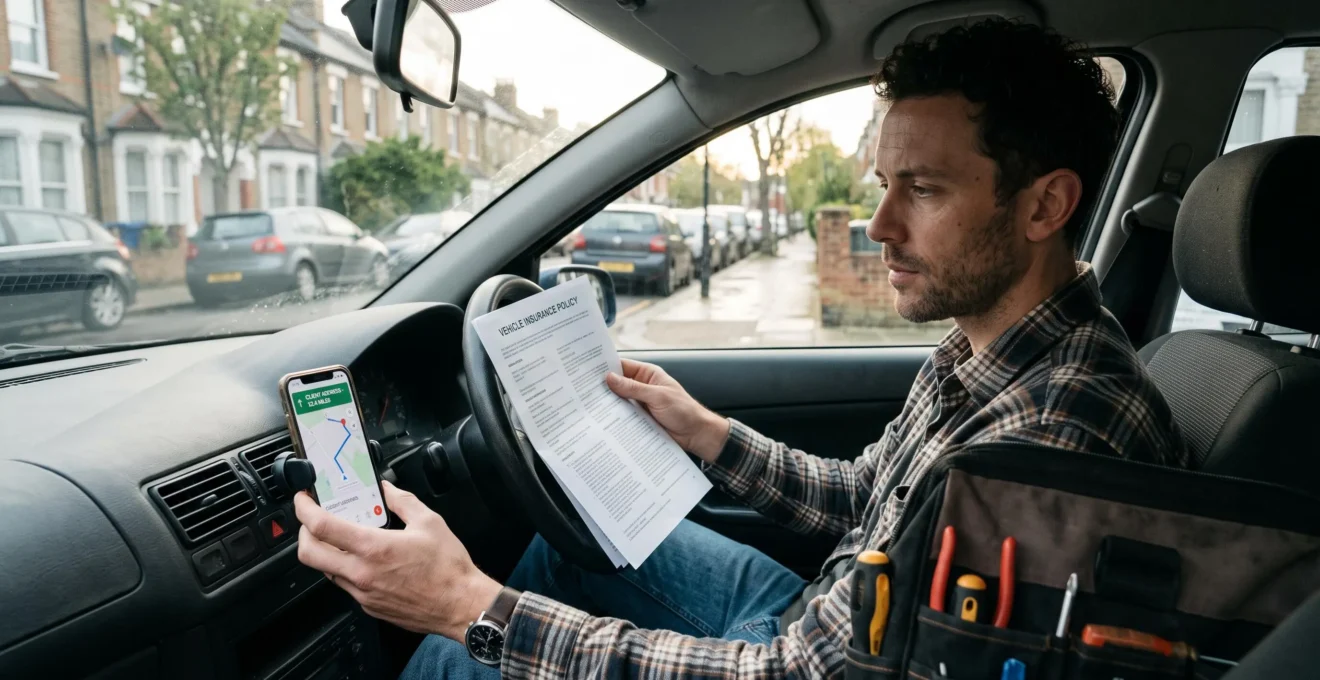
You can use your personal car for work without changing your insurance only if your existing policy already covers the journeys you intend to make. Driving to your usual workplace and driving between client appointments may seem similar, but insurers can treat them as different types of vehicle use.
This distinction matters whether you are an employee occasionally visiting customers, a self-employed tradesperson travelling between sites, or a hybrid worker driving from home to meetings. The fact that you own the car, receive mileage reimbursement or make only occasional business journeys does not automatically establish that the trip is insured.
In the United Kingdom, policies commonly distinguish social and domestic driving, commuting and business use. Other English-speaking countries operate under different insurance terminology and legal rules. The practical principle is consistent: the vehicle’s actual use must fit the cover agreed with its insurer.
Before making a work journey, identify the permitted use stated in your policy, describe your working arrangements accurately and obtain confirmation where necessary. This can prevent a relatively simple administrative oversight from becoming a difficult claims dispute.
Personal car insurance for work: the essentials
- Ordinary commuting cover does not necessarily include journeys to clients, changing job sites or multiple workplaces.
- Check the policy schedule and obtain written confirmation before undertaking journeys outside your declared use.
- Review business mileage, driving eligibility and vehicle condition whenever your working arrangements change.
- Why Is Driving to a Client Different From Driving to Your Usual Workplace?
- How Can You Confirm Your Car Is Covered Before Driving for Work?
- Commuting or Business Use: Which Insurance Class Fits Your Work Travel?
- What Can Happen if Work Journeys Are Not Declared to Your Insurer?
- When Does Occasional Work Driving Become a Regular Insurance Issue?
- When Should Drivers Recheck Their Legal Right to Use a Vehicle?
- How Can You Help Automatic Emergency Braking Work Properly?
- How Can Daily Car Use Stay Safe Without Creating Unnecessary Costs?
Why Is Driving to a Client Different From Driving to Your Usual Workplace?
Driving to a client differs from travelling to your usual workplace because insurers may classify the journey as business use rather than ordinary commuting. A policy covering travel to one regular workplace may not permit visits to customers, temporary sites or several business locations. The precise distinction depends on your insurer’s wording and your working arrangements.
In typical UK personal motor insurance arrangements, commuting means travelling between home and a regular place of work. Business use can encompass additional journeys made in connection with employment or self-employment.
The distinction becomes important when the destination changes because of professional duties rather than an ordinary journey to a fixed workplace.
For example, consider three hypothetical situations:
- An office employee drives from home to the same office each weekday. A policy including appropriate commuting cover may be sufficient.
- A consultant drives from home to different client premises. These journeys are more likely to require business-use cover.
- A maintenance worker drives between several sites during the working day. The driving forms part of the employee’s work activity and should be expressly covered.
A useful preliminary decision test asks three questions: Is the destination the driver’s normal workplace? Does the destination vary according to work assignments? Is travelling between locations part of the job?
The more a journey involves changing destinations and work duties, the stronger the reason to discuss business cover with the insurer. However, this is a screening method, not an official classification test.
The identity of the person arranging or paying for a journey is not decisive. An employer might instruct an employee to attend a client meeting, but that instruction does not transform the journey into ordinary commuting.
Hybrid and remote workers require particular care. A home-based consultant may travel to an office occasionally, visit customers regularly or attend temporary work locations. Their usual workplace arrangements and policy wording both matter.
The UK Health and Safety Executive guidance on driving for work distinguishes ordinary commuting from work-related journeys for occupational safety purposes. It also includes privately owned vehicles used for business, often called the grey fleet. That safety distinction does not itself determine the motor insurance classification.
If your work takes you somewhere other than your normal workplace, describe the specific journey to your insurer rather than assuming that commuting cover automatically extends to it.
How Can You Confirm Your Car Is Covered Before Driving for Work?
Confirm work-driving cover by checking the permitted-use wording in your current policy schedule, comparing it with the journeys you actually make and asking the insurer about any uncertainty. Obtain written confirmation or an updated schedule before the journey. A general statement that a car is fully insured does not establish that every business activity is covered.
Start with the policy schedule rather than the comparison website or advertising material used to purchase the policy. Look for wording such as social, domestic and pleasure, commuting, business use or an equivalent classification.
Then identify the vehicle’s actual role in your work. Travelling to one workplace, visiting clients, carrying equipment, delivering goods and transporting paying passengers are different exposure patterns.
The Association of British Insurers‘ motor insurance information identifies using a vehicle for business without appropriate business cover as an example of use that standard insurance does not usually cover.
When contacting an insurer, describe specific activities rather than asking only whether business driving is permitted.
Useful questions include:
- Does my policy cover visits to clients at different addresses?
- Can I drive between several workplaces on the same day?
- Am I covered when carrying tools, samples or equipment needed for my job?
- Does the policy include paid deliveries or transportation of goods?
- Can I transport clients or other passengers as part of my professional duties?
- Are all intended drivers covered for the same type of journey?
Ordinary business use should not be confused with carrying goods or passengers for hire or reward. Delivery work and paid passenger transport may require specialist insurance, depending on the activity, insurer and jurisdiction.
If the insurer agrees that a different use class is needed, ask when the change becomes effective. Check whether it affects the premium, excess, annual mileage allowance or restrictions on other drivers.
Keep the confirmation together with the policy documentation. An email, policy endorsement or updated schedule gives you a clear record of what was agreed, although the actual contractual wording remains decisive.
Five checks to complete before your first work journey
- Find your current policy schedule. Save a copy showing the permitted-use classification and covered drivers.
- Describe your work journeys. Write a short list of typical destinations, journey purposes and any equipment or passengers carried.
- Contact your insurer. Send the journey description and ask for confirmation of the cover required; retain the reply.
- Verify any amendment. Obtain an updated schedule or endorsement showing the effective date and applicable restrictions.
- Record a future review point. Note the renewal date and when work duties or annual mileage should be reassessed.
Once you have confirmed the permitted activities, the next decision is whether your present use class matches the amount and type of driving you expect to undertake.
Commuting or Business Use: Which Insurance Class Fits Your Work Travel?
The appropriate insurance class depends on why you drive, where you travel, who uses the vehicle and whether transporting people or goods is part of the work. UK policies commonly distinguish social use, commuting and business use, while commercial activities may need specialist cover. The policy’s actual definitions determine which journeys are insured.
The following comparison illustrates common UK insurance arrangements. Exact permitted activities and classifications vary between providers.
| Use class | Illustrative journey | Important limitation |
|---|---|---|
| Social, domestic and pleasure | Shopping, family visits or personal trips | Does not normally include commuting or professional travel unless expressly permitted. |
| Social use plus commuting | Home to a regular workplace | Additional client visits or travel between business sites may fall outside cover. |
| Business use | Client meetings, professional appointments or travel between work locations | Permitted drivers, occupations and business activities depend on the policy. |
| Commercial or specialist cover | Paid deliveries, transporting passengers for hire or reward, or other specialist operations | Requires cover specifically designed for the activity; ordinary business use may be insufficient. |
Business-use policies may contain further distinctions, including different permissions for a policyholder, spouse or other named drivers. The label alone is insufficient to establish the full scope of cover.
Self-employed drivers need particular attention. A sole trader might use the same car for shopping, family commitments and visiting customers. The insurer should know about both private and professional uses so that the combined policy reflects the actual exposure.
An employee using their own vehicle should not assume that employer-provided motor insurance covers it. Some employers arrange specific insurance protections for work-related driving, but the driver should obtain explicit confirmation of their scope, including any exclusions and excess arrangements.
Consider these common situations:
| Driving pattern | Likely insurance consideration | What to confirm |
|---|---|---|
| One occasional client visit | Business-use permission may still be necessary. | Whether a one-off journey is permitted under the existing policy. |
| Regular travel between company sites | Business cover is commonly relevant. | Multiple-location journeys and covered drivers. |
| Carrying work tools or samples | Business use and possible property-cover issues. | Whether work equipment is permitted and whether its loss is insured. |
| Mileage-reimbursed appointments | Classification follows the journey rather than reimbursement alone. | Business-use cover and total annual mileage. |
| Paid delivery or passenger services | Specialist cover may be required. | Exact commercial activity and applicable exclusions. |
Adding business use may sometimes be handled as an amendment to an existing policy, but it is not necessarily inexpensive or available from every insurer. Premiums can depend on annual mileage, the nature of work, vehicle use, drivers and other underwriting factors.
A policy amendment may also involve an administration charge or changed excess. Compare the full terms rather than only the premium difference.
Choosing the correct class matters because a mismatch may only become apparent when a claim is investigated, precisely when the financial consequences are most significant.
What Can Happen if Work Journeys Are Not Declared to Your Insurer?
Undeclared work journeys can create a dispute about whether a claim falls within the permitted use of a motor policy. Depending on the contract, the information given to the insurer and the applicable law, consequences may include restricted cover, reduced settlement or policy avoidance. However, an undeclared business journey does not automatically make every claim invalid.
When an incident occurs, an insurer may investigate the journey’s purpose. Relevant questions can include where the driver was travelling, why the journey was undertaken, whether the trip involved professional duties and what the insurer was told when the policy began or changed.
If the journey falls outside the permitted use, the insurer may assess whether a policy exclusion or condition applies. If the dispute concerns inaccurate information supplied during the insurance application, separate legal principles governing misrepresentation may become relevant.
The UK Financial Ombudsman Service information on insurance misrepresentation explains that the available remedies depend on factors including the questions asked, the policyholder’s care in answering and what the insurer would have done with accurate information.
These distinctions matter because a claim arising from use outside a permitted category is not necessarily analysed in exactly the same way as an incorrect answer at policy inception.
Three consequences should be considered separately.
- The current claim: cover for the insured vehicle or other losses may be disputed, restricted or refused where the contract and law permit.
- Future insurance: a cancelled or avoided policy may affect later applications, depending on the questions asked and applicable disclosure requirements.
- Third-party losses: compensation obligations and insurer rights are governed by the relevant motor insurance laws, which may provide protections for injured third parties even when cover is disputed.
The potential financial exposure from an accident involving injury can be substantial. Nevertheless, it would be inaccurate to conclude that every policyholder automatically becomes personally responsible for all third-party damages whenever business use was undeclared.
Nor does the fact that a journey happened only once establish that it was covered. A single trip can still fall outside the policy’s permitted activities.
Hypothetical example: an undeclared client visit
An employee whose insurance covers personal driving and commuting travels to a client meeting in their own car. During the journey, another vehicle is damaged in a collision.
The insurer investigates whether the trip was permitted under the policy. The result depends on the wording, the circumstances of the disclosure and applicable insurance law. The example illustrates the risk of a coverage dispute; it does not establish that the insurer would necessarily reject the claim.
If you realise that past journeys may not have been covered, contact your insurer promptly and explain the situation accurately. Ask how your policy should be amended for future journeys and whether earlier use affects your current position.
An amendment generally should not be assumed to provide retrospective cover for a previous incident. If a dispute already exists, consider obtaining independent insurance or legal advice appropriate to your jurisdiction.
Preventing future problems requires more than resolving one journey: the insurer should also have an accurate picture of how your vehicle is used throughout the year.
When Does Occasional Work Driving Become a Regular Insurance Issue?
Occasional work driving becomes a broader insurance issue when the journeys, annual mileage or professional activities no longer reflect the information held by your insurer. However, there is no universal number of business trips below which cover is automatically unnecessary. Even occasional driving may require prior permission, while regular use makes accurate declarations increasingly important.
A change in employment often reveals the problem. Someone previously driving to one office might begin visiting customers twice a week, travelling between regional sites or carrying work equipment.
Each change can affect the nature of the risk. Moving into self-employment, starting a delivery-based side activity or accepting a role involving field visits are additional reasons to review the policy.
Annual mileage is a separate consideration from the use class. A driver might have the correct permission for business visits but exceed the mileage estimate supplied to the insurer.
For example, a hypothetical worker who adds several long client journeys each week could accumulate considerably more annual mileage than expected when the policy was purchased. The issue is not a specific universal mileage limit but the accuracy of the information declared and the contract’s requirements.
The most practical approach is to maintain a simple record of vehicle use. This need not be an elaborate mileage-management system: an appointment calendar, odometer readings and a basic record of work journeys can help reveal changing patterns.
Reassess your policy when:
- Your job description begins to include regular travel.
- You start or expand a self-employed activity.
- You routinely visit more than one work location.
- You begin carrying tools, samples or goods for professional purposes.
- Your actual annual mileage moves materially away from your declared estimate.
- Your employer changes its arrangements for employees’ privately owned cars.
Reviewing these factors at renewal provides an orderly opportunity to update the insurer and compare quotations. But if your duties change during the policy year, notify the insurer when the change occurs rather than delaying until renewal.
Small developments can accumulate. A new part-time role, additional client visits and longer travel distances might each appear minor, yet their combined effect can make the original insurance assumptions inaccurate.
Insurance arrangements are only one part of responsible work driving. Your legal entitlement to drive and the vehicle’s condition also need periodic attention.
When Should Drivers Recheck Their Legal Right to Use a Vehicle?
Drivers should recheck their legal entitlement and vehicle documentation whenever their licence status, vehicle, insurance arrangements or work responsibilities change. A valid policy alone does not establish that a car is legally ready for the road. Licensing, registration, roadworthiness and other local requirements must also be satisfied, particularly when a privately owned vehicle is used professionally.
For UK drivers, relevant checks may include the appropriate driving licence entitlement, vehicle tax and any required MOT certificate. The precise requirements depend on the vehicle, its age, where it is registered and the applicable jurisdiction.
In other English-speaking countries, equivalent licensing, registration and safety inspection rules may differ substantially. A UK MOT certificate, for example, is not a universal requirement outside the relevant UK system.
Work use may create additional practical responsibilities. If tools or equipment are transported, drivers should ensure that loads are secured and the car remains suitable for the intended journey.
Employers also have an interest in privately owned vehicles used for business. In the UK, occupational road safety guidance addresses vehicles owned and driven by workers for business purposes, not just company-owned cars.
An employer may therefore request evidence of a suitable licence, insurance and vehicle condition as part of its work-driving arrangements. The exact responsibilities depend on local law and the employment circumstances.
Useful moments to repeat these checks include policy renewal, a change of vehicle, a new job or driving role, adding another driver and changes affecting licence entitlement.
A vehicle returning to use after an extended period off the road also deserves attention. Its insurance, legal status and mechanical condition may need reassessment before the next journey.
Another frequent misunderstanding concerns mileage reimbursement. An employer or client may reimburse work journeys according to an agreed rate, but the reimbursement arrangement is separate from insurance permission.
Receiving an approved mileage allowance does not itself prove that the journey is insured. Similarly, having appropriate business cover does not determine whether a reimbursement is tax-free or satisfies local tax rules.
With both legal and insurance requirements checked, drivers can turn to the vehicle’s safety systems, including technology that depends on proper maintenance.
How Can You Help Automatic Emergency Braking Work Properly?
Automatic emergency braking works best when its cameras, radar and other sensors remain clean, correctly positioned and unobstructed. Drivers should follow the vehicle manufacturer’s maintenance instructions, respond to warning messages and arrange professional inspection when necessary. The system can assist in certain hazardous situations, but it cannot detect every obstacle or replace attentive driving and safe following distances.
For people who use their own cars for work, frequent journeys can mean greater exposure to unfamiliar routes, traffic conditions and unexpected hazards. Maintaining driver-assistance equipment is therefore a sensible part of vehicle preparation.
Automatic emergency braking, commonly called AEB, typically monitors the road ahead and may apply braking when its system determines that a collision risk meets specified conditions.
The particular capabilities vary by manufacturer and model. Some systems can respond to certain pedestrians or cyclists, while others have more restricted detection functions or operating conditions.
AEB depends on components that may be located behind the windscreen, within the grille or in the bumper. Dirt, snow, ice, accessories and damage can interfere with detection.
Hyundai’s manufacturer documentation explains that its Forward Collision-Avoidance Assist can be affected by sensor obstruction, damaged glass, poor lighting and adverse weather. It also warns that malfunction is possible without a warning light being displayed.
Drivers can reduce avoidable interference through a simple maintenance routine:
- Keep the external windscreen areas used by forward-facing cameras clean.
- Remove dirt, snow or ice from relevant radar and sensor covers according to the owner’s manual.
- Check for system warnings before longer work journeys.
- Seek professional advice after impacts or repairs involving sensor mounting areas.
- Ask whether camera inspection or recalibration is required following windscreen replacement.
Cleaning must follow the manufacturer’s instructions. Avoid harsh products, inappropriate tools or direct interference with sensitive components.
After minor collisions, bumper repairs or windscreen replacement, the physical position of a camera or radar unit may be affected. Whether recalibration is required depends on the vehicle and the repair procedure. Drivers should not assume that every replacement requires the same process.
Accessories can also create difficulties. Unapproved bumper attachments, lighting modifications or objects positioned in front of a sensor may interfere with the system’s view.
Even a correctly functioning system has limits. Heavy rain, snow, fog, glare, poor road visibility and certain moving or stationary objects can challenge detection.
AEB is a supplementary safety aid, not a collision-prevention guarantee. The driver must remain alert, maintain appropriate distances and adapt speed to road conditions.
Maintaining vehicle safety also complements accurate insurance declarations, bringing the main legal, financial and practical considerations into one manageable routine.
Key takeaways before your next work journey
- Insurance suitability depends on the journey’s actual purpose, not simply how often it occurs or who pays for it.
- Changing work duties and rising annual mileage are reasons to review cover before the original declarations become inaccurate.
- Responsible work driving combines appropriate insurance, legal vehicle use and regular safety-system maintenance.
How Can Daily Car Use Stay Safe Without Creating Unnecessary Costs?
Keeping daily car use safe and affordable starts with accurate insurance declarations, realistic mileage estimates and preventive maintenance. Drivers should purchase cover suited to their actual activities rather than automatically choosing the cheapest or broadest policy. Reviewing driving permissions, vehicle condition and costs regularly helps avoid unnecessary premiums while reducing the risk of costly insurance disputes.
Begin with the use class. If your job involves client visits or travel between sites, confirm that the policy permits those journeys. If your work changes, ask whether the existing arrangement remains appropriate.
Do not automatically assume that an expensive commercial policy is necessary for occasional professional driving. Some insurers may be able to extend a personal policy to cover defined business journeys. Others may restrict particular occupations or activities.
Compare the total policy terms rather than focusing entirely on the quoted premium. Consider the excess, authorised drivers, permitted activities and any exclusions relevant to work travel.
Annual mileage deserves similar accuracy. Underestimating expected journeys to obtain a lower quotation can create problems, while unnecessarily overstating mileage may produce a less suitable offer. Ask insurers how changes should be reported.
Other potential cost considerations include voluntary excess choices, vehicle security and normal parking arrangements. Their effects on premiums vary by insurer and driver, and a larger voluntary excess should only be selected if the resulting out-of-pocket amount is affordable.
Maintenance is another practical cost-control measure. Keeping tyres, brakes, lights and driver-assistance systems in appropriate condition supports safe journeys and may help avoid preventable incidents and repair expenses.
Preventive maintenance does not guarantee lower insurance premiums, and claims history is only one of several underwriting factors. Nevertheless, reducing avoidable risks is worthwhile independently of any possible insurance saving.
For a manageable annual review, bring together the main information in one place:
- Compare your real work journeys with the use classification on your policy schedule.
- Check actual and expected annual mileage against the figure supplied to the insurer.
- Review premiums, excesses, authorised drivers and exclusions before renewal.
- Confirm that your licence, vehicle registration, roadworthiness and other applicable legal requirements remain valid.
- Inspect the vehicle and address outstanding safety warnings or maintenance needs.
Keep the documentation accessible, including insurer confirmations, policy endorsements and records of significant changes. For employees, checking the employer’s work-driving rules provides an additional safeguard. Self-employed drivers should also review whether their business activities require cover beyond ordinary business use.
This routine should not replace immediate notification when a material change occurs mid-policy. Renewal is a convenient review point, not permission to postpone a required disclosure.
Before your next professional journey, open your current policy schedule, check the use-of-vehicle wording against your planned trip and ask your insurer for written clarification where needed. That small administrative step is a practical starting point for using a personal vehicle at work safely, legitimately and economically.
Does comprehensive car insurance automatically include business use?
No. Comprehensive insurance generally describes the types of losses a policy may cover, not every permitted purpose for driving the vehicle. A comprehensive policy can still restrict use to personal journeys or commuting. Check the permitted-use wording separately.
Does carrying a laptop or work equipment automatically require business insurance?
Not necessarily. Carrying an ordinary work laptop while commuting is different from travelling between clients with professional equipment. Insurers may distinguish the purpose of the journey from the items being transported. Ask whether your work activities are permitted and whether the equipment itself is insured against loss or damage.
Can an employer’s insurance cover an employee’s privately owned car?
It may provide certain protections, but employees should not assume that an employer’s insurance replaces suitable motor cover for their own vehicle. Ask the employer what insurance arrangements apply, which risks are included and whether the employee must maintain business-use cover under their personal policy.
Can business-use insurance be added halfway through a policy year?
Some insurers permit mid-term amendments, subject to underwriting approval, additional premiums or administration charges. Others may not offer the required activity. Confirm the effective date of any change and do not assume that a new endorsement retrospectively covers earlier journeys.
Are personal car insurance rules the same in the UK, US, Canada and Australia?
No. Insurance terminology, legal requirements, exclusions and commercial driving rules vary between countries and, in some cases, states or provinces. The commuting and business-use categories discussed here primarily illustrate UK arrangements. Drivers elsewhere should check their local insurance contract and applicable regulations before using a private car for work.