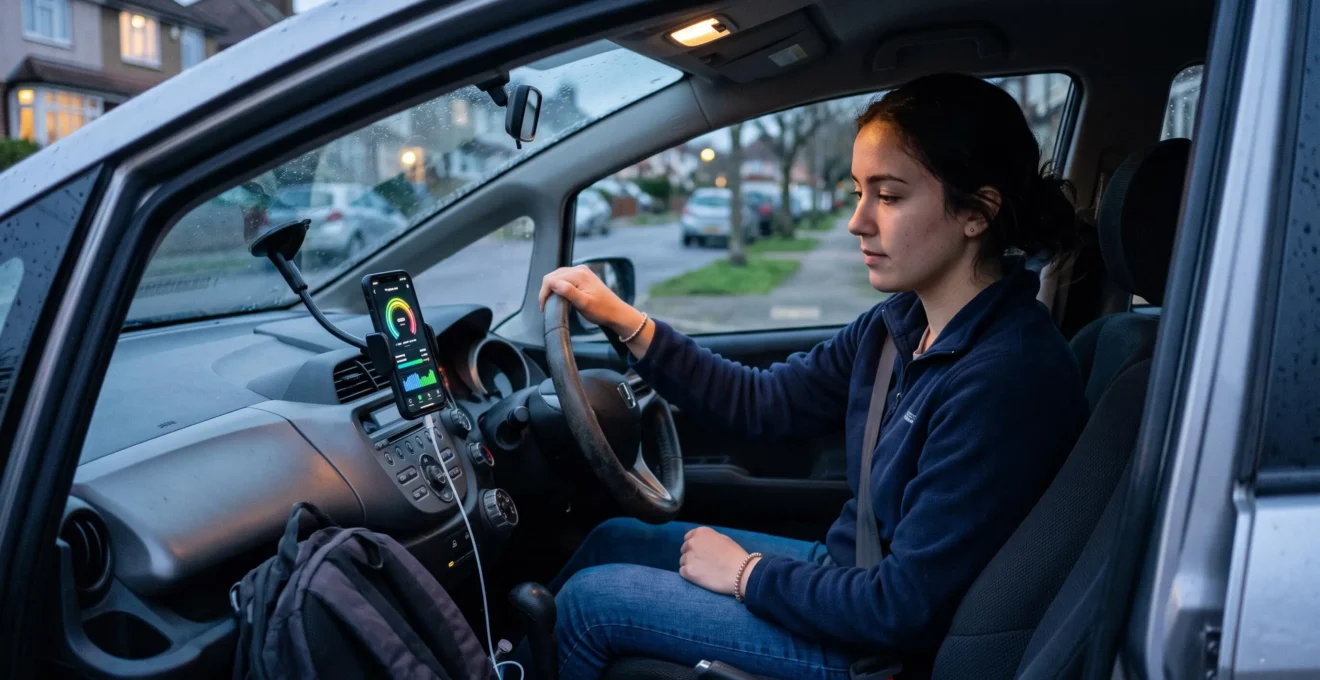
Vehicle telematics can make motor insurance more responsive to how, when and how much a car is driven. A smartphone application, fitted black box or connected-car system records selected journey information that an insurer may use to assess risk, calculate premiums or decide whether to continue offering cover.
For drivers facing expensive conventional insurance, particularly younger or newly qualified motorists, this creates an opportunity to demonstrate careful driving. However, accepting monitoring introduces questions that ordinary motor insurance does not always raise: which journeys count, who can examine location data, how scoring errors are corrected and whether a disappointing result could make renewal more expensive.
Not every telematics policy works the same way, and a strong driving score does not override all traditional pricing factors. The practical decision is therefore not simply whether monitoring can save money. It is whether the potential savings, contractual restrictions, data handling and cover offered make sense for your actual driving routine. Insurance rules and consumer protections vary between countries, so jurisdiction-specific guidance must be checked locally.
Vehicle telematics: essential considerations
- Driving data can influence insurance pricing, but discounts, penalties and renewal rules depend on the policy.
- Check what the device records, what affects your score, and how long identifiable information is retained.
- Compare monitored and conventional cover using total costs, excesses, restrictions and cancellation conditions rather than the initial premium alone.
- Why Can Telematics Data Change the Price of Motor Insurance?
- How Can You Check What a Telematics Device Records Before Using It?
- App or Fitted Black Box: Which Telematics Option Is More Practical?
- Which Driving Patterns Can Produce Poor Telematics Scores Without Speeding?
- When Is Telematics Insurance Worth Reconsidering?
- When Should You Move Beyond Third-Party Motor Insurance?
- Why Can Licence Suspension Affect Insurance Even After Driving Resumes?
- How Do Insurers Classify Your Car Use When Calculating Motor Cover?
Why Can Telematics Data Change the Price of Motor Insurance?
Telematics data can change motor insurance prices because it gives insurers information about actual journeys rather than relying exclusively on conventional risk categories. Depending on the contract, recorded speeding, braking, journey timing, mileage or phone distraction may affect a driving score, an ongoing premium, a renewal quotation or the insurer’s willingness to continue coverage.
In a score-based policy, the insurer interprets selected driving signals using its own assessment rules. For example, repeated harsh-braking events might reduce a smooth-driving score, while fewer recorded risky events might improve it. The actual weighting, thresholds and financial consequences are insurer-specific.
The UK’s Financial Ombudsman Service guidance on telematics insurance explains that insurers may use driving information to adjust premiums, set renewal prices or decide whether to continue providing cover. Its complaints experience also highlights disputes about scoring accuracy, premium increases and cancellation.
Crucially, telematics describes a monitoring method, not a single pricing model. Three common arrangements have different financial implications.
| Pricing model | How it works | Main financial consideration |
|---|---|---|
| Upfront discount | An initial reduction is offered in exchange for accepting monitoring. | Whether the discount can be withdrawn or future premiums changed. |
| Driving-score pricing | Selected recorded behaviours influence a score that may affect premiums or renewal. | How positive and negative results translate into costs. |
| Mileage-based cover | Charges depend partly on distance driven, under the policy’s stated charging formula. | Whether actual mileage and additional charges make the policy economical. |
Consider two hypothetical drivers who both travel carefully but have different mileage. A low-mileage driver might benefit from distance-based charging, while a higher-mileage driver with excellent braking and speed scores could find a behaviour-based policy more attractive. Neither outcome is guaranteed without the actual quotations and terms.
Another important distinction is the difference between possible rewards and consequences. A contract might offer a limited good-driving benefit but impose more substantial costs when a defined poor-score threshold is reached. That asymmetry is a possibility to investigate, not an established rule applying to all insurers.
Traditional rating factors remain important. Age, location, vehicle characteristics, previous claims, licence history and the cover selected can all influence the quotation alongside telematics information. An excellent score therefore cannot establish that a monitored policy is the cheapest available.
The relevant comparison is the likely total policy cost, including restrictions and possible adjustments. Understanding the data itself is the next requirement.
How Can You Check What a Telematics Device Records Before Using It?
Check the insurer’s privacy notice, policy conditions and monitoring explanation before activating a telematics device. Identify which signals are collected, which ones determine your driving score, whether precise location is recorded, how long information is retained and who may receive it. Also establish how to challenge errors and what happens to your data after cancellation.
Telematics equipment may collect GPS information, journey times, speed, acceleration, braking, mileage or device-interaction signals. These capabilities are not universal: an app and a fitted device can collect different information, and even systems with similar sensors may calculate scores differently.
Data collected is not necessarily data used to calculate the premium. A service might record detailed routes to identify trips while assigning the published driving score using only braking, speed and journey timing. Conversely, some information may be used for claims handling or fraud investigations without appearing as a visible scoring factor.
Compare the insurer’s description of its scoring methodology against the categories shown in the app. If the provider cannot explain whether particular data affects pricing, request clarification before agreeing to monitoring.
The UK’s Information Commissioner’s Office states in its ICO guidance on workplace vehicle monitoring that telematics information recording drivers’ activities is personal information subject to data protection law. That guidance concerns employment monitoring, particularly company vehicles; it does not determine every obligation applicable to private insurance worldwide.
Location monitoring deserves particular attention. Continuous tracking can expose patterns involving home, work and other sensitive destinations, whereas trip-based recording may limit the periods monitored. However, trip-based recording can still reveal precise locations during journeys. The privacy effect depends on the actual collection and retention arrangements.
Five checks before accepting telematics monitoring
- Identify the sensors. Create a written inventory of recorded signals from the product documentation, including location and phone activity where applicable.
- Match data to scoring. Record which monitored factors influence premiums, renewals or cancellation and identify any unexplained categories.
- Check retention and sharing. Save the relevant privacy-notice provisions describing storage periods, recipients and deletion arrangements.
- Test transparency. Obtain evidence of the app’s score display, journey correction process and available data-access or export options.
- Document exit terms. Keep a copy of the cancellation conditions, any trial provisions, and the provider’s explanation of what happens to recorded information after leaving.
Access and portability rights vary across jurisdictions. A provider may allow downloads of some personal data without offering the complete technical dataset used internally for scoring. Likewise, moving to another insurer does not necessarily transfer a favourable driving history.
Once the recording and processing arrangements are understood, the next decision is which monitoring technology fits the vehicle and its drivers.
App or Fitted Black Box: Which Telematics Option Is More Practical?
A telematics app is generally more convenient when a driver wants straightforward smartphone-based setup and minimal vehicle installation. A fitted black box may be more practical when consistent vehicle-linked monitoring matters or phone-based journey detection is unreliable. Neither technology is automatically more accurate, cheaper or more appropriate: hardware design, software quality and policy rules determine the result.
Phone-based systems can use location and motion information to assess journeys. Their convenience depends on compatible devices, permissions, battery availability and the ability to distinguish driving from travelling as a passenger. A misclassified bus journey, for example, could create an apparent driving event if the system fails to identify the travel mode correctly.
Some apps provide ways to correct incorrectly classified trips. Others may impose requirements concerning active tracking, permissions or minimum recorded journeys. Check whether an unrecorded trip merely disappears from the score or triggers a contractual consequence.
A fitted black box is associated with the vehicle rather than a particular phone. That can simplify recording when multiple people use the same car, although the insurer still needs a reliable way to interpret or attribute journeys if individual-driver scores matter.
Installation introduces different considerations. Some fitted products require professional installation, while plug-in units can be simpler to connect. Permanent equipment may also involve removal conditions when the vehicle is sold, returned to a leasing company or transferred to another insurer.
| Criterion | Smartphone app | Fitted black box |
|---|---|---|
| Setup | Usually software-based, subject to device permissions. | May require fitting or connection to the vehicle. |
| Recording reliability | Can depend on battery, permissions and journey classification. | Less dependent on the driver’s phone habits. |
| Shared vehicles | Driver identification and journey allocation need checking. | Can monitor the shared vehicle, but driver attribution may remain an issue. |
| Changing vehicles | Potentially flexible, subject to insurer rules. | May require equipment removal, replacement or reassignment. |
| Cost considerations | Check missing-trip rules and technical requirements. | Check installation, removal and replacement charges. |
For a sole driver who reliably carries a charged phone, an app may be the simpler choice. For a family sharing a vehicle, a fitted device might offer more consistent trip recording, but its scoring implications for different drivers still need examination.
Connected-car technology adds another option. Certain insurance products may obtain selected vehicle information from manufacturer-integrated systems, while others rely on plug-in equipment. The availability of these arrangements, the data shared and the need for separate consent are product-dependent.
Whatever the hardware, a useful driving score must reflect relevant behaviour accurately. That becomes particularly important when everyday conditions produce events the scoring system treats unfavourably.
Which Driving Patterns Can Produce Poor Telematics Scores Without Speeding?
A driver can receive a disappointing telematics score without exceeding the speed limit because insurers may assess more than speed. Depending on the policy, sudden braking, rapid acceleration, sharp cornering, late-night journeys, phone interaction or other trip characteristics may reduce a score. Some patterns reflect road conditions or necessary travel rather than deliberately unsafe driving.
Harsh braking is a useful example. A driver who repeatedly slows abruptly may be assessed less favourably by a system measuring sudden deceleration. Yet a single hard-braking event may be the correct response to an unexpected hazard. A reliable interpretation needs context rather than assuming every recorded event demonstrates poor judgement.
Urban journeys can involve frequent stopping, while winding roads generate steering and cornering events that may look different from motorway driving. Policies that consider journey timing may also treat night driving differently, regardless of whether the individual driver behaves carefully.
Risk scoring and driving fault are not the same thing. A night-shift worker may have little choice about travel times. A parent regularly completing school journeys may encounter congestion that makes smooth driving difficult. These circumstances should prompt questions about the scoring model, not unsafe attempts to avoid necessary braking.
If the app provides a breakdown, review individual components rather than focusing only on the overall score. Compare events against the relevant journeys, and check whether incorrect driver or passenger classifications can be amended. Keep records of disputed events while the information is still accessible.
Practical responses should prioritise safe, predictable driving: maintain sufficient following distance, anticipate ordinary traffic changes and avoid unnecessary phone handling. Optional journeys could be scheduled differently where convenient, but safety and legitimate travel needs should take precedence over gaming a score.
Frequency and mileage deserve separate scrutiny. Low total mileage does not necessarily produce an excellent behaviour score, and a few unfavourable events could be more influential under some calculation methods. Nevertheless, the available evidence does not establish that infrequent driving or long gaps between journeys are universally penalised.
Drivers should ask whether their insurer calculates results per journey, over a defined assessment period or using another method. The answer determines whether an isolated incident is likely to matter and whether the scoring system accommodates unusual conditions.
If reasonable corrections and safer habits do not improve the financial outcome, the issue may be the suitability of the policy rather than the driver’s conduct.
When Is Telematics Insurance Worth Reconsidering?
Reconsider telematics insurance when the monitoring conditions, driving scores or overall costs no longer suit your circumstances. A new night-shift job, additional driver, change of address or sustained unfavourable score can alter the value of a monitored policy. However, switching is worthwhile only when an alternative offers a better combination of price, cover and contractual conditions.
The first warning sign is a persistent discrepancy between expected and actual costs. If the policy allows adjustments during the term, review the bills and the insurer’s explanation of those changes. If scoring mainly affects renewal, compare the renewal quotation with conventional alternatives.
A second warning sign is a lifestyle change. Moving from daytime journeys to regular overnight travel could matter under a policy that assesses journey timing. Sharing a previously single-driver vehicle could also affect how events are recorded or attributed.
Before cancelling, distinguish between a driving-score incentive and a traditional no-claims bonus. They are not the same benefit. A score-based discount may be specific to one insurer, while no-claims history is subject to separate eligibility and recognition rules.
Mid-term cancellation can have consequences beyond changing insurers. Contractual fees, return of equipment, outstanding charges and the treatment of unused premium must be checked. Ending a policy before completing an insurance year may also affect the no-claims benefit that would otherwise have been earned.
Hypothetical renewal comparison
A newly qualified driver initially benefits from a monitored policy. Several months later, a new job requires regular late-night journeys, and the insurer’s published scoring criteria treat those journeys less favourably.
Rather than cancelling immediately, the driver obtains a standard insurance quotation and compares it with the monitored renewal offer. The comparison includes excesses, cancellation costs, any monitoring-specific benefit and the effect on no-claims history. The economically preferable option cannot be determined without those terms and prices.
Telematics can remain valuable despite imperfections, especially when conventional insurance quotations are difficult to afford. The possibility of demonstrating current driving behaviour may justify some monitoring inconvenience, provided the cost and privacy conditions are acceptable.
Compare like-for-like coverage before deciding. A seemingly cheaper alternative may protect the car less comprehensively or impose a higher excess, making the type of motor insurance just as important as its monitoring arrangements.
When Should You Move Beyond Third-Party Motor Insurance?
Consider moving beyond third-party motor insurance when losing or damaging your own vehicle would create a financial burden, or when broader cover costs little more than basic protection. Third-party-only insurance generally addresses qualifying liability to others, not damage to your own car. Comprehensive cover may offer better value, and it is not necessarily the more expensive option.
In the UK, the usual distinctions are third-party-only, third-party fire and theft, and comprehensive cover. Third-party fire and theft adds selected protection for the insured vehicle, while comprehensive insurance generally covers a wider range of qualifying damage to that vehicle.
MoneyHelper‘s explanation of UK car insurance cover confirms that the minimum level of cover is not necessarily the cheapest and that coverage details depend on individual policy conditions.
Begin with the car’s current market value and your ability to replace or repair it. Then compare actual quotes for equivalent drivers, vehicle use and annual mileage. A broader policy may be attractive when its additional premium is modest relative to the financial loss you could otherwise face.
For a low-value vehicle, the calculation can differ. Paying substantially more for comprehensive protection may be less appealing if the potential claim payment is limited by the vehicle’s value, the excess and relevant deductions. There is no universal numerical threshold that makes comprehensive insurance worthwhile for every car.
Look beyond broad policy labels. In particular, check the treatment of windscreen damage, fire, theft, personal injury benefits, replacement vehicles and driving other people’s cars. Some benefits are optional or restricted, and comprehensive insurance does not automatically include every extension.
Telematics belongs in the same comparison. A monitored comprehensive quotation may compete favourably with conventional third-party cover, especially for certain higher-premium drivers. But telematics availability is product-dependent: it should not be assumed that monitoring is restricted to comprehensive policies.
The right level of cover depends on the financial risks you can absorb, not merely the minimum insurance required. Driver history is another factor that can alter both availability and price.
Why Can Licence Suspension Affect Insurance Even After Driving Resumes?
A previous licence suspension or driving disqualification can affect motor insurance because insurers may consider relevant driving history when assessing future risk. Returning to lawful driving does not necessarily remove the record or its pricing consequences. Disclosure obligations, the length of time information remains relevant and the effect on cover depend on the offence, jurisdiction and insurer’s questions.
It is important to distinguish a formal disqualification, a suspension, a criminal conviction and an administrative licensing action. These are not interchangeable legal categories, and they may have different recording and disclosure requirements.
In the UK, relevant rules can differ between legal jurisdictions and depend on the status of a conviction and the information requested. Rules in the United States, Canada, Australia and other English-speaking markets are not identical. Drivers should therefore avoid relying on a general statement that every suspension must always be disclosed indefinitely.
An insurer may quote a higher premium, impose conditions or decline an application where the declared history falls outside its underwriting criteria. Certain drivers may need to consider specialist providers, but the availability of those providers cannot be assumed.
The practical disclosure method is to obtain an accurate record from the relevant licensing authority, identify the dates and nature of the action, and compare those details with the insurer’s actual questions. Where a question is unclear, request written clarification rather than guessing what must be declared.
Inaccurate answers can create serious difficulties if an insurer later reviews the application or a claim. The available remedies depend on the governing law, including whether an error was reasonable, careless or deliberate and whether it affected the underwriting decision. A claim is not necessarily invalid simply because a discrepancy exists.
Telematics may offer some drivers an opportunity to demonstrate safer current behaviour. However, there is no general guarantee that a good score offsets a previous disqualification. Insurers may continue applying their eligibility rules regardless of monitored performance.
Accurate documentation is more reliable than relying on assumptions about the passage of time. The same principle applies to another easily overlooked insurance declaration: how the vehicle is actually used.
Key points before declaring vehicle use
- Insurance eligibility depends on the accuracy of information supplied, not solely on driving scores.
- A journey that seems ordinary to the driver may fall within a different insurance-use category.
- Monitoring can create a detailed journey record, so declared usage and real-world driving should be consistent.
How Do Insurers Classify Your Car Use When Calculating Motor Cover?
Insurers classify vehicle use according to the purposes for which a car is driven, because commuting, private journeys and work-related travel can involve different risk exposures. A policy covering personal journeys may not automatically include business travel, deliveries or commercial passenger transport. The correct classification depends on the insurer’s definitions and your actual journeys.
UK motor insurance commonly distinguishes social, domestic and pleasure use, commuting and business use, with additional categories or specialist cover for commercial activities. These classifications are not necessarily identical between insurers or countries.
| Use category | Illustrative journeys | What to verify |
|---|---|---|
| Social, domestic and pleasure | Shopping, leisure activities and personal visits. | Whether commuting is excluded. |
| Commuting | Travelling to and from a regular workplace. | How the policy defines workplaces and commuting. |
| Business use | Travelling between work sites or visiting clients. | Which drivers, activities and destinations are included. |
| Commercial travelling | Regular work-related travel where this requires a separate usage classification. | Whether standard business cover is sufficient. |
| Delivery or hire use | Transporting goods or passengers for payment. | Whether specialist commercial or hire-and-reward cover is required. |
Misclassification can occur without an intention to deceive. Someone may correctly understand that personal motoring is covered but incorrectly assume that occasional travel to different client locations is included. Similarly, a driver may think a commuting extension automatically permits all work-related journeys.
A real UK complaint involving commuting cover
The Financial Ombudsman Service examined a motor insurance dispute in which a policyholder selected social and domestic use without commuting. The driver had understood the category differently because a previous policy treated commuting as included.
The Ombudsman considered the incorrect declaration careless rather than deliberate. Because the insurer would have offered the appropriate cover at a higher premium, the Ombudsman directed it to consider the claim proportionately under the relevant consumer insurance legislation. The case illustrates that an incorrect declaration can cause serious difficulties without automatically requiring outright refusal of every claim.
When an insurer identifies incorrect information, consequences depend on the circumstances and applicable consumer insurance law. Possible outcomes include adjusted terms, proportionate claim payments, refusal of a claim or avoidance of a policy where legally justified. It would be inaccurate to say every usage error automatically invalidates insurance.
Telematics adds a practical reason for accuracy. Detailed journey records might reveal patterns that prompt questions about declared use, although this possibility does not establish that every insurer checks location data for that purpose or that every device records precise routes.
To audit your declaration, review a normal working week alongside any unusual journeys. Include regular commuting, trips between sites, client visits, paid deliveries and use by additional drivers. Ask the insurer to confirm borderline journeys in writing, and update the policy when circumstances change.
Before accepting a monitored policy or renewing your cover, write down your actual vehicle uses, confirm the correct insurance classification, review the data and cancellation conditions, and compare complete quotations. That combination provides a sounder basis for deciding whether telematics insurance genuinely fits your needs.
Can an insurer use telematics data when investigating an accident?
Potentially, depending on the information collected, the policy and applicable law. Ask whether journey records, speed or location information may be examined during claims handling, what safeguards apply and how inaccurate records can be challenged. Not every system collects the same information.
Can passengers or other drivers affect a telematics score?
They may, depending on the monitoring system. A phone app could misclassify a passenger journey, while a vehicle-linked device may record journeys made by multiple insured drivers. Check how the policy identifies drivers, allocates journeys and corrects mistakes.
Does a good telematics score transfer to another insurance company?
Not necessarily. Telematics scores are often based on insurer-specific methods, and another provider may not recognise the previous score or associated discounts. Confirm which driving-history information can be exported and whether the prospective insurer accepts it. Keep any no-claims history separate from telematics-specific benefits.
Can you stop sharing location data without cancelling the policy?
That depends on the product and its contractual monitoring requirements. Some systems may offer configurable recording or privacy controls, while others require monitoring to remain active for the insurance arrangement. Disabling permissions could affect compliance with policy terms, so obtain clarification before making changes.
What should you do if a telematics driving score appears incorrect?
Preserve the journey details, screenshots and relevant scoring explanations, then request a review through the insurer’s correction or complaints process. In the UK, eligible unresolved insurance complaints may be referred to the Financial Ombudsman Service after the insurer’s final response or once the applicable eight-week response period has elapsed. Drivers elsewhere should consult their local complaint and dispute-resolution arrangements.