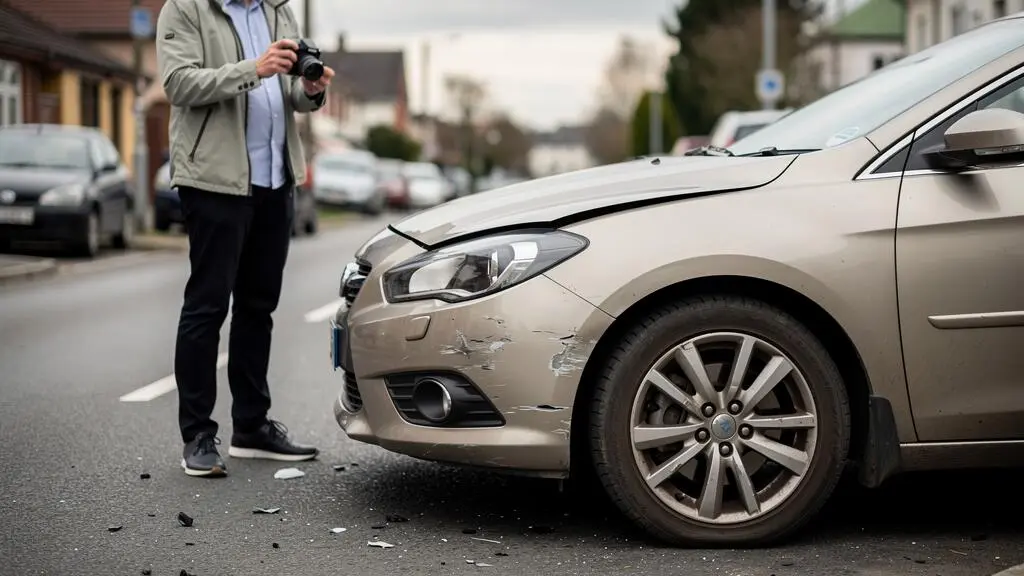
A collision does not have to leave a car visibly wrecked to create a complicated repair and insurance situation. A cracked bumper, a dented panel or a vehicle that still drives normally can conceal damage to mounting points, cooling components, sensors or other systems. The first estimate is therefore rarely a reliable basis for deciding whether to drive, repair privately or make an insurance claim.
The safest approach is to work through the decision in stages: protect people and the vehicle, preserve evidence, obtain an appropriate damage assessment, check the insurance policy and agree on the repair process before authorising work. The financial calculation should include more than the repair quotation. A deductible, possible premium consequences, vehicle value and applicable coverage conditions can all affect the outcome.
Procedures differ between countries, insurers and individual policies. Guidance from the United States, Canada, California and the United Kingdom can illustrate useful practices, but it should not be treated as a single set of rules applicable everywhere. The practical priority is to establish what happened, what is damaged and what the contract actually covers before making an irreversible decision.
Collision damage: the essential decisions
- Do not assume that minor visible damage means the vehicle is mechanically or electronically safe.
- Photograph the scene and the vehicle before repairs or changes make the original condition harder to establish.
- Compare the repair estimate with the deductible, policy coverage, potential premium consequences and vehicle value.
- Why Can Low-Speed Collision Damage Cost More Than It Looks?
- How Can You Photograph Collision Damage So the Evidence Is Useful?
- Approved Repairer or Local Garage: Which Route Fits Your Claim?
- Which Repair Mistakes Can Create Problems With a Collision Claim?
- When Is Collision Damage Serious Enough to Stop Driving the Car?
- How Should You Handle the First 10 Minutes After an Unexpected Crash?
- How Can You Protect Your Position After a Crash Without Admitting Responsibility?
- How Should You Assess Vehicle Damage Before Deciding What to Do Next?
Why Can Low-Speed Collision Damage Cost More Than It Looks?
Low-speed collision damage can cost more than the visible marks suggest because the outer bumper or body panel may conceal damaged supports, mounting points, cooling components or electronic sensors. A car can appear to have suffered only a superficial scrape while requiring additional inspection and repair work. The extent of the damage should therefore be established before relying on a cosmetic estimate.
Modern vehicles contain components behind the visible exterior. A bumper assembly, for example, may sit in front of sensor housings, brackets and other parts whose condition cannot be confirmed from an exterior photograph. An impact can also affect the alignment or operation of systems even when the plastic fascia appears only slightly cracked. This does not mean every minor collision damages hidden equipment; it means that appearance alone cannot rule out a problem.
Particular attention is warranted when the impact occurs near parking sensors, cameras, radar equipment, headlights, the radiator area or wheel arches. Warning messages, parking-assistance faults, unusual noises and changes in panel alignment are reasons to request a more detailed inspection. The vehicle manufacturer’s repair procedures should determine which components need testing.
The material and construction of the bumper also influence the repair decision. Modern assemblies may combine plastics, composites, reinforcement structures and metal supports. A visible crack in a replaceable exterior cover does not establish whether the underlying structure can be repaired or must be replaced. Nor does the apparent size of a dent establish the labour, paintwork or component costs involved.
Insurance decisions introduce a separate financial calculation. Four elements should be distinguished:
- Deductible or excess: the amount the policyholder must bear under the applicable contract before the insurer pays a covered amount.
- Repair cost: the amount established through an appropriate assessment, which may change when concealed damage is discovered.
- Premium consequences: a claim may affect future premiums or renewal conditions, depending on the insurer, jurisdiction and claim history.
- Diminished value: in some markets, a vehicle with an accident history may have a lower resale value even after repair. Whether this loss is recoverable depends on local law and the policy or claim circumstances.
The National Association of Insurance Commissioners (NAIC) explains that claim frequency and claim types can influence premiums and whether an insurer renews a policy. However, this guidance does not quantify an increase for an individual driver or establish a universal consequence for every minor collision. A driver should request policy-specific information rather than assume that filing a claim will always produce the same financial result.
Delaying notification can also make the claim harder to assess. As time passes, it may become more difficult to distinguish collision damage from subsequent deterioration or another incident. The NAIC recommends contacting the insurer promptly, but its guidance does not establish that a particular delay automatically invalidates coverage in every jurisdiction. The applicable policy wording and local reporting requirements remain decisive.
The NAIC identifies claim frequency and claim type as factors that can affect insurance premiums and renewal decisions. It does not provide a universal premium-increase percentage, so the financial impact must be checked with the insurer.
National Association of Insurance Commissioners, consumer guidance on auto insurance claims.
Before deciding that paying privately is cheaper, obtain a credible estimate that accounts for possible hidden damage and compare it with the amount the insurer would actually contribute. A repair quotation based only on visible scratches is not a reliable substitute for an inspection.
The next step is to preserve enough evidence for the insurer and repair professional to assess what happened and what needs attention. Photographs taken carefully at the beginning can make that process more straightforward.
How Can You Photograph Collision Damage So the Evidence Is Useful?
Useful collision photographs should show both the overall circumstances and the individual damaged areas. Start with safe, wide views of the vehicles and surroundings, then record identifying details and close-ups of each impact point. Include additional views requested by the insurer, and avoid returning to a dangerous scene just to obtain missing images.
Photographs serve two related but different purposes. Evidence photographs help establish the context of the collision: vehicle positions, road layout, surrounding conditions and visible points of contact. Assessment photographs help an adjuster or repair professional understand the extent of the damage: cracks, dents, panel gaps and areas requiring closer inspection. A single close-up may be useful for estimating a repair but insufficient to explain how the incident occurred.
A practical sequence can be organised into four stages, provided the scene is safe:
- Establish the overall scene. Photograph both vehicles and their positions, where possible, before they are moved. Include the surrounding road and relevant fixed reference points.
- Record the road environment. Capture the junction, lane markings, traffic signs, road surface, lighting conditions and any relevant obstruction. Do not enter traffic or put yourself at risk to obtain a particular angle.
- Document vehicle identity and condition. Photograph registration details where appropriate, vehicle identification information and the visible condition of each vehicle. Follow the insurer’s instructions about what identifying information to submit.
- Take detailed damage photographs. Photograph each affected area from several angles, including close-ups and wider views that show where the damage is located on the vehicle.
The Insurance Corporation of British Columbia (ICBC) provides a practical example of insurer-specific requirements. Its guidance requests overall vehicle views, close-ups of damaged areas, all four vehicle corners, the vehicle identification number, the post-incident odometer reading, the dashboard, roof and accident scene. It also notes that video can supplement photographs.
ICBC explains that photographs are not necessarily required to process every claim, but submitting them can help produce a more accurate estimate and may shorten waiting times. This is an example of a Canadian insurer’s process, not a universal photographic checklist. The insurer handling the claim should confirm which views and supporting documents it needs.
For the assessment itself, good lighting and a level surface can make images easier to interpret. Take a wide image before moving closer, then capture the damaged component from different angles. If a crack, dent or gap is difficult to see, a short video may provide additional context. Avoid manipulating a damaged part simply to make the defect more visible.
Photographs should not be limited to the policyholder’s own vehicle. When it is safe and lawful to do so, document the other vehicle and the scene as well. A record showing the surroundings and the positions of the vehicles can help explain the circumstances. The absence of a particular photograph does not automatically determine liability, but a more complete record gives the claims process more information to consider.
Some problems emerge only after the initial inspection. A new dashboard warning, unusual noise, changed door alignment or altered steering behaviour should be recorded promptly. Note when the symptom first appeared, under what conditions it occurs and whether it is worsening. A video can supplement the written record, but it should never require driving a potentially unsafe vehicle.
Preserve original image files where possible and avoid editing the evidence in ways that alter its content. Keep copies of submitted photographs, claim correspondence and any instructions received from the insurer. If the insurer requests additional images or documents, record the request and the date of submission.
Five steps to build a usable collision evidence file
- Photograph the overall scene when safe; save the original wide-angle images.
- Record the vehicles’ identifying details and the information requested by the insurer; keep a written vehicle-information note.
- Photograph every visible damaged area from wide and close angles; organise the images by vehicle location.
- Record new noises, warning messages or changes in vehicle behaviour; keep a dated symptom log and supporting video where useful.
- Submit the requested evidence to the insurer and retain copies; save the submission confirmation and correspondence.
Once the initial evidence has been secured, the choice of repair facility becomes the next practical decision. It should be made with reference to the policy, the applicable consumer protections and the technical requirements of the vehicle.
Approved Repairer or Local Garage: Which Route Fits Your Claim?
An insurer-approved repairer can simplify communication and payment arrangements, while an independent local garage may offer greater continuity with a trusted mechanic. Neither option is automatically better. The appropriate choice depends on the policy, local repairer-choice rights, the quality of the proposed work, parts availability and the written terms governing payment and repair guarantees.
The first distinction is between a repairer recommended by the insurer and one selected independently by the vehicle owner. Some insurers operate repair networks with agreed processes for estimates, authorisation, invoicing and claims administration. Using that network may reduce administrative work, but it does not necessarily mean that the insurer has an unrestricted right to dictate where the vehicle must be repaired.
California provides a documented example of consumer protection in this area. The California Department of Insurance explains that California Insurance Code §758.5 restricts an insurer from requiring an automobile to be repaired at a specific repair shop. Its guidance also addresses payment of reasonable repair costs when a consumer selects a facility that meets accepted repair standards. These rights are specific to California and must not be assumed to apply in other US states, the UK, Canada or elsewhere.
Three criteria are particularly useful when comparing repair routes:
| Criterion | Insurer-approved repairer | Independent local garage |
|---|---|---|
| Payment and administration | May offer direct insurer coordination and an established claims process. | May require the customer to obtain approval, pay an amount initially or manage differences between the quotation and settlement. |
| Repair guarantee | Check the written guarantee, its duration, exclusions and whether it remains valid if the vehicle changes ownership. | Check the garage’s own written guarantee and the entity responsible for correcting defects. |
| Replacement parts | Check whether the proposed parts are original, aftermarket, reconditioned or used. | Ask the garage to identify the proposed parts and obtain approval for any change. |
| Vehicle and repair expertise | Check whether the facility has the equipment and procedures required for the particular vehicle. | Check the garage’s experience with the model and access to the necessary technical information and equipment. |
Parts selection deserves particular attention. Original equipment manufacturer (OEM) parts are not the only parts that may be used in a repair. Depending on local rules and the policy, alternatives can include aftermarket, used, rebuilt or reconditioned components. The important questions are whether the parts are permitted, whether they meet the required standards and whether the customer has received clear information about what will be installed.
The California Department of Insurance explains that non-OEM replacement parts must be comparable in kind, quality, safety, fit and performance under the framework described in its guidance. It also advises consumers to review written estimates and final invoices. Repair facilities in California must provide written estimates before work begins and written invoices after completion, including identification of replacement-part categories. These requirements are jurisdiction-specific rather than universal rules for all repair businesses.
Another point to clarify is the replacement-vehicle arrangement. An insurer or repair network may offer access to a rental vehicle, but entitlement, duration, vehicle category and payment limits depend on the policy and applicable arrangements. A repairer located far from home can also create practical transport difficulties. Before accepting a repair route, establish whether the replacement vehicle is covered, when it becomes available, how long it can be retained and who pays if the repair takes longer than expected.
Declining a network repairer should not be assumed to leave all other policy benefits unchanged. Equally, accepting one should not be treated as automatic proof that every cost or guarantee is covered. Ask the insurer to explain in writing how the choice affects authorisation, direct payment, excess, parts and any replacement-vehicle benefit.
For a trusted independent garage, the safest process is to obtain a written quotation and submit it for the insurer’s review before work starts. Ask whether an adjuster must inspect the vehicle and whether additional damage will require separate authorisation. Compare the approved amount with the garage’s quotation, since a difference may leave the vehicle owner responsible for some costs.
Parts availability can change the practical decision. A newer or imported model may require a component that is not immediately available through one repair network. Another facility may have better access to the required part or specialist equipment. Obtain an estimated delivery time before selecting the repairer, but treat any delivery estimate as provisional until confirmed.
California Insurance Code §758.5 is identified by the California Department of Insurance as the basis for restrictions on insurers requiring a specific repair shop. This is a California-specific consumer protection, not a worldwide right.
California Department of Insurance accident and repair guidance
Before authorising a facility, make sure that the written estimate identifies the work, parts and costs, and that any insurer approval is documented. A verbal assurance about payment or a guarantee is not a substitute for clear written terms.
After selecting a facility, the focus should shift to controlling the quality and traceability of the repair. Clear authorisation and documentation reduce the risk of disputes when the vehicle is returned.
Which Repair Mistakes Can Create Problems With a Collision Claim?
Repair mistakes can complicate a collision claim when work begins without the required inspection or authorisation, unsuitable parts are installed, or safety systems are not checked according to the manufacturer’s procedures. The main protection is to preserve the original evidence, agree on the repair scope in writing and retain documentation showing what was inspected, replaced, tested and invoiced.
One common problem is authorising repairs before the insurer has had the opportunity to inspect the damage when an inspection is required. Removing a bumper, replacing a damaged component or repainting a panel can make it harder to establish the original condition. This does not mean that emergency safety work must always wait for an adjuster. If immediate action is necessary to prevent further harm or damage, contact the insurer as soon as practicable and document the condition before intervention whenever it is safe to do so.
Another source of disagreement is a change in the parts specified in the estimate. A quotation may identify an OEM component, while the final invoice refers to an aftermarket or previously used part. That difference should be explained and authorised where required. Consumers should not assume that a different part is necessarily defective, but they should be able to identify what was installed and establish whether it meets the applicable requirements.
ADAS systems require particular attention. Advanced driver-assistance systems may include cameras, radar, parking sensors and other equipment that support functions such as lane assistance, collision warnings and automatic braking. Damage to a sensor, its mounting point or the surrounding vehicle geometry can affect system operation even if the exterior repair looks satisfactory.
Thatcham Research published Insurance Industry Requirements for ADAS-equipped vehicle repairs in July 2020. The requirements address the identification of ADAS equipment, inspection of affected components, realignment and calibration when specified by the relevant repair procedures, and retention of verifiable records. Calibration requirements vary between vehicle models. Consequently, not every collision requires the same technical work, and a repairer should consult the manufacturer’s procedures for the particular vehicle.
“Sensor calibration requirements vary greatly from one vehicle to another.”
This distinction matters because an exterior panel can be restored without necessarily demonstrating that an affected assistance system operates correctly. Where calibration or inspection is required, ask for the relevant result and supporting documentation before accepting the vehicle.
A further problem occurs when dismantling reveals additional damage that was not visible during the first assessment. This is sometimes described as a supplementary estimate or supplemental claim. The repairer should document the newly discovered damage and communicate it to the insurer through the applicable process. The additional work should not simply be assumed to be covered because the original collision was accepted.
A sensible sequence is to stop the relevant repair work, preserve photographs of the newly exposed damage, obtain an updated written estimate and request the insurer’s instructions. Keep the original estimate alongside the revised version so that the differences can be traced. If the insurer disputes an additional item, ask for the reason in writing and identify the evidence supporting the repairer’s assessment.
Quick cosmetic repairs before an inspection can create similar difficulties. A temporary repair may be justified for safety or protection against further damage, but it should be documented. Keep photographs, invoices and a description of the work performed. Where the insurer has requested an inspection, obtain guidance before making changes that could remove evidence.
At collection, check more than the paint finish. Compare the completed work with the authorised estimate and final invoice. Look for discrepancies in the parts description, check panel alignment and verify that the systems associated with the impact have been tested. Any warning light, unusual sound or operational problem should be raised immediately rather than treated as a minor inconvenience.
- Check that the final invoice identifies the replacement parts and matches the authorised work.
- Obtain the repair guarantee in writing, including its scope and exclusions.
- Request records of inspections and ADAS calibration where the relevant procedures require them.
- Check the operation of lights, sensors, doors and other affected systems.
- Keep copies of the initial estimate, supplementary authorisations and final invoice.
California’s consumer guidance provides a useful example of the importance of written repair estimates and invoices, as well as identification of replacement-part categories. Thatcham Research provides a separate technical example of the documentation needed when ADAS-related repair procedures apply. Neither source establishes that one universal repair procedure applies to every vehicle or country.
Even a correctly authorised repair is not the right next step if the vehicle is unsafe to drive. The decision to continue using it must be based on its mechanical condition and the applicable roadworthiness requirements.
When Is Collision Damage Serious Enough to Stop Driving the Car?
Stop driving after a collision if braking, steering, visibility, lighting or wheel control may be affected, or if there are signs of structural damage, fluid leakage or airbag deployment. A vehicle that appears drivable can still have a safety-critical fault. When its condition is uncertain, arrange a professional assessment or recovery rather than testing it on public roads.
Damage can be assessed in three broad levels. These are practical decision categories, not a substitute for a legal roadworthiness inspection.
Level 1: Immediate safety or legal concern. Do not continue driving if any of the following conditions affect the safe operation of the vehicle:
- Headlights, brake lights or indicators are damaged or not functioning when required.
- The windscreen, mirrors or other visibility areas are obstructed or compromised.
- The braking system feels abnormal or does not respond as expected.
- The steering is difficult, unstable or noticeably different from normal.
- A wheel, tyre or suspension component appears damaged or insecure.
Whether a vehicle is legally prohibited from being driven depends on the jurisdiction and the nature of the defect. Local roadworthiness rules determine the legal position. However, a safety-critical fault is sufficient reason to stop and seek assistance rather than attempting to reach a garage under its own power.
Level 2: Possible mechanical or structural damage. An airbag deployment, deformation around the passenger compartment, leaking fluids, displaced wheels or significant changes in panel and door alignment can indicate more serious damage. A damaged cooling system may also lead to overheating. These signs require professional assessment before the vehicle is returned to service.
Fluid on the ground should not automatically be identified as harmless water. It may come from the cooling, lubrication, braking or other systems. Avoid touching unknown fluids or attempting repairs at the roadside. A mechanic can establish the source and whether the vehicle needs recovery.
Level 3: Apparently cosmetic damage with possible secondary risks. A superficial scrape or small dent may be compatible with continued use, but only when the vehicle’s safety-critical functions remain unaffected. Loose bumper sections, sharp edges, rubbing tyres, damaged sensors or insecure exterior components can turn an apparently minor defect into a practical hazard.
Do not rely on a short road test to establish that a collision-damaged vehicle is safe. If a wheel looks misaligned, the steering pulls, the brakes behave differently or an assistance-system warning appears, stop and obtain an inspection. A vehicle can also be unsafe even when no dashboard warning is displayed.
Driving with unresolved damage may create additional complications. A second collision could make it harder to distinguish the original damage from the new incident. An insurer may examine whether the vehicle’s condition contributed to subsequent damage or whether policy conditions were respected. The exact effect depends on the circumstances, policy wording and local law; it should not be assumed that every instance of driving after a collision automatically cancels cover.
Authorities may also be able to prohibit further use or arrange immobilisation when a vehicle does not meet applicable safety requirements. The relevant powers and procedures vary between jurisdictions. A driver should not interpret an insurance claim being opened as confirmation that the car is roadworthy.
When the vehicle must remain stationary, arrange recovery if necessary and ask the insurer how towing and storage expenses are handled. Check whether the policy requires the use of a particular recovery provider or imposes limits. Keep the towing receipt and record where the vehicle is taken, since storage costs may accumulate while the inspection or repair decision is pending.
Do not confuse the obligation to manage a claim with permission to drive. A vehicle can remain immobilised while the driver contacts the insurer, supplies evidence and arranges an inspection. The claims process should continue even when the vehicle cannot safely be moved without professional assistance.
Once immediate safety has been addressed, the remaining steps begin at the accident scene itself. A calm, structured response during the first few minutes can protect both people and the quality of the evidence.
Key points to remember before assessing the claim
- Preserve evidence before repair work changes the original condition of the vehicle.
- Do not authorise technical work without clarifying the insurer’s inspection and approval requirements.
- Stop driving whenever safety-critical systems or structural components may have been affected.
How Should You Handle the First 10 Minutes After an Unexpected Crash?
The first ten minutes after a collision should be used to protect people, secure the scene, record essential information and avoid premature statements about responsibility. The exact legal requirements differ between countries, but the priorities remain consistent: deal with injuries first, prevent further danger, preserve available evidence and contact the appropriate authorities when necessary.
A practical response can be organised into four stages.
1. Secure the scene. Switch on the hazard warning lights and, if the vehicle can be moved safely, get it out of traffic where local rules allow. Put on a high-visibility vest if available and use a warning triangle where required and safe to do so. The required placement distance and equipment differ between jurisdictions, so drivers should follow local roadside-safety requirements rather than assume one distance applies internationally.
Do not stand between vehicles, in an active traffic lane or in another exposed position to inspect the damage. If the scene is dangerous, move to a safe location and contact emergency services.
2. Check everyone’s condition. Establish whether the drivers, passengers, pedestrians and other people involved are injured. Call emergency services when someone needs medical assistance or when the incident creates an immediate danger. Do not assume that an absence of visible injuries means nobody requires medical attention.
Where an injury is suspected, avoid unnecessary movement of the injured person unless remaining in place presents a more immediate danger. Follow the instructions of emergency responders.
3. Document the incident. Once the situation is safe, record the location, time, vehicles involved, registration details and contact information. Identify witnesses and retain their contact details where they are willing to provide them. Photograph the scene and the damage without placing yourself in danger. Note the weather, road surface, lighting and visible traffic signs where relevant.
The National Association of Insurance Commissioners recommends collecting information about the other vehicle, witnesses, police officers, accident location, road conditions and weather. It also recommends using photographs or diagrams to document the scene. These records can help the insurer investigate the incident, although the information requested and the reporting process vary by jurisdiction.
4. Avoid premature commitments. Do not guess about the cause of the collision or accept responsibility before the circumstances have been established. Exchange the information required by local rules, but distinguish factual descriptions from conclusions about liability. Do not sign a document containing statements that you do not understand or that do not accurately describe what happened.
The accident report or collision form deserves particular care. In countries where a standard joint accident report is used, the parties may record the vehicles, circumstances, damage and other relevant details. The form should reflect what actually occurred. A diagram, vehicle position or circumstances box should not be completed merely to reach an agreement with the other driver.
A signed report and an insurance notification are not necessarily the same thing. The first records information about the incident; the second starts or advances the contractual claims process with the insurer. Their legal effect and the applicable submission deadlines depend on the country and policy. A driver should therefore check the insurer’s instructions rather than assume that completing a form at the roadside satisfies every notification requirement.
Several mistakes are particularly worth avoiding:
- Moving vehicles before recording their positions, when photographs could safely have been taken first.
- Making speculative statements about fault or apologising in a way that could be interpreted as a factual admission.
- Accepting a cash arrangement without understanding the damage or preserving an adequate written record.
- Leaving the scene without recording the other vehicle’s identifying information when it is possible and lawful to do so.
- Attempting to photograph or inspect the scene from an unsafe position.
An apology or polite expression of concern should not automatically be treated as a legally binding admission. Equally, drivers should avoid statements that speculate about responsibility. A simple factual account is more useful than an improvised explanation of the collision.
Where the other driver leaves the scene, record as much identifying information as possible, including the registration number, vehicle make, model, colour, location and direction of travel. Contact the police or relevant authorities promptly and obtain a reference number if one is issued. A hit-and-run or uninsured-driver claim may follow a different procedure from an ordinary collision claim, and additional reporting requirements may apply.
The NAIC specifically recommends promptly contacting the police following a hit-and-run incident. Its guidance concerns US claims and should not be treated as a substitute for the reporting rules in other countries.
After the immediate situation is under control, contact the insurer as soon as practicable. Explain what happened, provide the information available and ask what evidence, forms and inspections are required. If some details remain uncertain, distinguish confirmed facts from information that still needs checking.
Once the initial report has been secured, the next challenge is communicating accurately about responsibility. A driver can cooperate fully with the other party and insurer without making unsupported admissions.
How Can You Protect Your Position After a Crash Without Admitting Responsibility?
You can protect your position after a collision by describing observable facts, preserving evidence and avoiding speculation about who is legally responsible. Cooperating with the other driver, exchanging information and completing the required accident documentation do not require you to accept fault. The final liability assessment depends on the evidence, applicable rules and the insurance process.
The difference between a factual observation and an admission is important. Saying that two vehicles made contact, or that a particular part of a vehicle was damaged, describes something observable. Saying that the collision was entirely your fault is a conclusion about responsibility. That conclusion may depend on factors that have not yet been established, including road markings, traffic signals, vehicle movements and witness accounts.
Neutral descriptions are therefore preferable when the circumstances are not yet clear. For example:
- “My vehicle and the other vehicle made contact at the junction.”
- “The damage is visible on the front passenger-side bumper.”
- “I was travelling in the right-hand lane immediately before the collision.”
- “I have not yet established the full extent of the damage.”
- “I will provide the available information to my insurer for assessment.”
These formulations communicate information without adding an unsupported conclusion. They should not be used to conceal facts or avoid answering legitimate questions. The objective is accuracy, not strategic omission.
The accident report’s circumstances section is particularly important because it records the movements and positions of the vehicles. In some insurance systems, standardised accident diagrams and circumstances codes help insurers assess responsibility. However, the way those elements influence liability depends on the local framework. A form used in one European country should not be assumed to have the same legal or evidential effect in the United States, Canada or the United Kingdom.
Before signing a joint report, check the following:
- The vehicles and drivers are correctly identified.
- The location, date and circumstances are accurately recorded.
- The diagram corresponds to the actual movements and positions as far as they can be established.
- Any selected circumstances boxes accurately describe the events.
- Corrections or disagreements are recorded rather than concealed by an inaccurate joint account.
If the other driver disagrees with your description, do not invent a compromise version simply to obtain a signature. Follow the local procedure for recording disagreement and submit your own factual account to the insurer. Keep a copy of any completed document and the associated photographs.
Evidence should extend beyond the vehicles themselves. Witnesses may help establish what happened immediately before or during the collision. Ask for their names and contact details, subject to their willingness to provide them. Record the road conditions, visibility, weather, traffic signs and relevant lane markings while the information is still available.
Written communication also matters. Keep copies of emails, claim forms, repair estimates, insurer instructions and messages exchanged with the other driver. If an important conversation takes place by telephone, make a dated note of the discussion, the person spoken to and any instructions received. Confirm significant decisions in writing where possible.
Informal arrangements can create avoidable difficulties. An offer to pay privately may appear attractive when the visible damage seems minor, but the full repair cost may not yet be known. Hidden damage, later-discovered faults and disagreements about the amount can make a verbal arrangement difficult to enforce or reconcile with insurance obligations.
Before accepting a private settlement, establish whether the policy requires notification even if no payment is requested. Some contracts impose notification duties independently of whether the policyholder intends to make a claim. Local legal reporting requirements may also apply. An agreement with the other driver does not automatically override those obligations.
When an insurer asks for an account, provide a clear chronology rather than a speculative interpretation. Identify what you saw, what you did and what you learned afterwards. Separate direct observations from information supplied by witnesses or other parties. If you do not know something, say so rather than filling the gap with an assumption.
The NAIC recommends collecting witness and accident information and keeping relevant documentation as part of the claims process. Its guidance also explains that consumers can question settlement decisions, request written explanations and seek assistance from their state insurance department. Those escalation routes are US-specific, but the broader practice of requesting a written explanation is useful when discussing a disputed claim with an insurer.
Responsibility and damage assessment should also be treated as separate questions. A vehicle can be extensively damaged even when its driver is not responsible, while a minor impact can still create a liability dispute. A repair quotation does not, by itself, establish which party should pay.
With the evidence and circumstances documented, the driver can move to the final decision: whether to repair, claim, seek further assessment or reconsider the economic viability of the vehicle.
How Should You Assess Vehicle Damage Before Deciding What to Do Next?
Assess collision damage by examining three areas: the bodywork, the mechanical and structural components, and the vehicle’s electronic systems. Then compare the likely repair cost with the insurance deductible, potential premium consequences, vehicle value and policy coverage. This approach helps determine whether to claim, obtain another assessment, repair privately or consider the vehicle an economic total loss.
The first category is bodywork and exterior damage. Look for cracked bumpers, dented panels, broken lights, damaged glass, loose trim and changes in the gaps between doors and body panels. These observations help identify the visible repair requirements but cannot establish whether hidden components are intact.
The second category is mechanical and structural damage. Steering, braking, suspension, wheels, cooling components and the structure around the passenger compartment may need professional inspection. Signs such as fluid leakage, abnormal steering, unusual vibrations or displaced wheels should be treated as reasons to stop driving until the vehicle has been assessed.
The third category is electronic and ADAS damage. Check for dashboard warnings, parking-sensor faults, camera problems and changes in driver-assistance functions. An impact around a sensor or its mounting structure may require additional inspection or calibration. The applicable manufacturer’s repair procedure determines the necessary work.
Thatcham Research’s technical requirements for ADAS-equipped vehicle repairs explain why inspection, realignment and calibration may be necessary depending on the affected components and vehicle model. The repairer should be able to identify the relevant procedure and provide supporting records when the work requires calibration.
These three categories should be assessed together. A vehicle may have relatively inexpensive visible bodywork damage but require specialist electronic inspection. Conversely, a cosmetic repair may be straightforward when the underlying components and safety systems are confirmed to be unaffected.
The next step is a financial comparison. There is no reliable universal repair-cost threshold at which an insurance claim becomes worthwhile. The calculation depends on the contract, the driver’s circumstances, the repair assessment and the market value of the vehicle.
| Factor | Question to answer | Why it matters |
|---|---|---|
| Repair estimate | What is the complete expected repair cost, including additional damage discovered during inspection? | Provides the initial cost of restoring the vehicle. |
| Deductible or excess | How much must be paid by the policyholder? | Determines the immediate out-of-pocket contribution. |
| Insurance consequences | Could the claim affect future premiums, renewal or other policy conditions? | Helps estimate the wider financial consequences. |
| Vehicle value | What is the vehicle’s market value immediately before the collision? | Helps determine whether repairing the vehicle remains economically reasonable. |
| Coverage and exclusions | Is collision damage covered, and are there relevant exclusions or limits? | Establishes whether the insurer is expected to contribute. |
| Possible diminished value | Could the accident history affect resale value, and is compensation available locally? | Identifies a potential financial consequence beyond the repair invoice. |
Consider an explicitly hypothetical example. A driver receives a repair estimate and discovers that the cost is relatively close to the policy deductible. Paying privately might initially appear simpler, but the decision could change if dismantling reveals additional damage. Conversely, an insurance claim may involve financial consequences beyond the immediate deductible. The driver should obtain the insurer’s explanation of the applicable terms before comparing the alternatives.
Vehicle value introduces another important consideration. An insurer may decide that repairing a vehicle is not economically viable when the expected repair cost, salvage value and applicable settlement rules make a total-loss settlement more appropriate. The exact calculation and terminology differ between jurisdictions and policies. There is no universal repair-to-value percentage that can safely be applied to every vehicle.
Before accepting a total-loss assessment, check the valuation basis and the information used to establish the vehicle’s pre-collision market value. Relevant considerations may include the model, age, mileage, equipment, condition and comparable vehicles available in the relevant market. If the valuation appears inconsistent with the vehicle’s actual condition or market, request the insurer’s written explanation and ask how to challenge it under the applicable procedure.
Policy exclusions must also be checked before authorising substantial work. Relevant questions include whether the driver was declared under the contract, whether the vehicle was being used for an insured purpose and whether collision or own-damage cover was included. A policy that covers third-party liability does not necessarily cover damage to the policyholder’s own vehicle.
Other restrictions may concern geographical coverage, permitted drivers, vehicle use, excesses and policy limits. The exact wording matters. A driver should not infer that all collision costs will be covered simply because the policy was active on the date of the incident.
Where the coverage position is unclear, request written clarification before committing to expensive repairs. Ask the insurer to identify the relevant policy provision, explain any proposed deduction and confirm what documentation is still required. If the claim is disputed, request a written explanation of the decision and follow the complaint or review process available in the relevant jurisdiction.
For a more structured decision, record the following information in one place:
- The initial visible damage and any additional damage identified during inspection.
- The complete written repair estimate and any supplementary estimate.
- The applicable deductible and the insurer’s explanation of potential premium consequences.
- The vehicle’s estimated pre-collision market value and the basis of that valuation.
- The relevant policy coverage, exclusions, limits and authorisation requirements.
The decision should ultimately be based on the complete financial and technical picture, not the initial appearance of the damaged vehicle. A repair that seems economical before inspection may become unreasonable when additional components are included. Similarly, a low initial estimate does not establish that a vehicle can safely return to the road.
Before committing to repairs or accepting a settlement, ask the insurer to confirm the remaining steps, the approved costs and any outstanding conditions in writing. Keep the evidence and valuation documents together so that the final decision can be reviewed if the assessment changes.
Should you report a minor collision even if you do not intend to make an insurance claim?
Check the notification requirements in your insurance policy and the applicable local reporting rules. Some contracts require an incident to be reported even when the policyholder does not request compensation. A minor appearance does not necessarily mean that the damage is minor, and concealed damage may become apparent during a later inspection. Contacting the insurer promptly helps establish the applicable procedure.
Can an insurer refuse to pay for damage discovered after the initial repair estimate?
Additional damage is not automatically excluded simply because it was discovered after the first estimate. The insurer may require photographs, a supplementary inspection and an updated repair quotation to establish that the additional damage relates to the original collision and falls within the policy coverage. Contact the insurer before proceeding with additional work whenever possible, and retain the initial and revised estimates.
Can you choose your own garage instead of using the insurer’s approved repairer?
This depends on the applicable law and insurance contract. Some jurisdictions provide consumers with repairer-choice protections. For example, California Insurance Code §758.5 restricts insurers from requiring a specific repair shop. However, payment arrangements, authorisation requirements and other consumer protections differ elsewhere. Ask the insurer to confirm the consequences of choosing an independent garage before authorising repairs.
Does a bumper that looks slightly damaged always need to be replaced?
No. The appropriate repair depends on the bumper material, the location and extent of the damage, the condition of the mounting points and the manufacturer’s repair procedures. A professional inspection may also be necessary to check sensors, supports and other components behind the exterior cover. A visible crack alone does not establish whether repair or replacement is appropriate.
What should you do if the insurer’s repair estimate or vehicle valuation seems too low?
Request a written explanation of the assessment and identify the specific items you dispute. Provide supporting photographs, a detailed repair quotation, evidence of additional damage or relevant comparable vehicle valuations. Ask whether a supplementary inspection or independent assessment is available under the policy and local claims procedure. Keep all correspondence and follow the insurer’s formal complaint or dispute-resolution process if the disagreement remains unresolved.