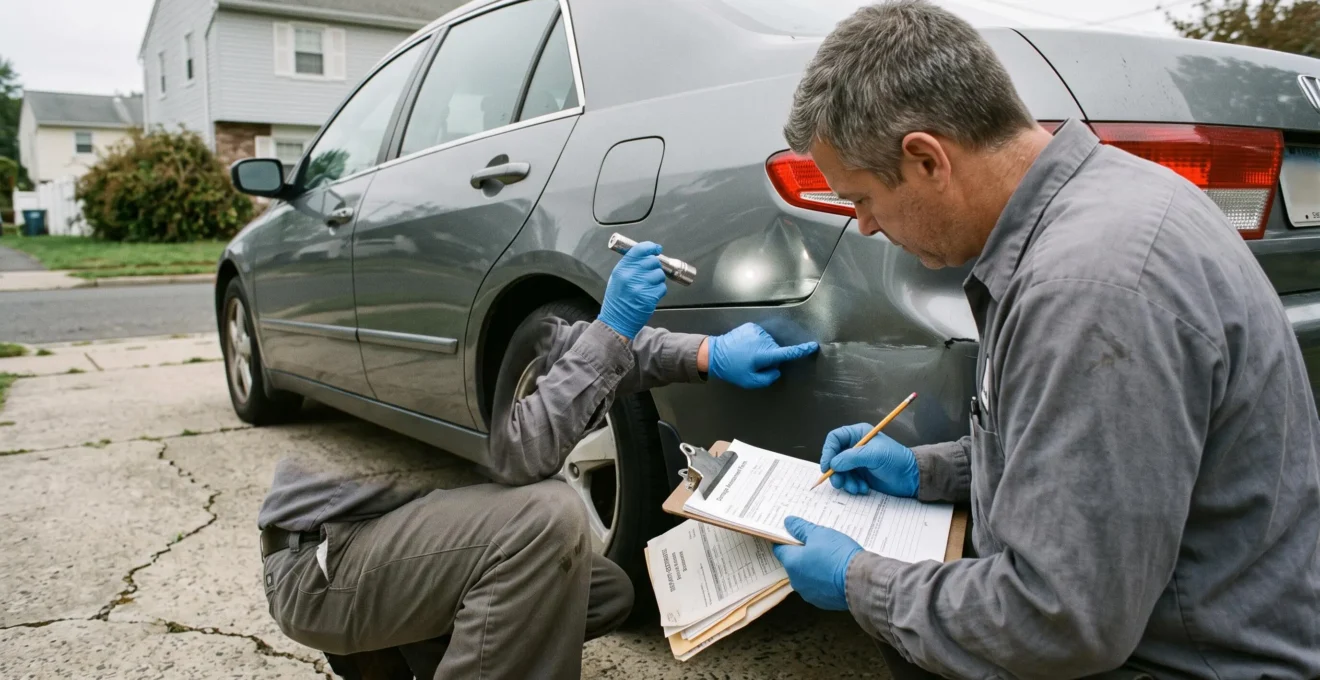
After a motor accident, the insurance adjuster is often the person whose assessment shapes how much the insurer offers to pay. But the adjuster does not necessarily make the final settlement decision, determine legal responsibility or decide independently whether your vehicle must be written off.
An insurance adjuster, also called a claims assessor or motor damage assessor in some markets, investigates the reported loss, examines vehicle damage, evaluates repair costs and provides findings that help the insurer decide how to handle the claim. Depending on the circumstances, this involves photographs, repair estimates, vehicle records, accident reports and discussions with the garage.
Understanding that process matters because an assessment is not always the same as a final payment decision. Additional damage may emerge, vehicle values can be disputed and responsibility can remain unresolved even after the repair estimate is complete.
Although the underlying assessment principles are similar across many English-speaking countries, insurance contracts, consumer protections and dispute procedures differ. Specific examples from the United Kingdom and United States should therefore be read within their respective jurisdictions.
Motor insurance assessments: the essentials
- The adjuster evaluates the damage and supporting evidence, while the insurer generally makes the contractual settlement decision.
- A garage estimate and an insurer’s assessment can differ because they use different repair assumptions, parts, labour costs or valuation methods.
- Photographs, maintenance records, written estimates and prompt reporting of hidden damage can strengthen a request for reassessment.
- Why Can an Insurance Adjuster Value Repairs Differently From Your Garage?
- How Can You Prepare for a Vehicle Insurance Assessment After a Claim?
- Insurance Assessor, Garage or Engineer: Who Decides What Happens to the Car?
- Which Assumptions About Insurance Assessers Can Create Claim Friction?
- When Can a Vehicle Need a Second Insurance Assessment?
- When Is Responsibility Assessed During a Motor Insurance Claim?
- When Is a Witness Statement Most Valuable in a Motor Claim?
- What Happens When an Insurer Reviews a Motor Claim Before Settlement?
Why Can an Insurance Adjuster Value Repairs Differently From Your Garage?
An insurance adjuster may value repairs differently from your garage because the two estimates can rely on different labour rates, repair methods, replacement parts and assumptions about the damage. The insurer assesses costs against the policy and what it considers reasonable for the covered loss, while the garage estimates the work it expects to perform.
A garage might recommend replacing an entire damaged panel, whereas an assessor may consider repairing the existing component. One estimate might specify manufacturer-original parts, while another allows alternative replacement parts where the policy and applicable rules permit them.
Labour costs can also produce differences. The garage may quote its own hourly rates and anticipated working time. The insurer may use estimating systems, reference repair times or rates it considers appropriate. Neither estimate is automatically correct simply because it comes from a professional.
Repair cost and vehicle value are separate questions. In some policies, the insurer’s payment obligation is limited by the vehicle’s value before the accident. In the United States, this may be described as actual cash value, or ACV. In the United Kingdom, market value is commonly central to write-off disputes.
The Financial Ombudsman guidance on motor valuations and write-offs explains that UK valuation complaints can involve vehicle history, repair estimates, independent engineering evidence and documented modifications.
Depreciation and betterment require particular attention. An insurer might propose a deduction when a replacement component would leave the vehicle in a better condition than immediately before the loss. Whether that is permissible, and how any deduction is calculated, depends on the contract and applicable rules. A universal depreciation percentage should not be assumed.
Modified, specialist or high-value vehicles deserve additional scrutiny. An ordinary valuation may not adequately reflect documented equipment, specialist components or unusual condition. However, modifications are not necessarily covered merely because they are installed: declaration requirements and policy limits still matter.
When estimates disagree, request a line-by-line comparison identifying the disputed labour, parts or repair operations. Ask the garage for a written explanation, then submit the supporting evidence to the insurer for review.
A documented disagreement over one repair operation is generally easier to investigate than a broad complaint that the insurer’s figure is too low. The next step is ensuring the original inspection captures the relevant evidence.
How Can You Prepare for a Vehicle Insurance Assessment After a Claim?
Prepare for a vehicle insurance assessment by preserving the damaged vehicle’s condition, collecting clear photographs, recording its mileage and gathering documents that establish its pre-accident condition and value. Give the assessor an accurate account of the damage and avoid authorising non-urgent repairs before confirming the insurer’s inspection requirements.
Start with photographs showing the entire vehicle, damaged areas, adjacent panels and any relevant interior damage. Close-up images help demonstrate surface damage, while wider views establish where it occurred. Preserve the original files where possible, including their available date information.
Vehicle records serve different evidential purposes. The odometer reading helps identify the vehicle being valued. Maintenance records can support claims about its condition. Invoices for replacement parts, previous repairs or declared modifications can help explain why a standard valuation might need adjustment.
Record pre-existing damage separately rather than concealing it. An assessor may need to distinguish accident-related loss from earlier wear, corrosion or repairs. An inaccurate description can undermine otherwise legitimate evidence.
Repairing the car before inspection can complicate assessment because damaged components may no longer be available for examination. This does not mean every preliminary repair is prohibited. Necessary safety measures, emergency recovery and contractual obligations may justify immediate action. Contact the insurer to establish what evidence must be preserved.
If repairs have already started, disclose that fact promptly. Obtain photographs taken before dismantling, the original estimate, records of removed components and any findings made during the work. Ask the insurer how it intends to verify the claim with the evidence still available.
The Texas Department of Insurance guidance on working with an insurance adjuster recommends attending the inspection where practical, checking that damage has not been missed and obtaining the adjuster’s contact details.
Five actions to prepare your assessment file
- Photograph the damage from wide and close angles; save a clearly named folder containing the original image files.
- Record the vehicle’s mileage, registration or identification details and visible condition; create a dated vehicle-condition note.
- Collect maintenance invoices, modification records and recent repair documents; compile them into one evidence file.
- Confirm the inspection arrangements and repair restrictions with the insurer; retain the written confirmation.
- Prepare a factual damage summary and list any suspected hidden damage; bring the document to the inspection and request the assessment findings.
During the inspection, describe what you know and distinguish it from what you suspect. For example, report that a warning light appeared after the collision without claiming that a particular mechanical component has failed unless this has been established.
Once the evidence is assembled, understanding who has authority over the findings and the claim decision can prevent avoidable delays.
Insurance Assessor, Garage or Engineer: Who Decides What Happens to the Car?
The insurance assessor evaluates damage and advises on repair costs or vehicle value, the garage assesses and performs repair work, and the insurer generally decides what settlement it will offer under the policy. An independent engineer may provide specialist technical evidence, but the precise authority of each party depends on the contract and applicable law.
These roles overlap in practice, which can make disagreements confusing. An assessor may communicate an approved estimate, but that does not mean every technical judgment automatically determines the insurer’s contractual obligations.
The garage has practical expertise concerning parts, repair methods, labour and the vehicle’s condition during dismantling. Its findings may be essential evidence, even though it does not normally determine insurance coverage or the amount the insurer is legally required to pay.
An independent engineer may be appointed when there is a technical dispute about the cause, extent or repairability of damage. Such an assessment may also be relevant when a vehicle’s structural condition is unclear or when existing estimates cannot be reconciled.
An engineer’s report is evidence, not necessarily a binding decision. Its effect depends on the appointment terms, policy wording and dispute procedure. It may lead the insurer to revise an estimate, obtain further information or maintain its original position with additional reasoning.
The following distinction helps direct questions to the appropriate person.
| Type of disagreement | Best initial contact | Useful supporting evidence |
|---|---|---|
| Repair method or labour time | Garage and claims assessor | Detailed repair estimate and technical explanation |
| Missing or hidden damage | Garage and insurer’s claims handler | Photographs, inspection findings and supplementary estimate |
| Pre-accident vehicle value | Insurer or valuation assessor | Vehicle specification, history and relevant valuation evidence |
| Technical cause of damage | Assessor or appropriately qualified engineer | Inspection records and specialist findings |
| Coverage, settlement or refusal | Insurer’s claims or complaints team | Policy wording, decision letter and supporting documents |
It is also important to distinguish an insurer-appointed adjuster from a professional independently retained by the policyholder. The former generally acts on behalf of the insurer, even when the individual is employed by an outside adjusting firm. A policyholder-appointed expert has a different role and may involve separate fees.
Before paying for independent technical advice, clarify the question the expert will answer, the expected cost and whether the policy provides a mechanism for appointing or sharing the cost of an expert.
Correctly identifying the decision-maker makes communication more productive. Equally important is avoiding assumptions about what the assessor’s involvement actually means.
Which Assumptions About Insurance Assessers Can Create Claim Friction?
Claims friction often begins when policyholders assume that the insurance assessor is either their personal advocate or an adversary determined to minimise payment. Neither assumption accurately describes the role. An insurer-appointed assessor investigates the loss for the insurer, and policyholders can question findings by providing relevant, verifiable evidence.
One common misconception is that an assessor must accept everything the garage recommends. A repair estimate is evidence of proposed work, not automatic proof that every item is covered or necessary. Conversely, an insurer’s initial estimate does not become unquestionably correct simply because an assessor prepared it.
Another misunderstanding concerns independence. An external adjusting company may be organisationally separate from the insurer while still acting under the insurer’s instructions. Professional assessment does not mean representation of the policyholder’s interests. Understanding this distinction helps maintain realistic expectations.
Communication can create difficulties too. A casual statement that a panel was already damaged, that the vehicle was travelling quickly or that an earlier fault might have contributed to the accident can become relevant to the claim. Such statements should not be concealed, but they should be accurate and properly qualified.
A useful approach is to separate three categories of information:
- Observed facts: what you directly saw, heard or experienced.
- Documented findings: what photographs, reports or repair inspections establish.
- Unconfirmed possibilities: what may have happened but has not yet been verified.
For example, saying that the steering felt different after the collision describes an observation. Stating that the collision destroyed the steering rack presents a technical conclusion that may require inspection.
The belief that a first offer cannot be challenged is also misleading. Depending on the policy and jurisdiction, review options may include a supplementary assessment, a complaint to the insurer, a contractual appraisal procedure or an external dispute-resolution service.
These routes are not interchangeable. Some consider valuation, some address complaint handling, and others may have limited authority over legal liability or coverage disputes. They can also involve costs, eligibility requirements and deadlines.
Keep a dated written record of discussions, requested documents and explanations received. A calm, specific objection supported by evidence is more actionable than an accusation about an assessor’s motives.
If disagreement persists because new damage or stronger technical evidence emerges, a further assessment may be more appropriate than continuing to debate the original estimate.
When Can a Vehicle Need a Second Insurance Assessment?
A vehicle may need a second insurance assessment when repair work reveals hidden damage, the garage produces materially different findings, the vehicle valuation is disputed or new technical evidence changes the original conclusions. A further assessment is not automatically required after every disagreement, but new information can justify reopening the estimate.
The most straightforward example is concealed damage discovered after parts have been removed. An initial inspection may identify external panel damage without revealing affected brackets, reinforcement components, sensors or structural areas underneath.
In that situation, the garage can document its findings and request an additional assessment or repair authorisation. This is commonly handled as a supplement to the existing claim rather than as a completely new accident claim, provided the additional damage is accepted as arising from the same insured event.
The California Department of Insurance guidance on motor accident claims explains that a repair shop can contact the insurer for approval when additional damage is found during repairs. The insurer may arrange a further inspection.
Other reasons for reassessment include a substantial difference between repair estimates, new evidence concerning pre-existing condition, or an error in the vehicle’s recorded mileage, specification or equipment.
Second assessments can also become relevant to write-off decisions. If an insurer has treated the vehicle as a total loss, a policyholder may challenge the pre-accident valuation by presenting missing equipment records, relevant market evidence or independent technical findings.
Report newly discovered damage promptly. Ask the repairer to photograph the affected area before proceeding with related work where practical, and obtain a supplementary estimate that clearly distinguishes new findings from work already authorised.
A simple written reassessment request should identify the original claim, explain the new material fact, attach the evidence and specify the decision being requested. It should also ask whether the insurer needs to inspect the vehicle again before repairs continue.
If an independent report is necessary, check who will appoint the expert, whether the appointment will be jointly agreed, and who must pay. Some insurance contracts provide appraisal or similar arrangements for particular disputes, but these mechanisms should not be assumed to exist universally.
A revised damage valuation may change the repair decision, but it does not automatically resolve who caused the accident. Responsibility is assessed through a related but distinct process.
When Is Responsibility Assessed During a Motor Insurance Claim?
Responsibility is assessed as the insurer investigates how the accident occurred, often alongside the vehicle damage assessment. However, liability and damage valuation answer different questions. An assessor may establish the repair cost while the insurer continues reviewing accident reports, witness evidence and applicable legal rules to determine responsibility.
The distinction matters because physical damage alone rarely establishes every element of fault. A damaged front bumper might be consistent with several accident scenarios. Determining responsibility may require the vehicles’ positions, road markings, traffic signals, driving actions and independent evidence.
An insurer may therefore know that a vehicle is uneconomical to repair before the liability position is settled. The timing and availability of any payment will depend on the policy, the type of claim, coverage and the applicable claims framework.
Responsibility can also be shared. Under legal systems that permit apportionment, a proportion of the loss may be attributed to each party. The financial consequence is jurisdiction-specific and can depend on whether the claim is brought against another driver or under the claimant’s own insurance.
Hypothetical example: how shared responsibility can affect compensation
Suppose a driver establishes a covered loss of $8,000 in a jurisdiction where a 25% finding of contributory responsibility reduces this particular third-party recovery proportionately.
Under those assumed rules, the reduction would be $2,000, leaving $6,000 before any other applicable adjustments. This is a mathematical illustration, not a universal claims rule: some jurisdictions apply different liability thresholds, and an own-policy claim may operate differently.
Before accepting a disputed liability allocation, ask the insurer which evidence supports it, how the applicable rules have been applied and whether contradictory evidence was considered. A policyholder may challenge the factual basis of the assessment, but negotiation does not override binding legal rules.
Initial accident statements deserve particular care. An accident report, roadside comment or signed description may later be considered alongside other evidence. Such statements do not necessarily determine fault conclusively, but inconsistencies can be difficult to explain.
Describe the events chronologically. Record what each driver appeared to do, where the vehicles were positioned and what could actually be observed. Avoid making unsupported statements about another person’s speed, attention or intentions.
Where the drivers disagree about what happened, independent witnesses can provide additional context that neither the damage estimate nor the drivers’ accounts establish alone.
When Is a Witness Statement Most Valuable in a Motor Claim?
A witness statement is especially valuable when drivers give conflicting accounts, physical evidence is inconclusive or no reliable recording captures the accident. A prompt, detailed statement from someone who directly observed the event can help the insurer assess disputed facts such as vehicle movements, traffic signals and the sequence of the collision.
Not all statements carry identical evidential weight. An independent witness with no apparent interest in the outcome may be considered more persuasive than someone directly involved. A passenger can nevertheless provide useful evidence, and involvement alone does not establish that a statement is inaccurate.
Credibility matters more than the number of witnesses. Consistency, vantage point, visibility and the ability to distinguish observation from assumption can all affect the value of testimony.
A witness who directly saw a traffic signal change may establish an important fact. Someone who heard a collision and turned afterwards may provide evidence about the aftermath, but cannot reliably describe a movement they did not observe.
Collect contact information as soon as reasonably possible, including the witness’s name and a reliable way to reach them. Ask for an account in their own words, ideally while the events are still fresh. The account can record the witness’s location, what they saw and any relevant uncertainty.
Photographs of the junction, road layout, vehicle positions and sightlines may provide useful context. Preserve the originals and avoid altering images in ways that could misrepresent the scene.
Do not coach witnesses, suggest particular answers or ask them to sign a version of events drafted to favour your claim. A statement containing details the witness could not have known may undermine the credibility of the evidence.
Technical evidence remains important. A witness may estimate that a vehicle appeared to be travelling quickly, but that observation does not necessarily establish an exact speed. Similarly, a statement about a vehicle’s movement may need to be considered alongside physical marks, video footage or engineering findings.
If a witness becomes available after the initial liability assessment, notify the claims handler promptly and ask whether the new evidence can be considered before a final position is taken.
Once the damage, liability and supporting evidence have been assembled, the insurer must review the claim and determine what outcome it can justify under the policy and applicable rules.
Key points before the insurer’s final review
- A complete evidence file should distinguish the original damage estimate, any later supplements and the insurer’s current liability position.
- Unresolved differences should be identified by specific document, calculation or factual finding rather than described as a general disagreement.
- Before accepting settlement terms, establish whether further evidence is outstanding and what rights or claims the proposed payment would resolve.
What Happens When an Insurer Reviews a Motor Claim Before Settlement?
Before settling a motor claim, the insurer reviews whether the reported event is covered, whether the evidence supports the claimed damage and whether the proposed payment follows the policy and applicable rules. The review may result in a settlement offer, a revised amount, a request for more information or a decision declining some or all of the claim.
This review is broader than the vehicle inspection. The claims handler may check that the insurance contract was in force, that relevant terms and exclusions have been considered, and that the documents consistently describe the accident and resulting loss.
Where liability is disputed, the insurer may also consider accident reports, witness accounts, correspondence with other parties and evidence of how the collision occurred.
Claims may undergo additional verification when information is incomplete or inconsistent. Examples include unexplained differences between reported damage and repair findings, conflicting accounts of the accident, unusually complex repair costs or a late notification that requires clarification.
Additional investigation does not automatically establish wrongdoing. It may simply mean the insurer needs further information before deciding whether the claimed loss is covered and correctly valued.
Settlement timing varies considerably. Straightforward claims with agreed liability and documented damage may progress differently from claims involving hidden damage, specialist vehicles, disputed responsibility or further investigation. There is no single reliable international deadline for completion. Applicable laws and regulatory rules may impose specific communication or handling requirements.
After reviewing the file, the insurer may take several different actions.
| Outcome | What it means | Appropriate next step |
|---|---|---|
| Settlement offer | The insurer proposes payment or another resolution under the relevant terms. | Check the amount, deductions, valuation basis and release conditions. |
| Partial settlement | The insurer accepts some items but disputes or excludes others. | Request an itemised explanation of the difference. |
| Further information requested | The insurer considers the evidence incomplete. | Provide the available documents and confirm what remains outstanding. |
| Revised assessment | New information changes the previous valuation or repair decision. | Compare the revised findings with the original assessment. |
| Claim declined | The insurer states that the requested payment is not payable under its assessment of the claim. | Request the written reasons and consider the available complaint or appeal procedure. |
Before accepting payment, check whether the proposed agreement is described as final settlement, an interim payment or payment for an undisputed portion of the claim. The consequences of accepting a payment while reserving rights vary by contract and jurisdiction. Do not assume that writing a reservation on a document will necessarily preserve every disputed claim.
If the explanation is unsatisfactory, submit a written complaint identifying the claim reference, disputed findings, supporting evidence and the remedy requested. Ask the insurer to confirm the applicable complaint process and relevant deadlines.
In the United Kingdom, qualifying unresolved insurance complaints may be considered by the Financial Ombudsman Service, subject to its jurisdiction and time limits. In the United States, state insurance regulators can provide information about complaints and applicable consumer protections, although they do not necessarily resolve every contractual or legal dispute.
Contractual appraisal, mediation, arbitration and court proceedings may also be relevant in some cases. Their availability, scope, costs and deadlines should be checked before choosing a route. Limitation periods for legal action should not be confused with an insurer’s internal complaint deadlines.
Request the final assessment and settlement calculation in writing, compare them against your evidence and identify any unresolved issue before accepting terms intended to close the claim. A clear, documented response puts the insurer in a better position to address the specific disagreement.
Do I have to use the repair garage recommended by my insurer?
Not necessarily. Your choice of repairer depends on the policy and applicable rules. Some insurance arrangements offer an approved repairer network with specific guarantees or service benefits, while choosing another garage may affect how estimates, authorisations or additional costs are handled. Check the policy and obtain written confirmation of the insurer’s position before arranging repairs.
Can I obtain a copy of the insurance adjuster’s report?
You can ask the insurer for the assessment report, itemised repair estimate and the calculations used to determine the proposed settlement. Whether every document must be disclosed depends on local law, policy terms and the nature of the record. If the full report is not provided, request a written explanation of the material findings and valuation assumptions.
Who pays for an independent vehicle assessment?
If you privately appoint an expert, you may initially be responsible for the cost. However, some insurance contracts or dispute procedures provide different arrangements, including jointly appointed experts or defined appraisal costs. Confirm the fees and potential cost allocation before commissioning the report.
Can an insurance assessor inspect a vehicle remotely?
Some insurers may assess damage using photographs, video or information supplied by a repairer. Whether this is appropriate depends on the damage, the insurer’s procedures and any applicable requirements. A physical inspection may still be necessary where structural damage, concealed components or conflicting evidence cannot be assessed reliably from images alone.
What should I do if the insurer does not respond to my valuation dispute?
Follow up in writing, quote the claim reference and keep copies of the correspondence. If the matter remains unresolved, use the insurer’s formal complaints procedure and check whether an insurance regulator, ombudsman or other dispute-resolution body can consider the issue in your jurisdiction. Check the relevant complaint and legal deadlines rather than assuming that an unanswered request keeps all options open indefinitely.